
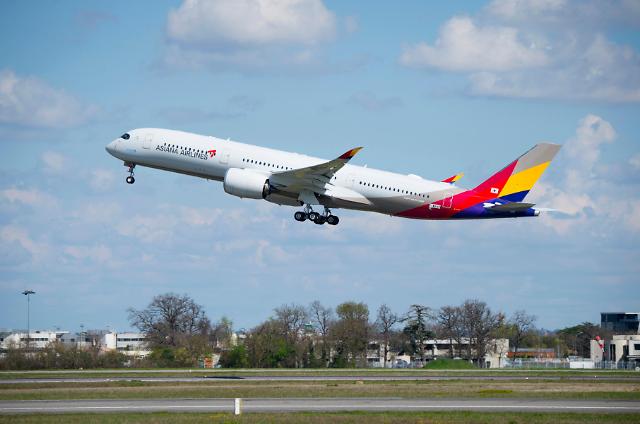
[Courtesy of Asiana]
A serious mid-air quarrel held by South Korean pilots in the cockpit of an Asiana plane during a flight from Seoul to Rome faces an investigation by transport authorities because it could have put the lives of passengers in peril.
South Korea's transport ministry said it has launched an investigation to find out what exactly happened on September 20 during the change-over of cockpit control between two pilots and two co-pilots, about six hours after takeoff at an international airport west of Seoul.
"We are to bring in all four pilots who were aboard the plane on that day to find out what happened," the ministry said in a statement on Thursday, adding the pilots would be punished if they are found to have violated rules on safety.
The pilots were meant to take turns in controlling the plane but an argument over their change-over broke out, and there were conflicting testimonies about the alleged flight of a plastic water bottle across the cockpit.

Park Sae-jin
Experienced journalist and editor at AJU PRESS specializing in multilingual news. I cover international diplomacy, geolpolitics, and policy, consistently delivering highly accurate, compelling reporting for a worldwide audience.
Copyright ⓒ Aju Press All rights reserved.
Related News
-
 Jin Air Joins Competition for Free In-Flight Wi-Fi Following Korean Air and Asiana
South Korea's low-cost carrier Jin Air will introduce the satellite internet service Starlink. The competition for high-speed free in-flight Wi-Fi has intensified as it expands from major airlines like Korean Air and Asiana to low-cost carriers.According to the airline industry on November 17, Jin Air plans to implement SpaceX's low-orbit satellite internet service Starlink next month. Starlink utilizes satellites positioned in low Earth orbit to provide high-speed internet access on aircraft. It offers faster communication speeds and lower latency compared to existing paid in-flight Wi-Fi, and its free availability has led to high customer satisfaction.In South Korea, Korean Air and Asiana Airlines first introduced Starlink on long-haul flights to the United States and other destinations on September 15. They have since increased the number of aircraft equipped with the service from 14 to 42. This means that 20.2% of their total fleet of 208 aircraft have adopted Starlink.The Hanjin Group has announced plans to sequentially introduce Starlink to Air Busan and Air Seoul, which are set to merge with Jin Air in the future. As a result, low-cost carriers that have been hesitant to adopt free in-flight internet services are now taking action.Multiple low-cost carriers, including Trinity Airlines, Jeju Air, Eastar Jet, and Parata Airlines, are also considering the introduction of free in-flight Wi-Fi services. New carriers are expected to emerge as early as the first half of next year.The push for airlines to expand and consider free internet services is driven by fierce competition for passenger acquisition. In particular, low-cost carriers face a structure where fare differences between routes are minimal, making it difficult to secure a competitive advantage based solely on price.According to the Financial Supervisory Service's electronic disclosure system, the average fare per international passenger for the third quarter of this year (including seat sales and fuel surcharges) was 175,946 won for Jin Air and 177,000 won for Jeju Air, showing little difference. Trinity Airlines, which has a higher proportion of long-haul routes, reported a higher fare of 222,133 won. With similar fare levels, the market analyzes that Jin Air is seeking differentiation through in-flight convenience services.Kim Kwang-ok, a professor at Korea Aerospace University, stated, "For Jin Air, in the context of fierce competition among low-cost carriers with similar fares and flight times, in-flight Wi-Fi is a differentiating factor that passengers can immediately perceive. It can be seen as a strategy to secure loyal customers by encouraging repeat boarding from those who have experienced it."* This article has been translated by AI.
-
 Hanjin ownership battle brews ahead of Korean Air-Asiana merger
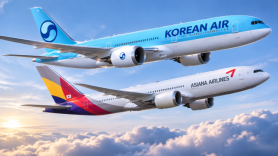
Integrated pilot conference ahead of the Dec. 17 merger of Korean Air and Asiana Airlines. Courtesy of Hanjin KAL SEOUL, November 02 (AJP) -A fresh ownership battle is brewing over Hanjin KAL, the holding company of Korean Air, just six weeks before the flag carrier's landmark merger with Asiana Airlines on Dec. 17, as Hanjin Group Chairman Cho Won-tae moves to bolster his stake against an aggressive buildup by construction conglomerate Hoban Group. The ownership contest comes at a critical juncture for Cho, who is preparing to complete the nearly six-year integration of South Korea's two largest airlines into a global aviation powerhouse. The merger, among the most ambitious in the country's corporate history, is expected to create one of the world's 10 largest airlines by fleet size. Cho, chairman and CEO of Hanjin Group and Korean Air, signed an agreement Monday to acquire 325,000 additional common shares in Hanjin KAL for 37.05 billion won ($27.6 million), according to a regulatory filing with the Financial Supervisory Service. The shares will be purchased at 114,000 won apiece through an off-hours block trade, with settlement scheduled for Dec. 3 or another date agreed upon by the parties. The disclosed transaction period extends through Jan. 1, 2027. Once completed, the purchase will raise Cho's personal holding from 3,869,612 shares, or 5.75 percent, to 4,194,612 shares, or 6.23 percent. Including family members and other related parties, his combined stake is expected to reach 21.06 percent. Shares surged 13 percent in after-hour trading as of 7:30 p.m. Monday in Seoul, extending an 8.8 percent rally during the regular session. Korean Air, in which Hanjin KAL owns a 26.13 percent stake, jumped more than 7 percent as investors weighed the prospect of an escalating shareholder contest. Cho described the purpose of the purchase as strengthening responsible management. Hanjin Group said the transaction had been planned for some time and was unrelated to Hoban's recent share purchases. The timing nevertheless puts the spotlight back on a simmering ownership contest over South Korea's largest airline group. Hoban recently acquired additional Hanjin KAL shares through open-market purchases and filed a business combination notification with the Fair Trade Commission (FTC) in October after determining that its holding may have surpassed that of Cho and his related parties. As of July 10, Hoban held 20.15 percent of Hanjin KAL, just 0.42 percentage point behind the 20.57 percent held by Cho and related parties as of June 30. The exact size of Hoban's latest stake has not been publicly confirmed. Hanjin KAL said in a separate regulatory disclosure Monday that it would provide an update once the relevant details were verified or within one month. Hoban became Hanjin KAL's second-largest shareholder in 2022 after acquiring shares previously held by activist private equity firm KCGI. It has since steadily increased its investment, narrowing the ownership gap with Cho's side. Under South Korea's competition law, companies meeting certain size thresholds must notify the FTC when they acquire at least 15 percent of a listed company and again when subsequent purchases make th em its largest shareholder. AI-assisted image of Korean Air and Asiana Airlines Becoming the largest shareholder would not automatically hand Hoban control of Hanjin Group. Cho retains the backing of major investors, including Delta Air Lines, which held 14.90 percent of Hanjin KAL at the end of June, and state-run Korea Development Bank, which held 10.58 percent. Together with Cho's family and related-party holdings, those stakes would represent more than 46 percent following his planned purchase, assuming no other changes. The National Pension Service, another major investor with a reported 5.46 percent stake, could also become an important factor in any future shareholder contest. Hoban has maintained that its share purchases are for investment purposes rather than management participation. Still, its steady accumulation of shares has revived questions over the longer-term ownership of Hanjin KAL. The stakes have become higher as Korean Air approaches the Dec. 17 launch of its integrated carrier, which will absorb Asiana Airlines and retire its brand after decades of rivalry. The merger will mark the culmination of a consolidation process launched in November 2020, reshaping South Korea's aviation industry and expanding Korean Air's international reach. While the latest shareholder maneuvers do not directly affect the approved airline merger, they introduce a fresh ownership uncertainty just as Cho prepares to preside over the biggest transformation in Hanjin Group's history.
-
Korean Air and Asiana Airlines Host Employee Parent Invitation Event
Korean Air and Asiana Airlines held a joint event inviting employees' parents to foster unity between the two companies. The airlines announced on October 1 that they hosted the '2026 Parent Invitation Event' the previous day for employees and their parents. The event will take place in three sessions, including on October 20 and November 12. This initiative allowed parents to experience key facilities such as the cabin training center, flight training center, and maintenance hangar, enhancing their trust and pride in their children's workplace. Notably, this year, employees and families from Asiana Airlines participated, sharing the significance of the merger and promoting harmony. Families from both companies toured the headquarters, experiencing various facilities during the first session. After the tour, they enjoyed a special lunch together at the cafeteria and took commemorative photos while trying on cabin and flight crew uniforms. A representative from Korean Air stated, "This meaningful gathering enhances the sense of belonging among employees and their families and strengthens the bonds toward integration. We will continue to implement various programs to establish a family-friendly corporate culture and create a happy workplace." Meanwhile, the two airlines are accelerating the integration of customer services, including reservations, flight numbers, and mileage, as they prepare for the launch of the merged airline in December.* This article has been translated by AI.