

SEOUL, May 30 (AJU PRESS) - Korea and India held a dialogue to enhance their bilateral cooperation in cybersecurity, focusing on developing standards and improving work capabilities, the Indian Embassy to Korea said on Wednesday.
The India-Republic of Korea Cyber Dialogue, now in its second year, took place on Tuesday in Seoul. Key participants included Amit A. Shukla, Joint Secretary of the Cyber Security Division at the Indian Ministry of External Affairs, and Rhee Dong-Yeol, Ambassador for International Security Affairs under the Korean Ministry of Foreign Affairs.
Specialists from the legal, law enforcement and communications sectors of both countries also attended the dialogue.
The embassy said that discussions covered a wide range of topics, including the establishment and standardization of cybersecurity capabilities and the training of specialists.
The participants exchanged views on the latest developments in the cyber domain, global challenges posed by rapidly evolving technology, and strategies for deepening cooperation at the United Nations and other international and regional forums to create a secure and robust cyberspace.
The embassy also said that the next dialogue will be held in New Delhi in 2025.
Park Sae-jin
Experienced journalist and editor at AJU PRESS specializing in multilingual news. I cover international diplomacy, geolpolitics, and policy, consistently delivering highly accurate, compelling reporting for a worldwide audience.
Copyright ⓒ Aju Press All rights reserved.
Related News
-
 AJP Forum: India eyes third K9 deal, shipyard project with Korea
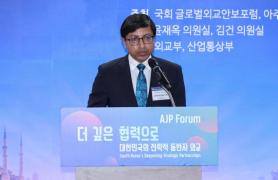
Indian Ambassador to South Korea Gourangalal Das delivers remarks at the AJP Forum at the National Assembly Members' Office Building in Yeongdeungpo-gu, Seoul on Nov. 19, 2026. AJP Yoo Na-hyun SEOUL, November 19 (AJP) - India is in talks with South Korea over a third phase of its K9 self-propelled howitzer program and aims to finalize a binding agreement for the development of a new shipyard in India next year, Indian Ambassador to South Korea Gourangalal Das said Thursday. Speaking at the AJP Forum at the National Assembly in Seoul, Das outlined India's priorities for 2027, focusing on turning agreements reached during the April summit between the two countries into concrete industrial and economic projects. The forum, titled "Beyond the Summit: From Agreement to Action," brought together ambassadors from seven countries including Brazil, India, Türkiye, Tajikistan, Uzbekistan, Kazakhstan and Kyrgyzstan that held summit-level talks with South Korea this year. "Right now we are discussing a third phase of the K9 program," Das said, referring to the South Korean-developed self-propelled howitzer known as the K9 Vajra-T in India. While he did not disclose the potential size or timeline of the third phase, Das said similar industrial cooperation could be extended to other defense platforms. Shipbuilding is another major priority for India next year, with discussions between a South Korean company and Indian authorities progressing over the development of a new shipyard. During President Lee Jae Myung's state visit to India in April, the two governments welcomed a non-binding memorandum of understanding involving HD Korea Shipbuilding & Offshore Engineering (HD KSOE) for the joint development, financing and operation of a large shipyard in southern India. "We want the final binding agreement to be signed with all the details of investment," Das said. India is also seeking South Korean assistance in modernizing its shipbuilding industry, including a workforce training program involving the Korea International Cooperation Agency (KOICA). The two countries also aim to hold vice-ministerial defense policy talks and convene a newly established "two-plus-two" dialogue between their vice ministers of foreign affairs and defense next year. India has set a target of increasing the number of South Korean companies operating in the country tenfold, he said, identifying semiconductors, critical minerals, solar manufacturing, heavy machinery and shipping containers as key areas for cooperation. Indian Ambassador to South Korea Gourangalal Das delivers remarks at the AJP Forum at the National Assembly Members' Office Building in Yeongdeungpo-gu, Seoul on Nov.19, 2026. AJP Yoo Na-hyun The two countries are also accelerating negotiations to upgrade their Comprehensive Economic Partnership Agreement (CEPA). Two rounds of talks have been held since the April summit, with a third round likely to take place in December. The two sides aim to conclude negotiations next year. Nuclear energy is another area of potential cooperation as India seeks to expand its nuclear power capacity roughly tenfold by 2047. Das described South Korea as having one of the most competitive offerings available for India's planned nuclear expansion. The ambassador also highlighted opportunities for cooperation in artificial intelligence, cybersecurity and the space industry, alongside efforts to facilitate travel between the two countries. Reflecting on progress since the April summit, Das said both the list of accomplishments and the list of remaining tasks ran to five pages. "I think we have not done too badly, but I think we have still a very rich agenda for next year," he said.
-
 Lotte Wellfood Reports 29.7% Increase in Q3 Operating Profit Driven by Growth in India and Kazakhstan
Lotte Wellfood reported a nearly 30% increase in operating profit for the third quarter, driven by growth in overseas markets such as India and Kazakhstan, along with improved domestic profitability. Despite a decline in domestic sales, the expansion of overseas subsidiaries offset this downturn, leading to overall performance improvement.On November 11, Lotte Wellfood announced that its consolidated operating profit for the third quarter reached 89.9 billion won, a 29.7% increase compared to the same period last year. During the same period, sales rose to 1.1739 trillion won, up 1.5%. The operating profit margin stood at 7.7%.For the first three quarters of this year, cumulative operating profit totaled 190.4 billion won, marking a 58.7% increase from the previous year. Cumulative sales reached 3.3569 trillion won, up 5%, with a cumulative operating profit margin of 5.7%.The primary driver of this performance improvement was the overseas business. In the third quarter, operating profit from overseas subsidiaries soared to 23.1 billion won, a 137.8% increase year-on-year. Sales from these subsidiaries grew by 16.1% to 271 billion won. For the year to date, cumulative operating profit from overseas subsidiaries reached 64.7 billion won, up 105.4%, while sales increased by 20.5% to 852.7 billion won.In India, the expansion of the Choco Pie production line has begun to yield results. The stabilization of operations at the fourth Choco Pie line and the expansion of sales regions contributed to revenue growth. In Kazakhstan, increased domestic sales and exports also supported overseas performance.Conversely, domestic operations experienced a decline in sales as part of a management efficiency process focused on profitability. Despite challenges such as weather impacts on the ice cream market and rising costs for packaging materials and crude oil, the company improved profitability by streamlining low-efficiency products and distribution channels while enhancing productivity.Lotte Wellfood plans to continue focusing on expanding its overseas markets and improving domestic operations in the fourth quarter. In India, the company aims to stabilize operations of the Choco Pie production line and expand quick commerce sales, while in Kazakhstan and Russia, it plans to broaden the distribution of Lotte brand products.Domestically, the company will strengthen marketing efforts for Pepero Day and expand product offerings tailored to new growth sales channels such as warehouse discount stores and household goods stores. Efforts to enhance profitability will also continue.A Lotte Wellfood official stated, "The continuous enhancement of our business structure and the strong performance of our overseas subsidiaries in India and Kazakhstan drove our third-quarter results. We will continue to pursue qualitative growth through strategies aimed at strengthening domestic profitability and expanding our global market presence."* This article has been translated by AI.
-
Why Japanese Steel Companies Are Investing in India
Steel mills cannot relocate like a shop that closes due to poor business. Once a company invests heavily in a location, it must produce and sell steel there for a long time. Therefore, examining where steel companies invest can provide insights into which countries they expect to profit from in the future.Recently, Japanese steel companies have been expanding their production facilities in India, with JFE Steel and Nippon Steel leading the way. These two companies are distinct entities, partnering with different firms in India. JFE is collaborating with Indian steelmaker JSW Steel, while Nippon Steel is working with Dutch steel giant ArcelorMittal.On October 23, JFE Steel announced plans to double the annual crude steel production capacity at the Sambalpur steel mill in Odisha, India, from 4.5 million tons to 9.5 million tons. Crude steel is the intermediate product before processing into steel products. The company plans to implement new blast furnaces and rolling equipment by 2030.The rationale behind this investment lies in demand forecasts. The World Steel Association recently projected a steel demand growth rate of 0.9% for Japan and 7.9% for India this year. For next year, the forecasts are 1.7% for Japan and 8.0% for India. While Japan is expected to recover, the pace is markedly different from that of India. For steel-selling companies, it makes sense to invest more resources in a rapidly growing market.India's growth rate is not the only noteworthy aspect. The projected steel demand in India for this year is 172.4 million tons, expected to rise to 186.2 million tons next year, indicating an annual increase of 13.8 million tons. Although these figures are projections rather than actual results, they illustrate the backdrop for steel companies expanding their operations in India.Building homes requires rebar, and laying railroads necessitates rails. Steel plates are also used in automobiles and refrigerators. The World Steel Association cites infrastructure construction, private real estate, and manufacturing growth as key drivers of demand in India. This indicates that steel is sought after in both construction sites and factories, differing from investments focused solely on one booming sector.While increasing local production facilities entails significant burdens, shipping steel from Japan is another option. Establishing a factory is just the beginning; securing raw materials, power, labor, and transportation networks is essential for stable operations. Increasing local production despite these challenges can be seen as a strategy to respond closely to Indian customers' orders and establish a long-term market presence.The name JFE has given to its Indian operations reflects this intention. The company positions the Sambalpur steel mill as its 'third integrated steel mill' following its facilities in eastern and western Japan. This signifies a commitment to making it a major production hub rather than merely securing another overseas investment.An integrated steel mill encompasses the entire process from extracting molten iron from iron ore to reducing impurities and producing steel, followed by rolling it into sheets. This type of mill has a broader production scope than facilities that merely cut or surface-process steel products. JFE announced its joint venture plans last December, proposing an investment of 157.5 billion rupees (approximately 270 billion yen). The joint venture, in which JFE and JSW each hold a 50% stake, was finalized in March of this year.Competitor Nippon Steel has also been investing in India through its partnership with ArcelorMittal, operating AM/NS India. This venture aims to increase the annual crude steel production capacity at the Hazira steel mill from approximately 9 million tons to 15 million tons. Nippon Steel's investment plan for related production facilities, announced in 2022, was around 410 billion rupees (approximately 730 billion yen).AM/NS India is also pursuing the acquisition of port and power-related facilities alongside its expansion. Steel mills require ports for importing raw materials and exporting products. If electricity supply is unstable, production can be disrupted. Establishing infrastructure outside the factory is as crucial as investing in blast furnaces and rolling equipment. Directly producing steel overseas entails numerous responsibilities.POSCO is also expanding its production base in India. The company already operates a cold-rolled and galvanized plant in Maharashtra with an annual capacity of 1.8 million tons, processing steel products for use in automobiles and other applications. It also has steel processing plants in Delhi and Chennai.In April of this year, POSCO signed a joint investment agreement with JSW Steel in India, each holding a 50% stake. This venture aims to construct an integrated steel mill in Odisha with an annual crude steel production capacity of 6 million tons. While the existing cold-rolled and galvanized plant processes steel products, the new steel mill will include the entire process from extracting molten iron from iron ore. The existing plant is operational, while the new integrated steel mill is still in the construction phase.Both POSCO and JFE Steel have partnered with JSW Steel in India, while Nippon Steel's partner is ArcelorMittal. As South Korean and Japanese companies secure production bases in India, Indian firms are also leveraging their technology and capital to expand their operations. It remains to be seen how the investments of South Korean and Japanese steel companies will impact the competitiveness of Indian firms.However, merely projecting increased demand does not guarantee investment success. JFE's new facility is targeted to commence operations by 2030. After completing construction and stabilizing production, the company must sell the increased output. As multiple companies expand production capacity, competition for securing customers may intensify. There is often a significant time gap between projected demand growth rates and the actual profits companies realize.Steel mills cannot be built hastily after orders come in. Securing land and establishing facilities takes considerable time. If companies wait to confirm rising demand before acting, other firms may have already captured customers. This context explains why Japanese steel companies are investing in India now, as they prepare to establish production bases for future steel sales.Of course, not all companies investing in the growing Indian market will profit. Local steelmakers are also increasing their production capacities. Market conditions may change during the construction of new plants, and if supply outpaces demand, price competition could become fierce. Japanese companies must secure not only factory sites but also a steady customer base for the steel produced there.POSCO faces similar competitive challenges. Steel companies that have competed in South Korea and Japan are now expanding their production bases in India in partnership with local firms. Simply entering the Indian market does not guarantee an advantage. They must meet the quality demands of automotive companies, deliver products on time, and generate profits in the process. Establishing a factory overseas and growing a business there are two distinct endeavors.The trend of Japanese steel companies moving to India is also relevant for South Korea. As Japanese firms increase their customer base locally, it will impact the volume available for South Korean companies. This is why the South Korean steel industry must closely monitor the scale of Japanese investments and their joint venture partners. The plants Japanese steel companies are building in India will serve as a foundation for steel sales for decades to come. POSCO must not only welcome the growth of the Indian market but also proactively respond to the movements of Japanese steel companies to remain competitive.* This article has been translated by AI.