
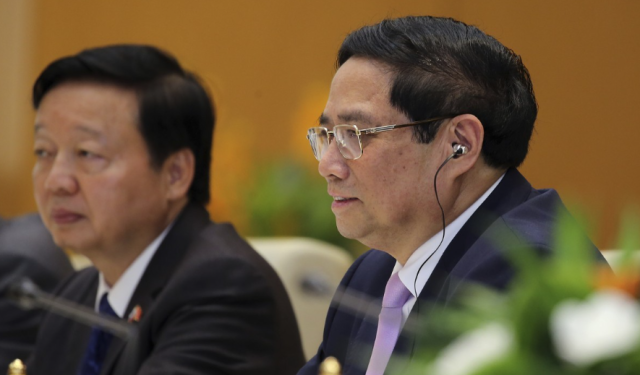
Chinh will attend the Korea-Vietnam Business Forum, organized by the Korea Chamber of Commerce and Industry (KCCI), at the Lotte Hotel in Seoul next Monday.
The forum will be attended by about 300 Korean participants, including Minister of Trade, Industry and Energy Ahn Duk-geun and executives from conglomerates such as Samsung Electronics, SK, Hyundai Motor, LG, and POSCO.
Chinh is expected to be accompanied by about 100 Vietnamese delegates from the government and businesses.
The event will be chaired by Hyosung Group Vice Chairman Cho Hyun-sang. Cho, who also heads the Korea-Vietnam Economic Cooperation Committee, is expected to discuss cooperation measures with Chinh during the forum.
The conference will also include the signing of various memoranda of understanding and presentations on topics such as digital financial cooperation and global supply chains.
During his trip, there is a possibility that the premier will meet with Samsung Chairman Lee Jae-yong and visit a Samsung plant, sources said.
He may also meet with CEO-level officials from SK Group, as Chairman Chey Tae-won will be on a business trip to the United States from June 22 to early July, they said.
South Korea is the largest foreign direct investor in Vietnam as of the end of 2023, with investments valued at $86 billion. Vietnam is Korea's third-largest trading partner, with bilateral trade volume reaching $76 billion in 2023.
Copyright ⓒ Aju Press All rights reserved.
Related News
-
 Samsung Electronics Accelerates Digital Transformation in Vietnamese Manufacturing
Samsung Electronics is showing improvements in production efficiency through its smart factory support program aimed at local manufacturing companies in Vietnam. Companies receiving technical and operational consulting from Samsung have been accelerating their digital transformation by shortening production times and integrating process data, thereby expanding their participation in the global supply chain. According to local media outlet Tien Phong on November 19, Samsung Vietnam has supported improvements in the production management systems of local companies through the '2026 Smart Factory Development Support Project' in collaboration with the Ministry of Industry and Trade of Vietnam. This year, a total of 14 companies completed the program, with Viet Uc Plastic Mechanical, located in Dong Nai Province, highlighted as a key success story. Production Time Reduced from 5 Days to 3 Days... Smart Factory Level Increased from 1.0 to 2.5 Viet Uc Plastic Mechanical improved its production processes and data management systems with Samsung's support. Previously, employees had to call multiple departments to check the production status for each order, but after integrating the system, the sales department and management can now remotely monitor production status. Nguyen Duc Hoang Jui, chairman of Viet Uc Plastic Mechanical, explained that after consulting with Samsung experts, the production time was reduced from the previous 4-5 days to 3 days. The time spent on paperwork and data retrieval has decreased, streamlining the order processing. Chairman Jui noted that before pursuing digital transformation, it was challenging to determine the scale of investment and the order of implementation. However, with Samsung experts conducting on-site diagnostics to analyze the company's strengths and areas for improvement, they were able to clarify the business direction and develop a phased implementation plan for the software to be introduced. During the smart factory construction process, employees' technical capabilities have also improved. Samsung experts provided training that went beyond simply automating production equipment, teaching how to connect equipment and processes to a central system and quickly collect and manage data. As a result, internal personnel have gained the ability to perform tasks such as data analysis, process standardization, and risk management. Tran Thi Chang, head of the integrated systems management department at Viet Uc Plastic Mechanical, stated, "What we are most proud of is not just the system we built, but that Viet Uc employees have gained the confidence to develop technology and operate it themselves." In fact, evaluations from Samsung experts indicated that the smart factory level of Viet Uc Plastic Mechanical increased from the previous 1.0 to 2.5. Samsung applied a five-level evaluation system, and the company plans to enhance its smart factory operational capabilities to level 3.0 and eventually to level 4.0. Chairman Jui remarked, "After completing the project, Viet Uc clearly understands the direction it needs to take to establish a smart factory," adding that the support from Samsung experts has instilled confidence in employees to continue tackling the remaining challenges. Support for 96 Vietnamese Companies... Expanding the Foundation for Global Supply Chain Entry Samsung's smart factory support program is expanding across the Vietnamese manufacturing sector. Since 2022, Samsung has been operating a smart factory development project in collaboration with the Ministry of Industry and Trade to enhance the production capabilities and management levels of local industrial companies. To date, Samsung has completed smart factory construction consulting for 96 Vietnamese companies and trained over 240 experts in related fields. This year, 14 companies, including Viet Uc Plastic Mechanical, completed the program. Samsung emphasizes not only the introduction of equipment or software in this initiative but also training local employees to manage and improve the systems themselves. This approach helps build internal technical operational capabilities so that productivity and quality can continue to improve even after external expert support ends. Cha Ji-ho, head of Samsung Vietnam's purchasing center, stated, "The key goal of the smart factory model is to support local personnel in operating the systems directly and identifying and resolving issues more quickly," emphasizing the importance of developing into an organization that can continuously pursue self-improvement. Samsung believes that activities to enhance the technological and quality management capabilities of local companies will also help expand opportunities for participation in the global supply chain for Vietnamese manufacturing. In particular, the plan is to strengthen Vietnam's industrial ecosystem through the sharing of technology and management know-how between foreign direct investment (FDI) companies and local manufacturers. Head Cha emphasized, "Samsung Vietnam believes that a strong supporting industrial ecosystem is formed based on trust, cooperation, and mutual development," adding that as Vietnamese companies improve their management capabilities, technology, and quality, they will enhance their competitiveness and secure deeper opportunities for participation in the global supply chain.* This article has been translated by AI.
-
U.S. Products Flood Vietnamese Market Amid Mixed Consumer Reactions
The presence of American products in Vietnam's retail market is rapidly increasing. Once primarily consumed in upscale restaurants and hotels, U.S. food ingredients are now expanding their sales into large supermarkets and general food stores, leading to a significant rise in import value. However, local consumers have expressed mixed reactions, welcoming the improved quality and variety while also raising concerns about high prices and freshness.According to local media reports on November 12, the import value of U.S. products to Vietnam reached $17.4 billion from January to September this year, marking a 14% increase compared to the same period last year. Customs statistics indicate that imports have risen across various categories, including agricultural products, food, electronics, and manufacturing machinery.Notably, American food products are now readily available in retail outlets frequented by Vietnamese consumers. Items such as American fruits, nuts, meats, and seafood have become key offerings in large supermarkets, broadening the choices for local shoppers.U.S. Potatoes to Beef Expand Sales in VietnamAmong American agricultural products, red and purple-skinned potatoes stand out. Previously supplied mainly to hotels and restaurants, they are now available in regular supermarkets. According to Dang Thi Dong Phuong, a representative of the U.S. Potato Board in Vietnam, the selling price for American purple potatoes is approximately 130,000 VND per kilogram. Although this is higher than regular potatoes, increasing consumer interest in their unique color and taste has led to a rise in seasonal imports.The price competitiveness of American fruits has also improved somewhat. Current retail prices show that American peaches are 15-20% cheaper than the same period last year, while apples have decreased by 5-10%. Sales of American walnuts have surged by over 20% in some large supermarkets compared to the previous year.The distribution of meat and seafood is also expanding. American beef and chicken are now sold to general consumers, while lobster, cod, and salmon are available through restaurant and retail channels.Despite the increase in U.S. beef imports to Vietnam, price concerns remain. According to Le Van Anh Tuan from the U.S. Meat Export Federation (USMEF), a 14% import tariff applies to boneless beef, while a 20% tariff is imposed on bone-in beef. This structure puts U.S. products at a disadvantage compared to Australian and Canadian imports, which benefit from tariff reductions under free trade agreements.The U.S. government is also showing interest in expanding its market presence in Vietnam. Steven Alexander Beiden, Deputy Undersecretary for Marketing and Regulatory Programs at the U.S. Department of Agriculture, noted at the 'Taste of USA 2026' event in Ho Chi Minh City on November 9 that Vietnam is one of the rapidly growing export markets for U.S. agricultural products.Vietnam ranks as the seventh-largest export market for U.S. agricultural products. Last year, U.S. agricultural exports to Vietnam reached approximately $5.6 billion, a 38% increase from the previous year. Local retailer MM Mega Market Vietnam offers around 500 American products, with sales of U.S. goods reaching about $8.3 million last year, particularly in fresh items like grapes, cherries, blueberries, and frozen chicken.Mixed Consumer Reactions: 'Quality is Good, but Prices are High'The influx of American products into the Vietnamese market has elicited varied responses from local consumers. Many readers commenting on local online articles cite price as the most important purchasing criterion. One reader remarked, 'I welcome American products, but if prices were just a bit lower, we could buy them more easily.'Another reader noted that while the popularity of American products is rising, prices remain a significant barrier, prompting them to question whether reasonable pricing should take precedence over quality and brand. Some view the increase in American imports as a natural outcome of expanding trade between the two countries. One reader stated, 'Given Vietnam's trade surplus with the U.S., it is natural for imports of American products to rise, and increased mutual trade could create more business opportunities for companies in both countries.'Conversely, concerns about the freshness of imported foods have been raised. One reader pointed out that most American beef, chicken, and seafood are distributed in frozen form, which they find disappointing compared to the fresh meat and seafood available locally.Another consumer expressed curiosity about how the freshness and quality of American fruits are maintained after long-distance transport. There were also preferences expressed for domestic products, with one reader stating, 'I prefer Vietnamese beef, fish, and fruits over imported ones.'On the other hand, some consumers view the quality and safety of American food products positively. One reader commented, 'I now have more opportunities to purchase American consumer goods and food, and it would be even better if they were competitively priced.' Interest in American automobiles was also noted, with some readers expressing hopes for reduced import tariffs on American cars or an expansion of automotive product distribution.Meanwhile, the increase in U.S. imports to Vietnam is not limited to consumer goods. From January to September this year, imports of American computers, electronics, and components reached approximately $5.32 billion, accounting for nearly 31% of total imports from the U.S. Imports of machinery, equipment, and parts also amounted to about $1.31 billion.* This article has been translated by AI.
-
Vietnamese Companies Struggle to Attract AI Talent Despite High Salaries
Vietnamese companies are rapidly expanding their artificial intelligence (AI) operations but are struggling to find engineers to deploy in the field. Despite offering high salaries and enlisting headhunting firms, it remains difficult to find talent with both AI project experience and industry knowledge, as well as foreign language skills. Job seekers are expressing concerns that the compensation does not match the skills required, highlighting a growing imbalance in the AI hiring market.According to VnExpress on October 5, a mid-sized tech company in Hanoi has been trying to hire engineers as demand for AI projects from the U.S. and Japan has increased, but it has been unable to fill positions for several months. The company is offering salaries ranging from 45 million to 50 million dong (approximately $1,900 to $2,100) per month, providing full pay during the probation period and even offering paid AI service accounts.However, finding the desired candidates has proven challenging. The company requires applicants to have at least three years of experience and practical project experience applying AI, along with sufficient English proficiency to work directly with overseas clients. The company's HR manager stated, "We have been searching for candidates for several months before the project starts, but we still have not filled all positions. Among the applicants who meet the experience criteria, many lack actual project experience applying AI, so hiring is still ongoing."Large corporations are facing similar challenges. Bosch, which has over 4,000 engineers involved in global projects related to software, automotive R&D, semiconductors, smart manufacturing, and AI in Vietnam, is also making significant efforts to secure AI talent.Tran Le Ngoc Doan, HR director at Bosch Global Software Technology Vietnam, explained that they need talent with not only machine learning and data science skills but also a solid understanding of technology and business. Candidates must be able to solve real-world business problems with technology, not just conduct research on AI itself.At Bosch's Dong Nai factory, AI is utilized for quality control and resource optimization. Consequently, the hiring criteria have expanded beyond pure AI roles to include individuals who understand production and business processes and can apply AI in the field. Doan noted, "We have already hired hundreds of AI engineers, but we still face a shortage of talent and are also conducting internal training."AI Engineer Salaries Surge as Companies and Job Seekers Have Diverging ExpectationsThe demand for AI talent is driving salaries upward. Vo Thi Bich Tuyet, operations director at Manpower Vietnam, stated that AI engineers are among the most sought-after positions in the current labor market. Hiring demand has expanded to include generative AI, large language models (LLM), and security fields, affecting not only tech companies but also finance, banking, manufacturing, semiconductors, and e-commerce.According to data from ITviec, TopCV, and TopDev, AI engineers with 2 to 4 years of experience earn between 30 million and 60 million dong per month, which is about 1.5 times higher than the salaries of general tech engineers, who earn between 20 million and 35 million dong. Senior AI engineers can earn salaries exceeding 70 million to 120 million dong per month.As experience increases, salaries continue to rise. The 'Vietnam IT Salary Guide 2026' from recruitment firm JT1 indicates that AI and machine learning engineers with 7 to 10 years of experience in Ho Chi Minh City can earn up to $4,500 per month. Salaries for top AI positions can be significantly higher. Manpower Vietnam reports that senior AI executives at large companies can earn between $15,000 and $25,000 per month, excluding bonuses, insurance, and employee stock ownership plans (ESOP).Particularly, senior AI and machine learning researchers who can develop new algorithms and models and apply them to real business scenarios are considered the hardest positions to fill.However, high salaries are not directly translating into successful hires. Some job seekers question whether a salary of 45 million to 50 million dong is adequate compensation for candidates with over three years of experience, practical project experience, business understanding, and English communication skills. There is a significant gap between the skills companies seek and the compensation job seekers expect.As AI rapidly expands into finance, manufacturing, semiconductors, and e-commerce, the skills required by companies are becoming increasingly difficult to meet with just technical knowledge. With a limited pool of candidates possessing actual project experience and industry understanding, addressing the gap between the desired skill level and the market rate for talent is a key challenge for securing AI professionals.* This article has been translated by AI.