
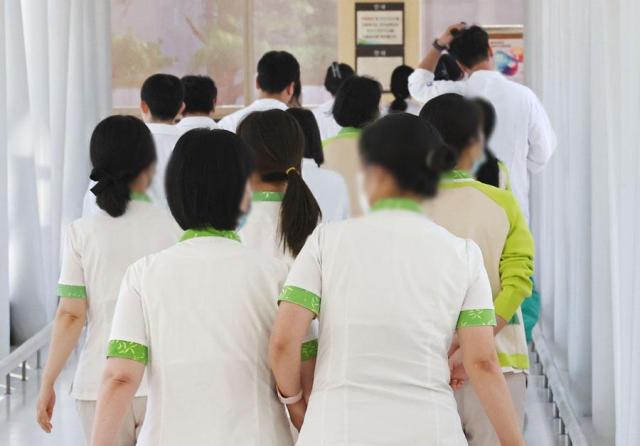
Their major walkout was averted as some 59 out of 62 medical institutions under Korean Health and Medical Workers' Union (KHMU) accepted a proposal over wages and working conditions.
The decision just came after a bill, which legalizes the medical practice of Physician Assistants (PAs) starting next year, was passed in the National Assembly the previous day.
However, three hospitals -- Chosun University Hospital, Honam Regional Rehabilitation Hospital, and Nowon Eulji Medical Center -- could not reach agreements, so nurses at these institutions are expected to go on strike as planned.
These negotiations took place against a backdrop of a severe manpower shortage in hospitals, exacerbated by trainee doctors resigning in protest against the government's decision to increase the admission quotas of medical schools.
The National Labor Relations Commission (NLRC) explained that failing to reach an agreement could have led to a larger medical crisis.

Park Sae-jin
Experienced journalist and editor at AJU PRESS specializing in multilingual news. I cover international diplomacy, geolpolitics, and policy, consistently delivering highly accurate, compelling reporting for a worldwide audience.
Copyright ⓒ Aju Press All rights reserved.
Related News
-
 Seoul Biohub Launches Open Research Platform to Connect Bio Startups with Hospitals
Seoul Biohub has launched the 'Seoul Open Translational Research Platform (STRP)' to connect bio startups with hospitals for collaborative research. The initiative aims to assist startups that possess promising technologies but lack the necessary equipment and clinical pathways to commercialize their innovations.On November 10, Seoul Biohub held the 'Seoul Bio-Medical Cooperation Governance Launch Ceremony' at its Global Center, where it signed a multi-party memorandum of understanding (MOU) with the Seoul Metropolitan Government, the Korea Institute of Science and Technology (KIST), and participating hospitals. Seoul Biohub serves as a support hub for bio and medical startups, established by the city of Seoul and jointly operated by KIST and Korea University.Bio startups often encounter what is known as the 'valley of death' when trying to turn basic research results into marketable products. Even with promising foundational technologies, many struggle to secure advanced research equipment and clinical channels in hospitals, hindering their ability to demonstrate effectiveness. The platform aims to bridge the infrastructure of universities, hospitals, and research institutions in Seoul with these startups. Research institutions will validate technologies, while hospitals will provide clinical research infrastructure, supporting the entire process from technology development to efficacy verification and commercialization. Hospitals and research institutions can identify collaborative research projects based on the startups' promising technologies.The Seoul Metropolitan Government plans to conduct a pilot project with three startups in 2027, with plans to expand participation to more hospitals and supported companies based on the results. Previously focused on open innovation with pharmaceutical and bio companies, Seoul Biohub is now broadening its support to include collaborative research with hospitals through this platform.O Sang-rok, president of KIST, stated, "Good technology in the bio field does not immediately translate into effective treatments. KIST will leverage its accumulated research capabilities and operational experience with Seoul Biohub to objectively evaluate the technologies of startups and ensure that collaborative research with hospital researchers leads to tangible verification outcomes."* This article has been translated by AI.
-
Kim Yoon: National University Hospitals Must Build Essential Medical Networks
Kim Yoon, a member of the Democratic Party, urged national university hospitals to establish strong connections with local facilities during the first National Assembly Health and Welfare Committee audit since the hospitals were transferred from the Ministry of Education to the Ministry of Health and Welfare. He emphasized that these hospitals should become the backbone of a 'regional essential healthcare cooperation network.'During the audit held on October 8, ten national university hospitals presented their operational status and discussed plans to expand essential medical services. The Lee Jae-myung administration has pledged to develop these hospitals to the level of the 'Big 5' in the Seoul metropolitan area, a project referred to as 'creating ten Seoul National University hospitals' to establish a comprehensive regional healthcare system.Hospital directors expressed concerns about the impact of the ongoing medical dispute, including the loss of residents, significant debt, and aging facilities. However, Kim Yoon stressed the need to focus on building a 'regional medical linkage network' rather than merely providing financial support or developing individual hospitals.He stated, 'Simply operating national university hospitals well will not resolve the current collapse of essential healthcare in the region. It is crucial for these hospitals to closely collaborate with local facilities to transform into a vast network responsible for essential healthcare in the area.'Kim criticized the complacency of both the Health Ministry and the national university hospitals. He noted, 'There is a complete lack of specific plans on how to establish an essential healthcare network in the proposals from the Health Ministry or the hospitals' reports. Among the reports submitted today, only Busan National University Hospital included relevant content, indicating that both the ministry and the hospitals lack ideas.'Despite the urgent need for local governments to prepare budgets for essential healthcare plans by the end of the year, there is no clear blueprint from the national university hospitals or the relevant ministry.In response, Son Young-rae, head of the Health Ministry's Regional Essential Public Health Office, stated, 'We are working to clarify the system through guidelines that bring together local governments and national university hospitals to analyze regional issues and discuss how to allocate essential accounting budgets.' He added, 'We will establish and share the process as quickly as possible.'Kim Hae-young, director of Busan National University Hospital, remarked, 'While the regional cooperation network project is very important, simply hiring essential healthcare physicians with high salaries would lead to a 'zero-sum game' by poaching professors from other local university hospitals. Given the absolute shortage of medical personnel in the region, a single hospital cannot handle everything alone. Therefore, national university hospitals must be empowered and funded to lead local medical resources for true collaboration with regional hospitals.'* This article has been translated by AI.
-
14 Major Hospitals Avoid Regional Emergency Centers, Sparking Public Responsibility Debate
Many of the country’s top medical institutions are reportedly neglecting their public responsibility to respond to severe emergency patients by avoiding designation as 'Regional Emergency Medical Centers.' This issue was raised during a National Assembly audit of the Ministry of Health and Welfare on October 7.Imanhee, the chair of the Health and Welfare Committee, stated, "Out of 47 major hospitals nationwide, only 33 are designated as regional emergency medical centers. Prestigious hospitals like Samsung Medical Center, Seoul St. Mary's Hospital, and Yeungnam University Medical Center are not included, and both Pusan National University Hospital and Chonnam National University Hwasun Hospital have not even applied for designation."When asked about the reasons for avoiding the designation, Health Minister Jeong Eun-kyeong replied, "Each hospital has its own circumstances, but factors such as profitability and the significant responsibilities associated with emergency medical care likely play a role."In response, Imanhee pointed out that the reluctance to take on responsibility, along with the opportunity cost of operating dedicated beds (30 inpatient beds and 10 intensive care beds) and low reimbursement rates, reflects a thorough consideration of the hospitals' financial interests. He criticized major hospitals for enjoying the benefits of their prestigious status and high reimbursement rates while neglecting their minimal emergency medical responsibilities that are directly linked to public health.Indeed, hospitals that do not operate regional emergency centers have reported substantial profits. According to Imanhee, the net profits before setting aside reserves for specific purposes were 43.2 billion won for Samsung Medical Center and 49.2 billion won for Yeungnam University Medical Center last year.Imanhee condemned the practice of disguising significant profits as accounting losses by reallocating them to specific purpose funds, using operational difficulties as an excuse to evade emergency medical responsibilities. He also highlighted the dire emergency medical conditions in 98 medically underserved areas and criticized the government's inadequate response.He urged, "With only 20 billion won in annual emergency medical funds and unrealistic reimbursement rates, we cannot prevent hospitals in vulnerable areas from withdrawing. The government and local authorities must work together to develop a fundamental restructuring plan for the emergency medical system that connects major hospitals with vulnerable medical institutions, and submit it before the comprehensive audit."In response, Minister Jeong stated, "I will identify and report on specific plans to newly establish the emergency medical system in medically underserved areas."* This article has been translated by AI.