
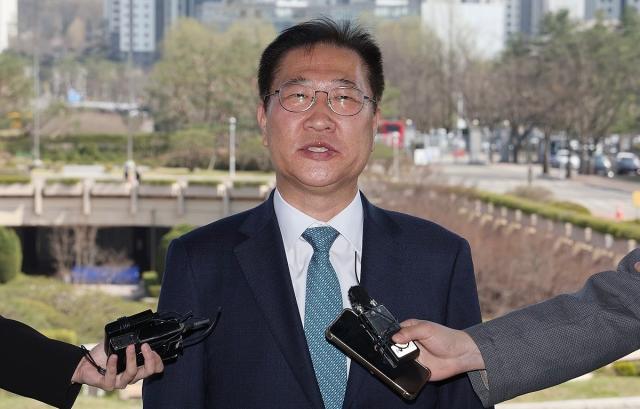
The court said it found "no evidence or other objective records" showing that Park aided Yoon's Dec. 3 declaration of martial law or tacitly supported it.
With the ruling, Park was immediately reinstated, nearly four months after the National Assembly impeached him over his alleged involvement in the debacle on Dec. 12.
Park had denied the charges, saying he actively tried to stop Yoon from declaring martial law during a Cabinet meeting and did not participate in follow-up discussions such as plans to arrest a slew of lawmakers.
Copyright ⓒ Aju Press All rights reserved.
Related News
-
 Education Minister Choi Kyo-jin Resigns Amid College Entrance Exam Confusion
Choi Kyo-jin, the Minister of Education, abruptly announced his resignation on November 22, taking responsibility for the confusion surrounding the response to cheating incidents involving artificial intelligence (AI) and smart devices during the 2027 College Scholastic Ability Test (CSAT). With the unprecedented fallout from the mismanagement of the exam, attention is now focused on the selection of the next minister who will lead the management of college admissions and future educational reforms. “I take responsibility for the CSAT confusion”... Ministry of Education faces urgent challenges In a statement released through the Ministry of Education's spokesperson, Choi said, “In the preparation process for the 2027 CSAT, various changes occurred close to the exam date, causing inconvenience to examinees and the public. As the minister of the responsible department, I believe I cannot be free from criticism for not being adequately prepared. Now that the CSAT is over, I feel the weight of this responsibility and hereby resign.” This year's CSAT faced turmoil due to concerns over cheating using advanced devices like AI-based miniature cameras and smart glasses, which emerged just before the exam. The Ministry of Education changed guidelines repeatedly until just days before the exam and even issued emergency disaster alerts nationwide on the exam day. However, over 100 incidents of cheating involving smart devices were detected, failing to quell the controversy over fairness. With the ministerial vacancy now a reality, the Ministry of Education faces urgent challenges in managing key schedules for the end of the year and early next year. The Ministry and the Korea Institute for Curriculum and Evaluation will accept applications for objections to the CSAT questions and answers until November 23, finalize the correct answers by December 1, and notify examinees of their scores by December 11. Disciplinary actions against those caught cheating must also be resolved before the score announcement. Additionally, there are pressing issues such as the announcement of early admission results by December 18, the regular admission application process in early January, and preparations for the implementation of AI educational materials and textbooks in schools, necessitating minimal disruption during this transition. Four strong candidates for the next minister... What are the strengths of Kim Young-ho, Park Baek-beom, Ko Min-jeong, and Choi Eun-ok? In political and bureaucratic circles, potential candidates for the next Minister of Education include Democratic Party lawmaker Kim Young-ho, Park Baek-beom, president of Catholic Kkotdongnae University, Democratic Party lawmaker Ko Min-jeong, and current Vice Minister of Education Choi Eun-ok. Kim Young-ho, a three-term lawmaker, has served as the chair of the Education Committee in the 22nd National Assembly and is considered a traditional expert on current issues. He has consistently been mentioned as a ministerial candidate since the beginning of the current administration and has proposed a core educational vision centered on a 'reading nation,' showing deep interest in addressing issues of declining literacy and digital over-immersion among students. An education sector insider noted, “During his time as chair of the Education Committee, Kim effectively coordinated educational issues across party lines, demonstrating excellent negotiation skills in the National Assembly. He has emphasized the importance of basic literacy and reading education, which have paradoxically become crucial in the era of AI, making him a suitable candidate to restore the essence of public education while being cautious of technological over-reliance.” Park Baek-beom, president of Catholic Kkotdongnae University, is a seasoned bureaucrat with experience as the director of the Ministry of Education's University Support Division, Planning and Coordination Division, deputy superintendent of the Seoul Metropolitan Office of Education, and vice minister of education during the Moon Jae-in administration. His extensive experience in both primary and secondary education administration, as well as higher education, and his current role as a university president give him a significant advantage. Ko Min-jeong, a two-term lawmaker who previously served as the spokesperson for the Moon Jae-in administration, currently leads the ruling party's education committee in the 22nd National Assembly. With a background as a KBS announcer and a proven ability to communicate with the public, she has focused on addressing educational disparities and increasing investment in public education through initiatives like leading seminars related to creating ten Seoul National Universities. A member of the ruling party remarked, “One of the key causes of this situation was the education authorities' inadequate crisis communication and lack of on-site communication. Ko has a high understanding of policy and excels in communicating with parents and examinees, making her an attractive candidate for promoting gender diversity in ministerial appointments and internal party balance.” Choi Eun-ok, the current Vice Minister of Education, is also considered a strong candidate for internal promotion. Following the minister's resignation, she has been leading the acting duties and overseeing the Ministry's operations, which is seen as a significant advantage as no additional training is required. An education sector insider commented, “In an emergency situation where even a single day of administrative vacancy is unacceptable regarding CSAT score notifications and regular admissions, Choi's promotion is the most realistic option in terms of continuity and speed, as she can address current issues while stabilizing the organization.” Diverse candidates from academia, bureaucracy, and politics also mentioned... Former professor Park Kyung-mi among them In addition, various individuals with expertise and practical experience are being discussed as potential candidates. Notably, former Hongik University mathematics education professor Park Kyung-mi, who also served as the education secretary and spokesperson at the Blue House, is considered a strong alternative. Having worked as a researcher at the Korea Educational Development Institute and the Korea Institute for Curriculum and Evaluation, she has a comprehensive background in education theory and government experience, making her a well-rounded candidate. As a mathematics education expert, she has a high understanding of the transition to AI and digital education, and her experience as a spokesperson enhances her political and communication skills, making her competitive in terms of gender representation in ministerial appointments. Additionally, Hong Chang-nam, a professor of education at Pusan National University and chair of the Ministry of Education's Policy Advisory Committee, is mentioned as a candidate with insights into educational governance and policy design. Sung Gi-seon, a professor at Catholic University of Korea's Graduate School of Education and former head of the Korea Institute for Curriculum and Evaluation, is seen as suitable for addressing issues in admissions and assessments. Kwon Oh-nam, a professor at Seoul National University’s Department of Mathematics Education and president of the Korean Federation of Science and Technology Societies, is categorized as a candidate for innovation in science and mathematics education in the AI era. From the political sphere, Baek Seung-a, a Democratic Party lawmaker and former chair of the Gangwon Teachers' Union, and Kang Kyung-sook, a lawmaker from the Rebuilding Korea Party and former professor of special education at Wonkwang University, are also being mentioned. Furthermore, the possibility of Kim Dae-jung, the superintendent of education in Gwangju, and Yoo Eun-hye, the former Deputy Prime Minister and Minister of Education, returning to the forefront is being widely discussed. Challenges for the next Minister of Education in the AI era... “Fair assessments and future education must go hand in hand” Within and outside the education sector, there are calls for the next Minister of Education to not only resolve the CSAT crisis but also to lead a comprehensive transformation of the education system suitable for the rapidly changing AI era. This is due to the limitations of traditional written exams and analog supervision methods in an environment where AI and wearable devices have become commonplace. An education administration expert stated, “The first duty of the next minister is to quickly restore the fairness and trustworthiness of the CSAT and college admissions process, alleviating the anxiety of examinees and parents.” However, they also emphasized that “at the same time, the minister should not only seek to control AI technology as a tool for cheating but should demonstrate proactive policy leadership by clearly establishing standards for future assessment methods and the use of AI in classrooms.” A current high school teacher, who requested anonymity, remarked, “The minister we hope for is one who listens to the voices from the school field rather than relying on hastily prepared guidelines from a desk, and who can support the system in line with technological changes through effective communication.” * This article has been translated by AI.
-
Discussion on Retirement Age Extension Accelerates as Labor Minister Says Government Will Step In if No Agreement
Labor Minister Kim Young-hoon stated on November 22 regarding the discussion on extending the retirement age, "Since labor-management discussions have sufficiently matured, it is the government's duty to responsibly prepare measures." This emphasizes that if no labor-management agreement is reached, the government will directly propose alternatives. During his appearance on KBS's Sunday Diagnosis, Minister Kim remarked, "We will push for an agreement between labor and management as much as possible, but it is true that the final agreement is uncertain." The turning point seems to be the Democratic Party's special committee meeting on retirement age extension. Minister Kim noted, "I understand the next special committee meeting is on the 27th, and the time for the government to announce its position will be approaching around that time." The Democratic Party's special committee on retirement age extension plans to initiate legislative procedures by the second half of this year. However, up to now, discussions have only reached the level of holding meetings with labor-management groups, and there has been no progress in discussions for ten months. The labor sector argues that the legal retirement age should be extended from the current 60 years to 65 years. This is to minimize the income gap that occurs at the retirement point and the age at which national pension benefits begin. On the other hand, the business sector insists on ensuring companies' autonomy regarding reemployment after retirement. They are concerned that this could increase labor costs and potentially dampen new hiring of young workers. Minister Kim diagnosed that while both labor and management agree on the necessity of extending the retirement age, there are significant differences in the specific methods. He acknowledged some of the business sector's concerns about rising labor costs and the potential impact on youth employment. He stated, "There are criticisms that the government is passively waiting behind labor-management agreements, but I have no intention of being cowardly. We will promote labor-management agreements, but if it does not work out, the government must step in responsibly, and that time is approaching." He added, "I understand the business sector's position that it would be difficult to absorb the shock of suddenly raising the retirement age to 65, so the government has no choice but to proceed gradually." In relation to this, the Ministry of Labor issued a press release stating, "The government will support labor-management agreements as much as possible and will fulfill its responsible role considering the results of the special committee," and expressed hope that visible results would be produced in the subcommittee meeting on the 27th, given that discussions have been ongoing for over a year in the Democratic Party's special committee. Regarding concerns about a decrease in youth jobs due to the retirement age extension, he stated that separate employment measures would be announced alongside it. Minister Kim expressed, "There are worries that if the retirement age is extended in the public sector, youth employment will become even more difficult," and added, "When we announce measures for extending the retirement age, we plan to present these youth employment measures as a package." He also hinted at the possibility of conditionally allowing exceptions to the 52-hour workweek for research and development personnel in advanced industries. Minister Kim emphasized the need for reasonable compromises regarding the labor time exceptions surrounding the super-large special zone law, stating, "Both labor and management agree on the need for one-point social dialogue." In particular, regarding the industry's demands, he said, "I understand that they are asking to recognize the uniqueness of R&D and to allow them to work intensively without being confined to the 52-hour framework," and noted, "There is no principle without exceptions, so exceptions can be granted." However, he maintained that appropriate compensation for workers and the protection of their health must be guaranteed. Minister Kim stated, "Innovation is not sustainable in bad jobs," and expressed his intention to find a way to harmonize these two aspects of compensation and health rights. Regarding the recent controversy over cheating in exams using artificial intelligence (AI), he announced that the management and supervision of national technical qualification exams would be significantly strengthened. Minister Kim explained that measures have been prepared for the approximately 528 national technical qualification exams managed by the Ministry of Labor, covering pre-, during, and post-exam stages. This includes exam supervisors directly collecting candidates' mobile phones to check if they are powered off and randomly calling during the exam to check for cheating. Even after the exam concludes, if any anomalies are detected during the analysis of answer sheets, the final pass announcement will be postponed for investigation. Minister Kim emphasized, "Just because candidates leave the exam room does not mean it is over. We will start from that point," and added, "We will track this thoroughly through a cross-ministerial cooperation task force."* This article has been translated by AI.
-
Education Minister Resigns Amid AI Cheating Scandal, Calls for College Entrance Exam Reform Rise
2027 College Scholastic Ability Test (CSAT) has seen numerous instances of cheating using artificial intelligence (AI) and ultra-small smart devices, leading to the abrupt resignation of Education Minister Choi Kyo-jin on November 22. This has reignited discussions on reforming the CSAT. President Lee Jae-myung has called for a comprehensive overhaul of the national examination system, and the National Education Commission is reportedly considering expanding written and essay evaluations. This raises questions about whether the multiple-choice format, which has been in place for over 30 years, will undergo significant changes.In a statement released through the Education Ministry's spokesperson, Minister Choi expressed, "With the exam approaching, various changes have caused inconvenience to examinees and the public," adding, "I cannot escape criticism for not being prepared in advance." President Lee accepted Choi's resignation about an hour after it was submitted.On November 20, President Lee had ordered a strict response to threats against the fairness of the exam during a meeting with senior aides and via social media, emphasizing the need for a complete reform of the national examination system. The early resignation of the head of the relevant ministry, coupled with the president's commitment to reform, has led to expectations that discussions on changing college admissions evaluation methods will gain momentum.Ultra-small AI devices breach multiple-choice format, reigniting discussions on written and essay evaluationsRecent events have starkly revealed that advanced wearable devices, such as smart glasses and ultra-small cameras and earphones combined with generative AI, can undermine the analog monitoring systems in examination halls. The current multiple-choice structure, which requires selecting one answer, is structurally vulnerable to cheating facilitated by advanced devices, as even a short number or symbol sent from outside can easily lead to the correct answer. The technology now allows for the possibility of capturing text and transmitting it externally, with AI deriving the correct answer in mere seconds, highlighting the limitations of relying solely on metal detectors or visual checks by proctors.Consequently, there is a growing call to move away from memorization-based multiple-choice evaluations and to introduce written and essay evaluations that measure critical thinking and problem-solving skills into the CSAT and college admissions process. The National Education Commission is also reviewing plans to gradually expand written and essay evaluations in school assessments as part of its mid- to long-term national education development plan, lending weight to the argument that the evaluation paradigms of school assessments and the CSAT should be linked. With the 2028 college admissions reform plan already indicating a shift to a five-grade system for school assessments and the full implementation of a high school credit system, it is seen as a natural progression for the expansion of written and essay evaluations in school assessments to lead to changes in the CSAT evaluation methods.Education groups say urgent need for critical thinking assessments in the AI era, while concerns over grading fairness and private education ariseWhile education circles and various educational organizations agree on the need to move toward an evaluation system that overcomes the limitations of multiple-choice CSATs and aligns with the AI era, there are differing opinions on specific methodologies and the pace of implementation.Progressive teacher organizations, such as the Korean Teachers and Education Workers Union (KTU), and educational civic groups argue that it is urgent to transform the CSAT into a qualification exam and introduce written and essay evaluations to alleviate excessive competition and rote learning. They contend that since AI has already surpassed humans in simple knowledge memorization and problem-solving techniques, the transition to written and essay evaluations that assess students' critical thinking and creative problem-solving processes cannot be delayed any longer. They emphasize that written and essay evaluations and absolute grading should first be firmly established in high school assessments before the CSAT is also reformed to focus on written and essay formats, which would lead to meaningful changes in classroom instruction.Conversely, conservative teacher organizations, such as the Korean Federation of Teachers' Associations (KFTA), and some parent groups advocate for caution regarding the hasty introduction of written and essay evaluations. They argue that implementing such questions in a high-stakes national exam taken simultaneously by around 500,000 examinees each year would make it difficult to ensure the objectivity and fairness of grading. Given the sensitivity of South Korean society to a one or two-point difference in college admissions outcomes, there is a significant concern that large-scale disputes over grading criteria and results could arise, potentially exacerbating the pressure on teachers and leading to an increase in private tutoring for essay preparation.“Switching to written evaluations alone won't stop AI cheating... Independent testing environments and grading verification are priorities”Education experts warn that discussions on introducing written and essay evaluations should not be limited to merely changing question formats. They stress that enhancing monitoring systems to block external assistance during exams and establishing strict grading criteria must go hand in hand. With generative AI capable of producing plausible essay responses and solutions, if security in examination venues is compromised, written evaluations will not be immune to AI cheating.Moon Hyung-nam, president of the Korean AI Education Association and a professor at Sookmyung Women's University, stated, "The belief that simply changing from multiple-choice to written or oral formats will resolve AI cheating is a misconception." He pointed out that since generative AI can also write essay responses, the effectiveness of cheating prevention ultimately depends on how well unauthorized external assistance is blocked and how an environment is created for examinees to independently produce their answers.Moon further emphasized that to expand written evaluations, it is essential to thoroughly verify the consistency of grading criteria and among graders, along with designing questions that ask for evidence supporting conclusions. In the case of the CSAT, which has a large number of examinees, it is crucial to consistently apply device management and monitoring procedures before the exam. He concluded that when reviewing exam reform plans, two principles must be clearly established: "What abilities are we trying to assess?" and "How can we confirm that examinees demonstrated those abilities independently?"Another education assessment expert noted, "Given the significant practical constraints of immediately converting the entire CSAT to written and essay formats, it would be more realistic to first stabilize the written and essay evaluations and process-oriented assessments being considered by the National Education Commission, and then gradually introduce them in certain areas of the CSAT, while also building infrastructure such as AI-assisted grading systems."* This article has been translated by AI.