

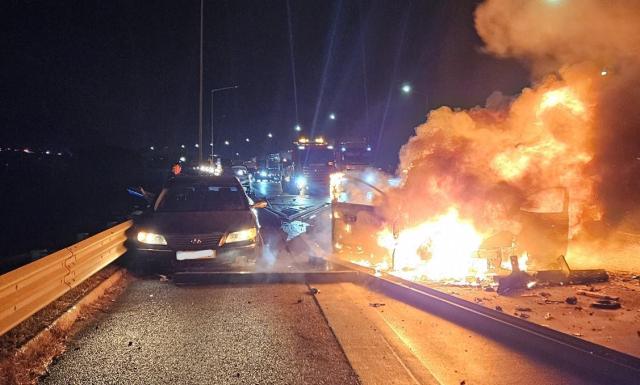
Seven people were killed and nine others injured Saturday morning in a string of traffic accidents across highways and national roads in North Gyeongsang Province, with police citing black ice as the main cause.
The accidents unfolded within a narrow early-morning window, when light precipitation met subzero temperatures — the precise conditions that make black ice most dangerous.
Vehicles appeared to lose traction on road surfaces that looked dry, triggering chain collisions and truck rollovers at multiple locations.
While investigations are continuing, the incidents have once again exposed the limits of South Korea’s winter road safety measures.
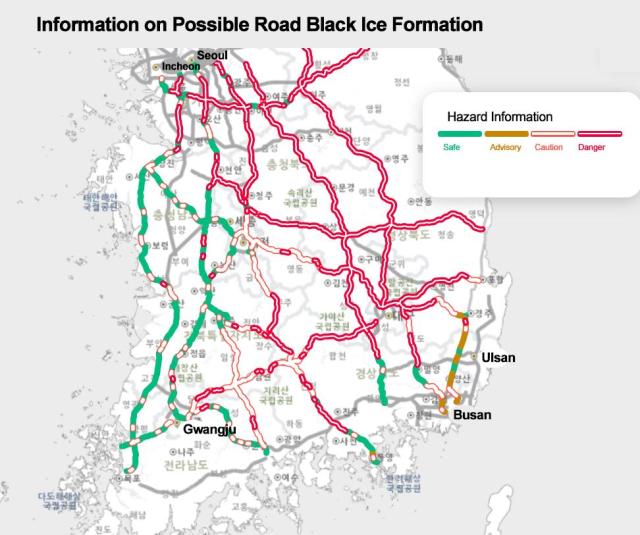
The risk is neither new nor rare. According to the Ministry of the Interior and Safety, icy roads caused 4,112 traffic accidents nationwide between 2020 and 2024, killing 83 people and injuring 6,664 others. Nearly 80 percent occurred in December and January.
Data from the Korea Road Traffic Authority show that accidents on icy roads are significantly more lethal than on dry pavement. The fatality rate is about 1.5 times higher overall, and more than four times higher on bridges and overpasses — structures that freeze faster due to air circulation above and below.
Despite repeated incidents, officials acknowledge that prevention options are limited.
De-icing agents such as calcium chloride remain the primary response, but their effectiveness depends on timing, traffic volume and sudden temperature drops. The Ministry of Land, Infrastructure and Transport said it is reviewing whether de-icing materials were sufficiently applied on the highway sections where Saturday’s accidents occurred.
Local governments have focused on targeted measures rather than broad fixes. The Seoul Metropolitan Government said it sends early-morning alert messages during freezing conditions and plans to expand road heating systems and brine-spraying devices at high-risk spots such as tunnel entrances and bridges.
Structural constraints, however, remain the biggest hurdle.
“In Europe and Japan, many highways use porous asphalt that allows water to drain more effectively,” Son said. “Replacing pavement in black ice-prone sections would reduce risks, but it would require large-scale and costly reconstruction.”
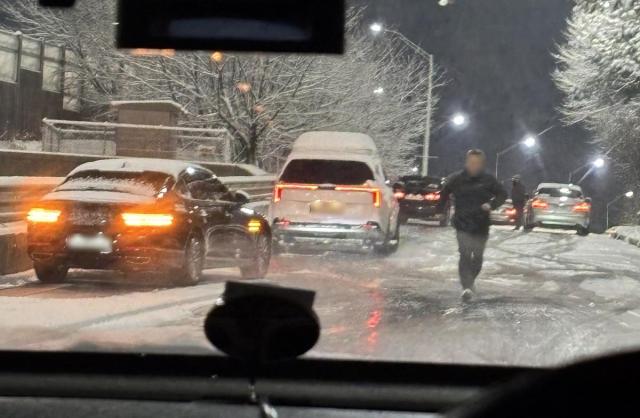
With infrastructure fixes limited, experts say driver behavior becomes the last line of defense.
Professor Choi Jae-won of the Korea Road Traffic Authority said braking distances on icy roads can increase up to sevenfold compared with dry surfaces, based on experimental data.
“Black ice accidents occur most frequently at dawn,” Choi said. “Drivers should slow down well in advance, especially near bridges, tunnel entrances and shaded sections.”
As winters grow more volatile, officials say managing black ice will continue to rely on a mix of localized engineering, faster alerts and heightened driver awareness — rather than a single, comprehensive solution.

Copyright ⓒ Aju Press All rights reserved.
