

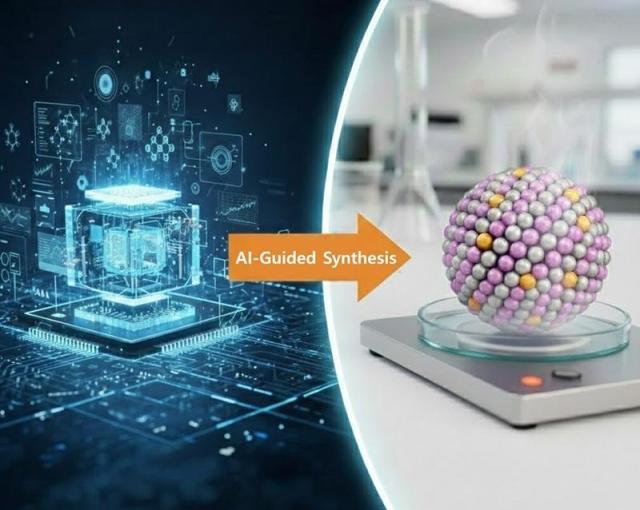
SEOUL, February 26 (AJP) - A research team from the Korea Advanced Institute of Science and Technology and Seoul National University has developed a technology that uses artificial intelligence to precisely predict the arrangement of atoms in catalysts. By calculating atomic tendencies before conducting experiments, the researchers identified a way to improve both the performance and durability of the fuel cells that power hydrogen vehicles.
Hydrogen fuel cells are often described as the heart of eco-friendly mobility, but they remain expensive and have limited lifespans. Much of this is due to the platinum catalyst, a critical material that generates electricity. Platinum reacts slowly, its performance drops over time, and its high cost drives up the price of hydrogen cars. The South Korean team addressed these issues by using AI to design a more efficient atomic structure for the catalyst.
The research focused on platinum-cobalt alloy catalysts. While these alloys are powerful, creating a stable, ordered structure known as an intermetallic compound typically requires extremely high heat. This heating process often causes the tiny particles to clump together or become unstable, which limits their use in real-world fuel cells. To solve this, the team used machine learning simulations to analyze how atoms move and arrange themselves at the atomic level.
The AI discovered that introducing a small amount of zinc acts as a mediator. This zinc allows the atoms to settle into their proper positions more easily, creating a more precise and stable structure. In simple terms, the AI found a more efficient path for the atoms to follow, acting like a digital blueprint that was then tested in a laboratory.
When the researchers synthesized the zinc-platinum-cobalt catalyst based on these AI predictions, it showed higher activity and better long-term durability than traditional platinum catalysts. This suggests that the AI-guided design can successfully translate from a virtual simulation into a high-performance physical material.
The technology is expected to help reduce manufacturing costs and extend the life of fuel cells in various sectors, including passenger cars, long-haul trucks, ships, and energy storage systems.
KAIST's Department of Materials Science and Engineering Professor Cho Eun-ae stated that the study used machine learning to predict atomic ordering before realizing it through actual synthesis. She noted that AI-based material design will provide a new paradigm for developing next-generation catalysts.
Jang Hyun-woo, a doctoral student at KAIST, and Ryu Jae-hyun, a researcher at Seoul National University (SNU), served as joint first authors for the study. The findings were published in the energy materials journal Advanced Energy Materials on January 15.
(Paper information)
Journal: Advanced Energy Materials
Title: Machine Learning-Guided Design of L1₀-PtCo Intermetallic Catalysts: Zn-Mediated Atomic Ordering
DOI: https://doi.org/10.1002/aenm.202505211

Copyright ⓒ Aju Press All rights reserved.
