

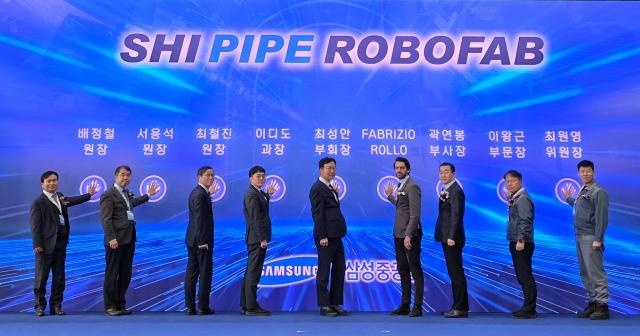
The completion ceremony was held at the Chilseo industrial complex in Haman, South Gyeongsang Province, with about 70 attendees including Samsung Heavy Industries Vice Chairman and CEO Choi Seong-an, officials from the Ministry of Trade, Industry and Energy, shipowners such as ENI and MISC, and other industry representatives.
Piping, often described as a ship’s circulatory system, is produced through a spool-making process in which components such as elbows, tees and flanges are welded and assembled into a single unit based on design drawings.
Samsung Heavy Industries said it built a smart management system that integrates the entire workflow — from pipe design to automated logistics, high-precision machining and measurement, alignment and welding — and combined it with vision AI to create an automated production system.
The Pipe Robofab facility has a total floor area of 6,500 square meters and can produce about 100,000 pipe spools a year, the company said. It said shifting spool production to advanced robotics is expected to shorten production time while ensuring consistent quality and improving safety.
“Pipe Robofab is a site that has innovated the pipe spool process by combining Samsung Heavy Industries’ skilled welding technology with 3X (AX·DX·RX) technologies,” Choi said. “It will be an opportunity to upgrade the manufacturing competitiveness of the shipbuilding industry by one level.”
Choi Won-young, chairman of the company’s labor-management council, said AI and automation are “an unavoidable major trend” across industries. He said labor and management will keep communicating to expand jobs as shipbuilding volumes grow, while supporting employment stability for workers and a safer work environment.
* This article has been translated by AI.
Copyright ⓒ Aju Press All rights reserved.