

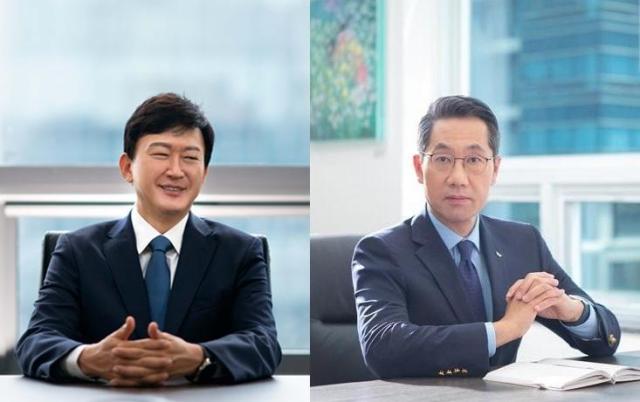
Top executives at major South Korean biotech companies including Samsung Biologics, Celltrion and SK Biopharmaceuticals are expected to extend a run of CEO reappointments this year, buoyed by record results posted last year. Analysts say the companies still face major growth tasks, including expanding contract development and manufacturing (CDMO) capacity, building antibody-drug conjugate (ADC) businesses and broadening global new-drug portfolios.
Industry officials said March 16 that regular shareholder meetings at Samsung Biologics, Celltrion and SK Biopharmaceuticals are expected to put CEO reappointment items on the agenda. With each company delivering all-time-high performance, the market is largely betting on approvals.
Samsung Biologics reported 4.557 trillion won in revenue last year and 2.0692 trillion won in operating profit, putting it within reach of surpassing 5 trillion won in revenue this year. The company roughly doubled operating profit in just two years after first topping 1 trillion won in 2023, results seen as validating its strategy to widen its lead in CDMO.
That performance has strengthened the outlook for another term for CEO John Rim. Rim became CEO in December 2020 and won one reappointment at the 2023 shareholders meeting. If the agenda item passes as proposed at the meeting scheduled for March 20, he would begin a third term.
Key tasks ahead include rebalancing global capacity around its fifth plant and its Rockville, Maryland, production base; turning its ADC business into visible revenue; and winning orders for a sixth plant. The company has been pursuing new contracts by promoting integrated ADC drug substance and drug product manufacturing since last year, and securing commercial production deals that translate into sales is viewed as a priority. Industry watchers say the effort ties into a longer-term order strategy after the sixth plant begins full operations next year, calling it a potential inflection point for another step up in scale. With labor-management wage talks repeatedly faltering, Rim’s role as a key figure in resolving the dispute has also drawn attention.
Celltrion posted record results last year on a consolidated basis, exceeding 4 trillion won in revenue and 1 trillion won in operating profit. Its operating margin reached 36%, easing profitability concerns raised at the time of its merger with Celltrion Healthcare in just one year. The company has set a goal of reaching 5.3 trillion won in revenue in 2026 by reducing reliance on biosimilars and expanding CDMO and new-drug businesses starting this year.
Investors are also focused on whether CEO Ki Woo-sung will be reappointed. Industry officials say his chances look strong given his role in driving merger synergies and earnings growth under the integrated Celltrion structure.
Still, the shift toward a “post-biosimilar” business model is seen as a work in progress. Celltrion has signaled plans to spin off CDMO into a separate subsidiary and to secure global customers through U.S. facility acquisitions, raising concerns that risks could emerge if order volume and profitability do not follow.
SK Biopharmaceuticals has been scaling up quickly on the strength of its epilepsy drug cenobamate, sold in the United States as Xcopri. Revenue rose from 246.2 billion won in 2022 to 354.9 billion won in 2023 and 547.6 billion won in 2024, marking 40% to 50% growth for two consecutive years. With Xcopri’s U.S. sales climbing, the company is seen as having achieved both a return to profitability and a stronger business structure. Last year, it reported 706.7 billion won in revenue and 203.9 billion won in operating profit.
The outlook for reappointing CEO Lee Dong-hoon has also improved. The company is pursuing both expanded indications for Xcopri and expansion into Europe and Asia, while accelerating development of central nervous system (CNS) candidates and next-generation platform-based drugs including RPT, TPD and CGT. However, heavy reliance on a single product leaves commercialization of follow-on pipelines and diversification of global partnerships as Lee’s biggest challenges.
“Record results may have delivered reappointments, but the next few years will determine whether those renewals were truly earned,” an industry official said. “Each company will have to prove its chosen growth engines by turning them into concrete orders, revenue and profit.”
* This article has been translated by AI.
Copyright ⓒ Aju Press All rights reserved.