

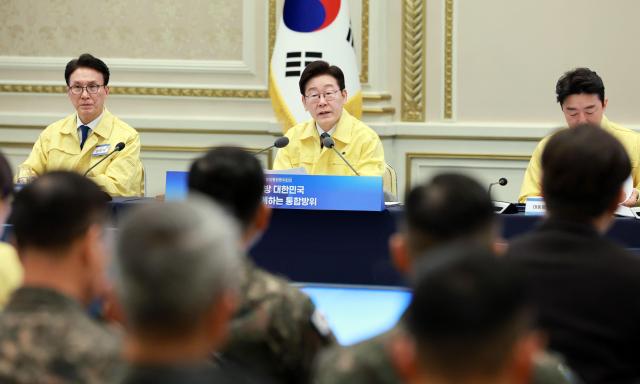
“Self-reliant defense is the most important core of integrated defense,” Lee said while presiding over the 59th Central Integrated Defense Council at the Cheong Wa Dae in Seoul.
The council, held annually, brings together senior officials across various national defense sectors to assess the country’s integrated defense posture and discuss ways to strengthen it. This marked the first such meeting since Lee took office.
Lee stressed that ensuring public safety, maintaining everyday stability and safeguarding national continuity are the fundamental responsibilities of the government.
“The most critical aspect of national security is ultimately our integrated defense capability, and at its core lies national defense,” he said.
He emphasized that defense must remain a sovereign responsibility.
“It is something we must never entrust to others, a core responsibility we must ultimately bear ourselves,” Lee said. “We must be able to protect ourselves under any circumstances without relying on external assistance.”
Lee highlighted South Korea’s defense capabilities, noting that the country’s annual defense spending is about 1.4 times North Korea’s gross domestic product and that it ranks fifth globally in military strength.
“With an economy among the top 10 globally and a defense industry envied worldwide, we have sufficient capacity to defend ourselves without external support,” he said.
He called on officials to strengthen preparedness and maintain confidence, urging them to build systems capable of ensuring national defense under any conditions.
Lee also underscored the importance of coordination among civilian, military, police and emergency response sectors.
Regarding global tensions, including the conflict involving the United States, Israel and Iran, Lee described the international situation as “highly complex and fluid.”
He warned that threats now extend beyond conventional military risks to include cyberattacks, terrorism, climate-related crises and disasters. “In such an environment, all elements of defense must respond in a unified and coordinated manner in times of emergency,” he said.

Copyright ⓒ Aju Press All rights reserved.
