About 40 percent of South Korea's urea and ammonia — key inputs for nitrogen fertilizers — move through the chokepoint, according to the Korea International Trade Association. While domestic fertilizer output exceeds local demand, the industry remains structurally dependent on imported feedstocks.
That dependency leaves Korea exposed to what analysts describe as a "second-round shock": not just higher energy prices, but a breakdown in the economics of fertilizer use worldwide.
"The immediate impact will be on raw material costs for fertilizer exporters, but the bigger picture is that fertilizer prices, oil prices and exchange rates are all moving together, driving up overall agricultural production costs," said Chung Dae-hee, a researcher at the Korea Rural Economic Institute.
"If imports of not just fertilizer but also pesticides and other raw materials remain disrupted, it will directly affect agricultural commodity prices."
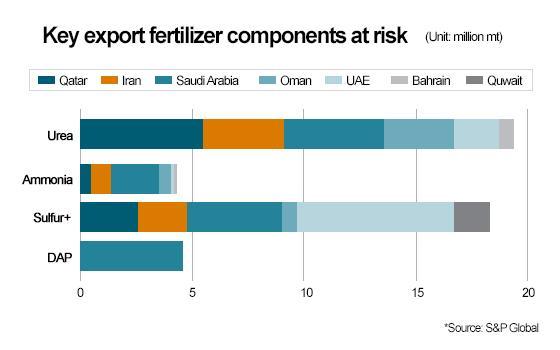
With shipping effectively halted since late February, at least 21 vessels carrying nearly 1 million metric tons of fertilizer remain stranded in the Gulf. Major suppliers including Qatar's Industries Qatar and Saudi Arabia's SABIC Agri-Nutrients have declared force majeure on deliveries to Asia.
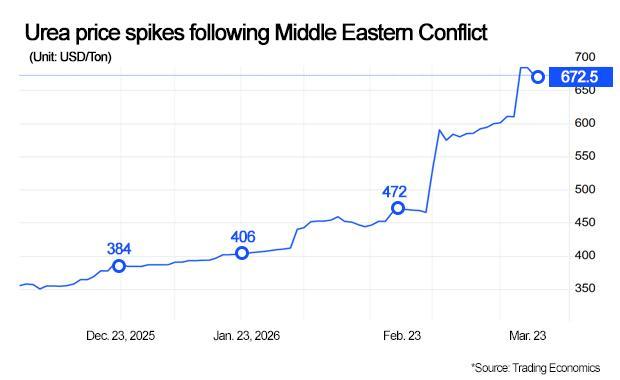
The result is a sharp spike in global fertilizer prices, with some contracts jumping from $750 to $1,000 per ton within weeks. More critically, the surge is already altering planting decisions.
U.S. Department of Agriculture projections show corn acreage falling to around 94 million acres this year from nearly 99 million in 2025, as farmers shift to less fertilizer-intensive crops such as soybeans. Some growers are planning to cut fertilizer application by as much as 25 percent — a move that directly lowers yields.
Brazil, which imports about 85 percent of its fertilizer, has warned of an "extremely high risk" to its 2026–2027 harvest. Any disruption there feeds straight into South Korea, which depends heavily on Brazilian and U.S. soybeans for cooking oil, animal feed and processed foods.
The crisis extends well beyond fertilizer.
South Korea's wheat self-sufficiency rate stands at around 2 percent, and the country ranks among the world's top five corn importers. Overall grain self-sufficiency — excluding rice — hovers near 20 percent, underscoring its exposure to global supply shocks.
"Unlike the 2022 Ukraine shock, which primarily hit grain exports, this crisis is choking fertilizer inputs that every major food-producing country depends on," said Lorenzo Rosa, a principal investigator at the Carnegie Institution for Science, as cited by the World Economic Forum.
That dynamic creates a lagged but more entrenched risk. While energy and shipping costs rise immediately, the impact on food supply emerges months later as lower fertilizer use translates into weaker harvests.
At the same time, policy responses are compounding the pressure. China has expanded export controls on fertilizers, including nitrogen-potassium compounds and certain phosphate products, on top of existing urea restrictions. India's urea production has been disrupted by reduced LNG inflows from Qatar, while Bangladesh has shut down four of its five fertilizer plants, according to Hana Securities analyst Yoon Jae-sung.
The United Nations World Food Programme warned on March 8 that rising fuel and food costs could push more households into food insecurity, calling the situation a rare "dual chokepoint" crisis spanning both the Red Sea and the Strait of Hormuz.
"If agricultural production costs rise like this, margins that are already razor-thin will force producers to pass costs onto consumers," Chung said. "Food price increases are particularly sensitive for the public — it becomes a situation where nobody wins."
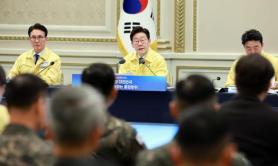
Seoul is scrambling to contain the fallout. Agriculture Minister Song Mi-ryung convened an emergency review on March 20, pledging to mobilize all available resources while confirming that domestic fertilizer supplies remain stable through the first half of the year.
"Over the medium to long term, diversifying import sources toward countries such as China and the United States will need to be explored."
But diversification offers only partial relief in a market where supply is tightening globally at the same time.
With its fertilizer industry reliant on imported inputs, limited strategic reserves, and a grain supply chain that depends overwhelmingly on overseas harvests, Korea is now confronting a deeper question emerging across global agriculture: not just how much food can be shipped — but whether farmers can afford to grow it at all.

Copyright ⓒ Aju Press All rights reserved.