

China’s biotech sector is rapidly closing the gap with the United States, reshaping global collaboration in drug discovery, licensing and co-development. As China’s share of new drug candidates rises, global pharmaceutical giants such as AstraZeneca and Pfizer — along with major South Korean drugmakers — are stepping up partnerships with Chinese companies.
McKinsey & Company said on the 13th that last year’s global share of new drug candidates was led by the United States at 33%, followed by China at 30.5% and South Korea at 6%. The gap between the United States and China narrowed to 2.5 percentage points in just one year.
McKinsey also said Asia, as of 2024, was driving the global pipeline for innovative drugs, highlighting China’s surge. In 2023, China’s share was 23% versus 36% for the United States, a 13-point gap. At the current pace, some forecasts say China could overtake the United States in global share of new drug candidates as early as next year.
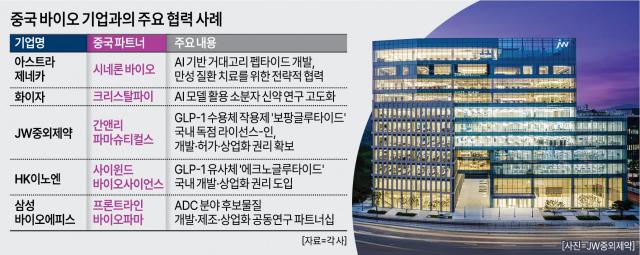
AstraZeneca last March signed a strategic collaboration with Beijing-based Sineron Bio, an artificial intelligence-driven peptide drug startup, to develop a first-in-class macrocyclic peptide for chronic disease treatment. Under the deal, AstraZeneca gained access to Sineron Bio’s Synova platform.
The platform is designed as an intelligent, high-throughput, large-scale macrocyclic peptide R&D system to support research programs exploring future treatment options for chronic diseases, including rare diseases, autoimmune disorders and metabolic diseases.
Pfizer is also using an AI model from China’s CrystalPi to advance small-molecule drug research. The deals underscore that China’s biotech industry is emerging not only as a manufacturing base but also as a source of early-stage discovery and platform technologies.
Market observers describe the partnerships as evidence that global drugmakers are increasingly recognizing Chinese firms’ technical capabilities. Some also say the rise in global dealmaking involving China’s AI-biotech sector reflects growing technological maturity.
South Korean companies are also bringing in promising Chinese candidates and expanding development ties. JW Pharmaceutical on April 8 signed an exclusive license-in deal with China’s Gan & Lee Pharmaceuticals for the GLP-1 receptor agonist candidate “bofanglutide” in South Korea. JW Pharmaceutical secured exclusive rights for development, regulatory approval, marketing and commercialization in the country. Gan & Lee agreed to provide regulatory data needed for clinical trial plan approval and product authorization in South Korea.
HK inno.N last year acquired South Korean development and commercialization rights from China’s Sciwind Biosciences for the GLP-1 analog “ecnoglutide.” The candidate is in Phase 3 clinical trials in China for type 2 diabetes and obesity. HK inno.N is pursuing development in South Korea for obesity and diabetes treatments.
Samsung Bioepis also signed a joint research partnership with Chinese biotech Frontline Biopharma to develop, manufacture and commercialize candidates in the antibody-drug conjugate, or ADC, field.
A biotech industry official said South Korea’s industry long focused on catching up with U.S. and European technologies, but is now moving to secure next-generation modalities through co-development with China. The official said China’s biotech sector is growing quickly, supported by its large population and active government policies.
* This article has been translated by AI.
Copyright ⓒ Aju Press All rights reserved.