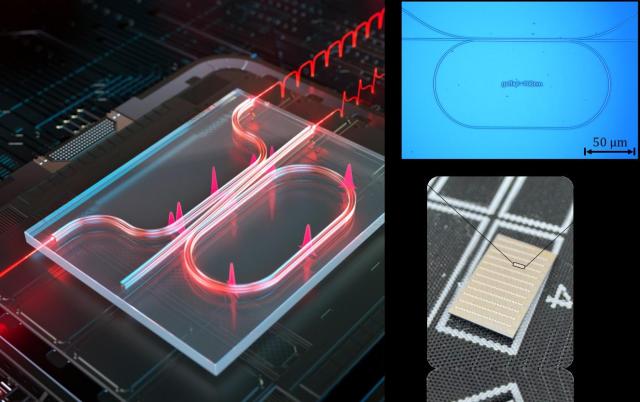
SEOUL, April 15 (AJP) - Researchers in South Korea have created a new component that makes it easier to control light on a microchip, which could significantly boost the performance of artificial intelligence and quantum computers. The team, representing both the Korea Advanced Institute of Science and Technology and Hanyang University, designed a device that uses light interference to manage signals with much higher accuracy than current methods. The Korea Advanced Institute of Science and Technology said Wednesday.
This technology focuses on Photonic Integrated Circuits (PIC), which use light to carry data at high speeds with low energy use. These circuits are essential for running the massive data centers that power AI, but they require very precise control over light waves.
Standard devices usually rely on a single channel to move light, which makes it hard to change the shape or timing of the signal. The researchers introduced a dual-path system that allows light waves to interact with each other in a controlled way, effectively letting them program the light.
Much of the work for the project was done by Kim Tae-won, an undergraduate student working through a specialized research program at KAIST. He worked alongside Professor Kim Sang-sik and Professor Yoon Jae-woong to prove the concept.
"I was able to take the resonator principles I learned in my introductory photonics class and turn them into an actual device design and a published paper," Kim Tae-won said.
The team found that this new layout allows for much better frequency conversion, which means they can change the color and properties of light more efficiently. This is expected to help AI accelerators and secure communication systems work faster while using less power.
Professor Kim Sang-sik said, "this research goes beyond suggesting a new device by providing a detailed analysis of optical properties that were previously overlooked."
He added that the team showed physical limits can be overcome through precise engineering. The findings were published in the journal Laser and Photonics Reviews on March 6, 2026.
(Reference Information)
Journal/Source: Laser and Photonics Reviews
Title: Dual-bus resonator for multi-port spectral engineering
Link/DOI: 10.1002/lpor.202502935

Copyright ⓒ Aju Press All rights reserved.