

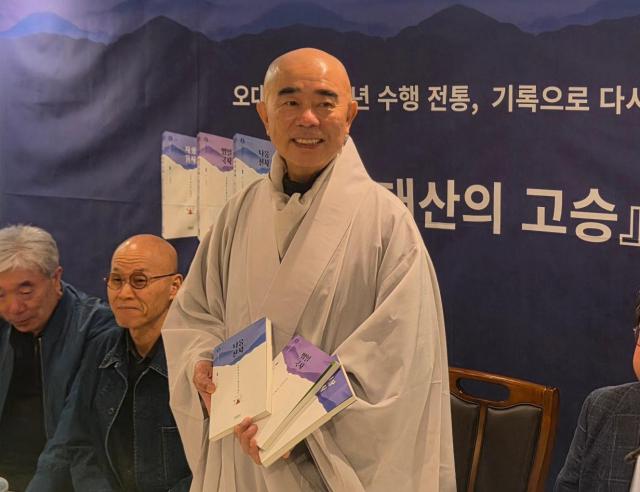
"We're in an era where established religions are bound to weaken, with people leaving religion and spirituality becoming secular and commercialized," Venerable Jeongnyeom said. "But if we reflect carefully on what came before, we can always open a new path."
Jeongnyeom, 70, abbot of Woljeongsa Temple on Mount Odaesan in Gangwon Province, made the remarks at a press briefing on April 14 at the National Museum of Modern and Contemporary Art in Seoul for the publication of <Great Monks of Odaesan>.
Saying most established religions are losing influence, he urged closer attention to the legacy of eminent monks. He said the public should be able to understand the monks' practice, ideas and the broad Buddhist culture of Odaesan. He described the series as a biographical project planned to prepare for the artificial intelligence era and to produce new cultural content that future generations can use easily.
<Great Monks of Odaesan> compiles the lives and teachings of eight eminent monks who passed through Mount Odaesan over about 1,400 years, from the Silla period to modern times. The project totals 10 volumes: eight on individual monks, one general history volume and one reference volume. Three volumes have been released first, with the remaining seven to be published sequentially within the year. The series highlights figures including Jijang Yulsa, Beomil Guksa, Naong Seonsa, Tanheo Seonsa and Manhwa Seonsa, presenting continuity in the Korean Buddhist lineage centered on Odaesan.
The project began with Jeongnyeom's idea. He has led efforts to systematically organize the monks' practice, thought and cultural legacy, but much of the work had accumulated mainly in academic papers, limiting access for general readers.
Determined to finish his term as abbot well, Jeongnyeom approached publisher Minjoksa. He said he sought an unconventional format written in modern language so readers could engage with it more easily.
The books are based on documented research but add about 20% fictional elements. Minjoksa asked writers to produce a format that even middle and high school students could understand, without leaning too heavily toward a novel or a conventional biography. Participating authors revised and supplemented drafts repeatedly before completing the volumes.
Throughout the briefing, Jeongnyeom stressed what he called an "AI transformation," voicing concern about "a situation where machines become humanlike and humans become machine-like." He said society is facing a civilizational shift marked by a loss of meaning and confusion over values, and urged Korean Buddhism to renew its sense of purpose and serve as a source of wisdom in a time of transition.
He also described the monks featured in the series as people who illuminated Odaesan and did their best to overcome turmoil in Korean society. Citing a sense of crisis over an approaching "AI tsunami," he said Buddhism, too, must move forward with new hope.
Asked about reporters' questions related to the Buddhist order's election for its chief administrator, he emphasized leadership, calling for change, hope and unity.
"In an uncertain era where change never stops, the most important quality of leadership today is to see the future and set direction," he said. "Many parts of the order's culture fall short in building the public's affection for Buddhism. A forward-looking design is important."
* This article has been translated by AI.
Copyright ⓒ Aju Press All rights reserved.