

Korean retail investors have been selling across major overseas stock markets at the same time, and attention is turning to whether that money will flow back into domestic shares.
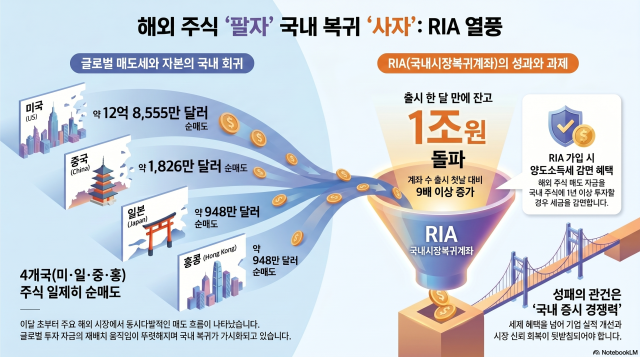
Data from the Korea Securities Depository’s Seibro portal show that from April 1 to 24, Korean individual investors were net sellers of U.S. stocks worth $1.28555 billion (about 1.8915 trillion won). Over the same period, they were net sellers of Japanese stocks worth $9.48 million (about 14 billion won), Hong Kong stocks worth $9.48 million, and Chinese stocks worth $18.26 million (about 27 billion won).
With that trend in view, market participants are also watching the government’s new domestic market return account, known as an RIA. The program offers a capital gains tax break if proceeds from selling overseas stocks are invested in domestic stocks for a set period of at least one year, aiming to encourage overseas investment funds to return home.
The RIA has grown quickly since its launch. The Korea Financial Investment Association said that as of April 23, cumulative RIA sign-ups totaled 168,347 accounts, with balances of 1.1051 trillion won. That compares with 17,965 accounts on the first day, meaning the number of accounts rose more than ninefold and balances surpassed 1 trillion won within about a month.
Market experts have said the tax incentive could reduce the burden on gains from overseas investing and lift investors’ effective returns. Some also see the capital gains tax reduction as a buffer that can encourage reinvestment after short-term profit-taking.
Analysts also say the RIA could help stabilize supply and demand and expand liquidity by drawing retail money into the local market, while serving as a policy signal that could bolster confidence and strengthen the base for mid- to long-term investing.
Still, they caution that while the RIA may bring short-term inflows, longer-term results will depend on the competitiveness of Korea’s stock market. Without improved corporate earnings and a recovery in market trust, they say tax benefits alone may not sustain the shift. As the RIA spreads rapidly, some in the brokerage industry say investor interest is rising, but concerns are also being raised about the potential for distorted investment strategies.
* This article has been translated by AI.
Copyright ⓒ Aju Press All rights reserved.