

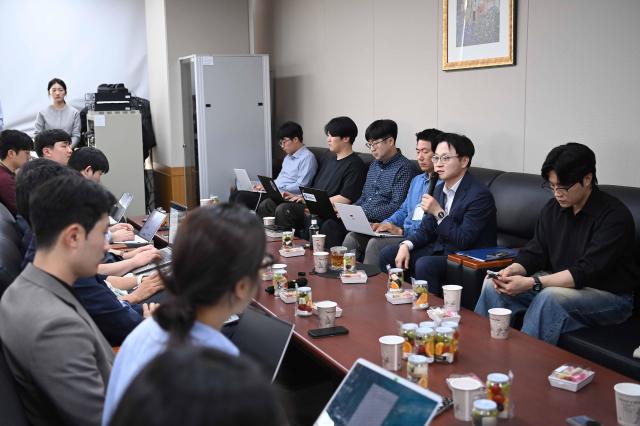
“The semiconductor industry is the only industry in our country that is still maintaining competitiveness, and the gap is steadily narrowing,” Kim told reporters at the Government Complex Sejong. “Since workers clearly have a share, I urge both sides to fully consider the various conditions and come to a mature conclusion.”
Kim said he still could not imagine a strike. He said the company should weigh how to balance sharing current profits with maintaining future competitiveness.
Samsung Electronics’ union is demanding the abolition of a cap on performance bonuses set at 50% of annual salary and wants 15% of total operating profit distributed as performance pay. The union has said it will launch a general strike from May 21 to June 7 if no agreement is reached.
Kim said Samsung’s performance should not be viewed as the result only of executives and workers. He pointed to the broader semiconductor ecosystem, including many partner companies, infrastructure, shareholders and the National Pension Service, saying local and national communities are also tied to it.
He added that with large-scale investment unavoidable, both sides should consider how much profit can be enjoyed and recognize how big an impact a strike could have across the industry.
On the maximum price system for oil products in effect since last month, Kim called it an unsatisfying policy but an unavoidable step in an emergency. He said the government plans to end it as early as possible once the war ends or international oil prices stabilize.
Kim compared the situation to closing windows in summer heat or opening them and letting mosquitoes in, saying government action on prices is not desirable but was unavoidable due to the unprecedented Middle East war.
On when the system could end, he said the government would consider the course of the Middle East war, conditions around the Strait of Hormuz, and discussions on a post-settlement system and exclusive supply contracts. He said differing interests between refiners and gas stations would also be weighed.
On delayed restructuring of the petrochemical sector in Ulsan amid the Middle East war and other factors, Kim said he believes it can proceed autonomously even without government intervention. He said talks have slowed due to supply-chain issues but are expected to pick up soon.
On a first project for investment in the United States, Kim said discussions are ongoing and it is difficult to predict the timing.
* This article has been translated by AI.
Copyright ⓒ Aju Press All rights reserved.