

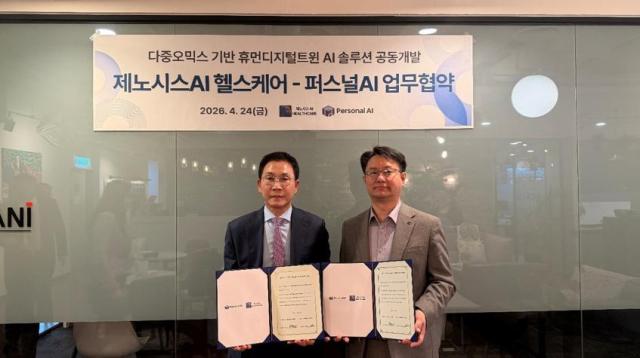
GenosisAI Healthcare Co., led by CEO Lee Hee-won, said it signed the partnership agreement with Personal AI on the 23rd.
The deal centers on combining Genosis’ third-generation Human Digital Twin (HDT)-based medical data and platform technology with Personal AI’s on-device AI, federated learning and its personal data-sovereignty platform, my:D. The companies said they will jointly develop a platform that lets patients manage their own medical data while using AI-driven precision medicine services.
Genosis said it holds clinical data on 200,000 people, including data related to NK cells, stem cells, genomes and cancer immunotherapy. It is developing disease prediction and personalized health management services by applying HDT technology that analyzes individual genomic information and multi-omics data.
Personal AI said its on-device AI stores personal data on users’ devices rather than a central server, and its federated learning trains AI models without directly transferring data outside. It has also developed my:D, designed to let individuals control and use their own data.
The companies said the collaboration aims to secure both data security and usability. They said they plan to build a platform that can respond to global privacy and medical data regulations, including GDPR and HIPAA, by combining Genosis’ medical and clinical data with Personal AI’s data-protection technology.
As a first step, they plan to build an integrated architecture linking Personal AI’s my:D with Genosis’ Genosis OS. Under the approach, original medical data would not be directly moved off users’ devices; instead, encrypted queries and results would be used. Genosis said it plans to apply its “federated learning and differential privacy-based distributed medical data learning system” technology to the platform.
The companies also plan to connect health “my data,” collecting and linking health checkups, prescriptions and medical records to analyze individual health histories, then connecting genomic data with the HDT layer. They said they plan to build a data pipeline that can also link to Genosis’ health supplement recommendation service.
In federated learning, they plan to combine Personal AI’s SNP FL-STUDIO with Genosis’ HDT technology. They said they will verify a method that uses data from MSO-affiliated hospitals and overseas partner hospitals for AI training while keeping the data inside each institution.
They also said they will consider a data-economy model in which, if a patient agrees to data transactions, part of the related revenue would go to the patient. The companies said they aim to establish a system for using high-quality medical data by combining Genosis’ clinical data with Personal AI’s data distribution pipeline.
Customized health supplement commerce is another area of cooperation. The companies said they plan to build a service within the my:D app that runs from product recommendations and purchases to tracking effects, based on Genosis’ gene-based customized health supplement and nutritional supplement manufacturing technology. They said they will also consider analyzing changes in health indicators on the HDT platform to improve recommendation accuracy.
They said they also plan to build a global medical AI federated network. The companies said they will gradually expand a federated learning cluster that uses data from overseas partner hospitals — including in Japan, Dubai, Africa and Mongolia — for AI training without transferring the data outside each region. They said they aim to build a global clinical data federation covering 1 million people in 2027.
The companies outlined a timeline: starting in the second quarter of 2026, they plan to begin pilot hospital linkage verification, then pursue expansion across the full MSO in the third and fourth quarters of 2026. From 2027, they plan to expand the global federated learning cluster centered on overseas partner hospitals, including in Japan, Dubai and Africa.
Lee said, “GenosisAI Healthcare’s 200,000-person clinical dataset accumulated over five years and its third-generation HDT technology are completed as a true global precision medicine service only when they meet Personal AI’s data sovereignty platform.” He added, “Patients owning their data while receiving the best medical care — that is the future of medicine we will build together.”
Personal AI said, “Personal AI’s on-device AI and federated learning technologies were designed to solve the issue of medical data sovereignty.” It added, “Combined with Genosis’ world-class clinical capabilities, this will be a turning point for the my:D platform, introduced at CES 2026, to establish itself as a core part of global AI precision medicine infrastructure.”
* This article has been translated by AI.
Copyright ⓒ Aju Press All rights reserved.