

That raises an obvious question: Has Washington suddenly become more generous? Why would an administration that has championed "America First" intervene in a way that also supports South Korea, China and the rest of Asia?
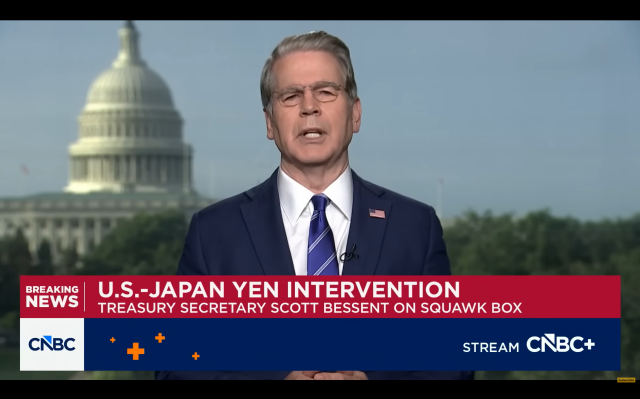
U.S. Treasury Secretary Scott Bessent's explanation suggests the answer is no.
Supporting the yen is not an act of generosity but one of self-interest. Washington believes a sharply weaker yen would trigger competitive devaluations across Asia, undermine U.S. exporters and ultimately threaten global financial stability. In that sense, helping Japan also helps America.
"If the yen were to weaken substantially, then the other currencies would follow it," Bessent told CNBC. "That could trigger competitive devaluations, which is unhealthy."
Until June, the yen and won have been trading at multi-decades lows.
Washington sees the yen as a regional anchor and believes a sharp depreciation in the Japanese currency could drag down the Korean won, Chinese yuan and other Asian currencies, undermining U.S. exporters while raising the risk of broader financial instability.
Bessent went further, arguing that an excessively weak yen had contributed to the 1997-98 Asian financial crisis.
"The Asian financial crisis, in my opinion, part of it was triggered by an overly weak yen," he said. "A stable yen is not only important for the U.S., but it's very important for the entire region."
In effect, Washington is arguing that supporting one ally's currency is the best way to stabilize Asia's broader foreign-exchange complex.
He said intervention buys Japan time to implement policies that can support the currency over the longer term.
"We can give market signals, but at the end of the day, it's going to be policy and fundamentals," Bessent said. "The U.S. decided to join because we are very optimistic on their policy path."
Asked whether Washington was prepared to intervene again, Bessent replied that the United States would do "whatever it takes" to support Japan "in a way that helps the American economy, the American taxpayer, and stabilizes the global economy."
The remarks sit somewhat uneasily with the Trump administration's broader "America First" agenda, which has generally emphasized U.S. interests over regional coordination. Yet in the currency market, Washington appears to have concluded that stabilizing the yen ultimately serves American interests as well.
For Seoul, the outcome has been welcome, regardless of Washington's motivation.
The dollar-won exchange rate fell 141 won last month, from 1,559 won to 1,418 won, according to KB Kookmin Bank, before trading around 1,423 won on Wednesday afternoon in Seoul.
The won, which ended June at 1,549.4 per dollar—nearly 8 percent weaker than six months earlier—had recovered to trade about 0.5 percent stronger for the year as of Aug. 4.
The yen, which had fallen 3.47 percent from the end of 2025 to 162.15 per dollar by June 30, recovered following the intervention but remained 0.65 percent weaker than its year-end level at 157.73 as of Aug. 4.
South Korean authorities have not confirmed intervention.
But Reuters, citing market participants and analysts, reported that South Korea and Japan each bought their own currencies on July 30, when the won strengthened about 2 percent to its strongest level in nine months.
Japan returned to the market the following day in a coordinated operation with the United States, with the U.S. Treasury selling euros to purchase yen, although Washington has not disclosed the size of its transaction.
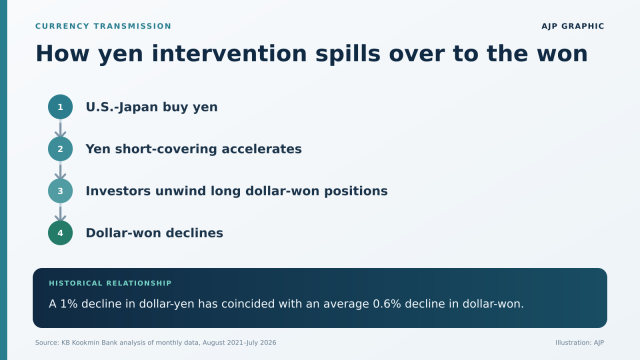
KB Kookmin Bank found that a 1 percent decline in the dollar-yen exchange rate has historically been accompanied by an average 0.6 percent decline in dollar-won, based on monthly data between August 2021 and July 2026.
The bank said further intervention could trigger additional short-covering in the yen, forcing investors to unwind long dollar-won positions as well.
Global investors frequently use the Korean won to express broader views on Asia and China because it trades more freely than many regional currencies.
When investors are forced to cover bearish bets against the yen, those position adjustments often spill over into the won as well.
Still, analysts caution against attributing the Korean currency's entire appreciation to intervention alone.
The latest rally has also been supported by corporate dollar repatriation, broader weakness in the U.S. dollar and lower oil prices, all of which have improved South Korea's external balance.
Another factor drawing market attention is Washington's proposal to expand the Federal Reserve's Foreign and International Monetary Authorities Repo Facility, or FIMA.
The facility allows foreign central banks to obtain short-term dollar funding against U.S. Treasury holdings instead of selling those securities outright, potentially enabling Japan to finance yen purchases while preserving its roughly $1.14 trillion Treasury portfolio.
Bessent has urged the Federal Reserve to consider raising FIMA's $60 billion limit, arguing that the Treasury market has expanded substantially since the program was introduced in 2020.
Daleep Singh, chief global economist at PGIM, described a larger facility as positive for Treasury-market stability but "a shock absorber, not a cure," while Evercore ISI warned that any cap could eventually encourage markets to test Washington's commitment.
For South Korea, however, FIMA matters less because Seoul is expected to use the facility than because it could spare the won from bearing one-way regional selling pressure without U.S. support for the yen.
The Bank of Korea reported Wednesday that foreign exchange reserves rose to $427.95 billion at the end of July, up $590 million from the previous month.
The increase reflected foreign-currency stabilization bond issuance, investment income, valuation gains on non-dollar assets and foreign-exchange swaps with the National Pension Service, meaning the figure does not directly measure recent intervention capacity.
Dominic Bunning, head of G10 foreign-exchange strategy at Nomura, said Japan was no longer confronting markets alone with U.S. backing, while MUFG strategist Lee Hardman said recent rate checks by the New York Fed had heightened expectations of further action.
Even so, Bunning cautioned that the current arrangement remained closer to tacit U.S. support than the fully coordinated intervention mounted after Japan's 2011 earthquake.
KB Kookmin Bank estimates the dollar-won's fair value at around 1,417 based on the dollar index, the Korea-U.S. interest-rate differential and structural foreign-exchange supply and demand.
Position adjustments could temporarily push the exchange rate toward 1,390, the bank said, while stronger-than-expected U.S. economic data and renewed Federal Reserve tightening expectations could instead send it back toward 1,450.
Atsushi Takeuchi, a former Bank of Japan official who participated in past interventions, said Washington and Tokyo would probably act again if the yen resumed its slide. But he warned that intervention alone could not deliver lasting appreciation without tighter Japanese monetary policy and reduced expectations for fiscal expansion.
Whether this rare "prosper-thy-neighbor" approach marks a lasting shift in regional currency management remains uncertain. A sustained break below 1,400 won per dollar will ultimately depend less on intervention than on stronger Japanese policy fundamentals, continued U.S. backing and healthy dollar inflows into South Korea.
AJP Key Takeaways
• The U.S.-Japan yen intervention is providing the Korean won with an indirect backstop by reducing depreciation pressure across Asian currencies.
• Because the won closely tracks the yen, coordinated support for Japan's currency could keep downward pressure on the dollar-won exchange rate.
• A durable move below 1,400 won per dollar, however, will require stronger policy fundamentals rather than intervention alone.

Copyright ⓒ Aju Press All rights reserved.
