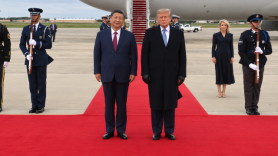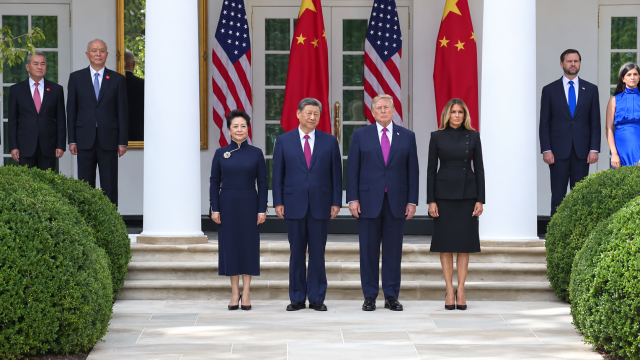
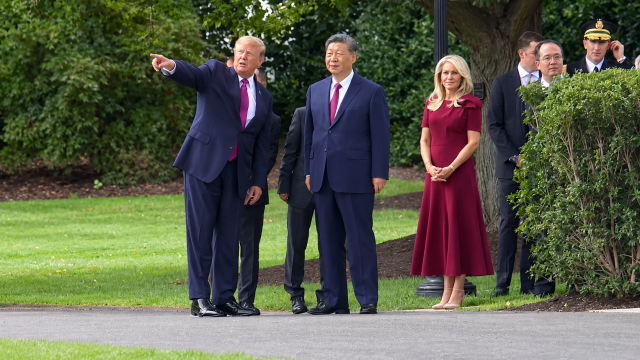
President Donald Trump and first lady Melania Trump greeted Xi and his wife Peng Liyuan with a red carpet, military honors and a fighter-jet flyover before talks and a state dinner, Xi's first White House visit in more than a decade. The White House said the dinner would include government officials and business leaders and evoke Richard Nixon's 1972 opening to China.
Xi came bearing a highly symbolic gesture instead of a large commercial package: two giant pandas, Ping Ping and Fu Shuang, will be sent to Zoo Atlanta, he announced during his arrival remarks. He also invited 100,000 young Americans to visit China over the next five years.
The economic side was notably restrained.
The most concrete trade development had largely been arranged before the summit: an extension of the two countries' tariff truce, while negotiators continue trying to reach a broader agreement. Chinese and U.S. accounts both referred to progress in recent economic and trade consultations, but neither side immediately unveiled a sweeping new accord.
Xi instead used the meeting to reiterate Beijing's core political demand over Taiwan.
China's official Xinhua account prominently reported Xi telling Trump that Washington should maintain what Beijing called the “correct position” of opposing Taiwan independence and handle the issue cautiously. Xi said China's position on national reunification and territorial integrity was unequivocal.
The Chinese readout appeared before the two governments issued a detailed joint account and gave Taiwan a prominent place among Beijing's public messages from the summit.
Trump gave no comparable public commitment on Taiwan. Asked after the meeting about the issue, he described the talks as a “great meeting” without detailing what had been agreed, according to reports included in the summit material.
The leaders also discussed artificial intelligence, Iran, Ukraine and the Korean Peninsula. Xi called for U.S.-China dialogue and cooperation on AI while urging a negotiated resolution to the Iran conflict. The two sides agreed to support each other's hosting of upcoming APEC and G20 meetings.
The contrast between presentation and outcome was hard to miss.
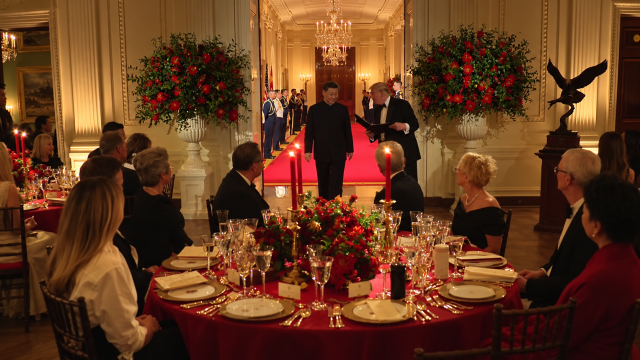
Yet beneath the ceremony, the central disagreements remained largely intact: Taiwan, China's ties with Iran, strategic competition in AI and unresolved trade disputes.
For Beijing, the summit offered Xi a White House stage to restate China's red lines while portraying bilateral ties as stable and cooperative. For Trump, it showcased a restored leader-to-leader channel and the prospect of continued negotiation without an immediate confrontation.
The pandas may prove the most tangible new arrivals from the summit for now.
AJP Takeaways
- The summit delivered more optics than hard outcomes.
- Trump rolled out full state-visit pageantry, but there was no headline commercial breakthrough and no sign of a major reset in the core disputes.
- Beijing used the visit to reinforce political messaging, especially on Taiwan.
- The business angle was notably thin. The absence of a Chinese business delegation underscored muted expectations for commercial deliverables, leaving the clearest outcome as continued dialogue and a temporary trade-truce extension rather than new economic concessions.
Copyright ⓒ Aju Press All rights reserved.