

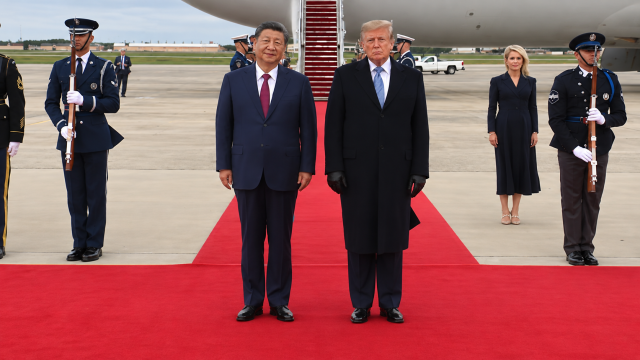
SEOUL, September 24 (AJP) -U.S. President Donald Trump rolled out a rare red-carpet welcome for Chinese President Xi Jinping on Wednesday as Beijing reciprocated with conciliatory language and the two sides extended their trade truce by two months, setting a cordial opening to a three-day state visit carrying a crowded agenda from trade and artificial intelligence to Taiwan and Iran.
Trump and first lady Melania Trump flew by Marine One to Joint Base Andrews outside Washington to personally greet Xi and his wife, Peng Liyuan, when their Air China aircraft arrived.
Trump's helicopter landed at 4:54 p.m., while Xi's plane touched down at 5:39 p.m., leaving the U.S. president waiting at the base for more than an hour before the Chinese leader emerged from the aircraft. The couples shook hands at the foot of the stairs before walking a red carpet lined by a U.S. military honor guard.
A military band played the two national anthems as ceremonial guns fired and two B-1 bombers roared overhead. Trump and Xi smiled and spoke repeatedly during the roughly 10-minute ceremony, while Melania Trump and Peng also chatted as they walked behind their husbands.
The welcome represented an unusual break with U.S. protocol. Reuters reported that it was the first time in 11 years that a U.S. president had personally welcomed a foreign leader at Joint Base Andrews, after then-President Barack Obama greeted Pope Francis there in 2015.
Xi, making his first U.S. state visit since 2015, reciprocated conciliatory tone.
China and the United States should be “partners, not rivals,” Xi said in written remarks after arriving in Washington, according to China's state-run Xinhua News Agency. He said cooperation between the two countries could make the visit productive.
The message echoed the language Xi used when Trump visited Beijing four months ago. At a state banquet in May, Xi said the “great rejuvenation of the Chinese nation” and Trump's “Make America Great Again” agenda could “go hand in hand,” arguing that the two countries could help each other succeed.
The political warmth was accompanied by a tangible economic gesture before Thursday's summit.
U.S. Treasury Secretary Scott Bessent said Washington and Beijing agreed Wednesday to extend their so-called Busan Agreement, a trade truce due to expire Nov. 10, until Jan. 10, 2027.
Bessent reached the agreement after meeting Chinese Vice Premier He Lifeng at the World Bank in Washington as officials made final preparations for the Trump-Xi talks.
“We will extend what we call the ‘Busan Agreement,’” Bessent told Fox News, saying the additional two months would give the two sides more time to determine whether a broader economic agreement could be reached. He cautioned that it remained unclear whether they could produce a bigger deal or would ultimately roll over the existing arrangement.
Trump and Xi struck the original truce on the sidelines of the Asia-Pacific Economic Cooperation summit in Busan last October, pausing an escalating trade conflict in which retaliatory tariffs had topped 100 percent and restrictions on critical minerals and advanced technology threatened global supply chains.
The extension removes an immediate Nov. 10 deadline but leaves many of the hardest disputes unresolved.
The closely-watched summit is expected to cover China's rare-earth export controls, U.S. restrictions on advanced technology, agricultural purchases and aircraft sales as well as fentanyl trafficking. Taiwan remains among the most sensitive political issues, while Washington is also expected to raise Beijing's economic ties with Iran.
Artificial intelligence has also emerged as a new area of both rivalry and possible dialogue. Bessent and He discussed establishing a U.S.-China channel for AI-related concerns during preparatory talks, while officials have explored ways to prevent dangerous AI incidents from escalating into broader security crises.
Asked after returning to the White House whether Iran would come up in his talks with Xi, Trump said it would.
“I'll be talking about that and many other subjects,” Trump said, adding that the issue was among a wide range of matters the two leaders would discuss.
The ceremonial treatment will continue Thursday with a formal White House arrival ceremony, summit talks and a state dinner. Apple CEO Tim Cook, Nvidia CEO Jensen Huang and OpenAI CEO Sam Altman are among technology executives expected to attend the dinner.
Xi's visit runs through Friday, when the two presidential couples are scheduled to have tea at the White House and visit the National Archives.
The meeting is the second Trump-Xi summit in four months following Trump's May state visit to Beijing.
AJP Takeaways:
- Rare personal welcome sets warmer tone: Trump personally greeted Xi at Joint Base Andrews, an unusually high-level gesture as the Chinese leader began a three-day state visit. Xi reciprocated by saying China and the U.S. should be “partners, not rivals.”
- Trade truce buys two more months: Washington and Beijing agreed to extend their Busan trade agreement from Nov. 10 to Jan. 10, 2027, giving negotiators additional time to explore a broader economic deal without immediately reviving suspended trade restrictions.
- Warm optics precede a difficult agenda: Thursday’s White House summit comes with major differences still unresolved over trade, technology and AI, Taiwan and geopolitical issues including Iran. The extended truce provides breathing room but does not itself settle those disputes.
Copyright ⓒ Aju Press All rights reserved.
