
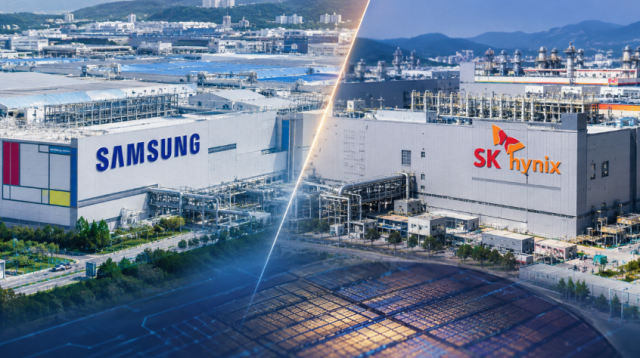
SEOUL, November 17 (AJP) - South Korea’s two biggest memory chipmakers are running their production lines at full utilization as the AI boom drives up prices, with Samsung Electronics reporting a 270 percent increase in average memory selling prices and SK hynix turning to long-term agreements to underpin future sales.
Quarterly regulatory disclosures show how spending on artificial intelligence is reshaping the memory industry, fueling production and investment even as questions persist over the durability of global AI infrastructure demand.
Samsung and SK hynix both reported 100 percent utilization at their memory production facilities during the first nine months of 2026. But that does not mean they have exhausted their ability to bolster output: utilization based on operating hours does not necessarily translate into maximum physical production.
Samsung said its average memory selling price in the third quarter was about 3.7 times its 2025 annual average, an increase of approximately 270 percent.
SK hynix reported that average DRAM selling prices rose by a percentage in the high 20s from the preceding quarter, while NAND flash prices increased by a percentage in the mid-20s.
The figures use different benchmarks. Samsung compared prices with last year’s annual average, while SK hynix measured changes from the preceding quarter.
Samsung benefited from surging demand for high-bandwidth memory (HBM), alongside conventional server DRAM and solid-state drives used in AI data centers.
Its share of the global DRAM market reached an estimated 38.3 percent in the third quarter, up from 34.0 percent in 2025, according to figures in its filing based on DRAMeXchange data. The increase points to a recovery in Samsung’s broader DRAM position after last year’s loss of market share, although it does not establish the company’s standing in HBM alone.
For SK hynix, longer-term customer commitments are becoming an increasingly important part of the business.
The company disclosed that it and its overseas subsidiaries had entered into long-term memory supply agreements with major customers. It withheld their total value and duration, citing commercial confidentiality and the possibility of changes in market conditions.
In its October earnings announcement, SK hynix said agreements with 14 major customers, including cloud service providers, covered more than half of its total production capacity for 2027 and 2028.
Samsung has also identified multi-year supply agreements as a priority as it expands sales of HBM, server DRAM and enterprise storage products.
Such commitments could give manufacturers a clearer view of future demand as they pour money into facilities that take years to complete.
Samsung invested 52.75 trillion won in its Device Solutions (DS) division during the first nine months of 2026, primarily to expand and upgrade advanced semiconductor manufacturing capacity.
SK hynix reported 31.22 trillion won in acquisitions of property, plant and equipment over the same period. It also disclosed approximately 42.7 trillion won in outstanding commitments for future asset purchases as of the end of September.
The figures cover different accounting and reporting categories and should not be treated as directly comparable measures of capital expenditure. Together, however, they illustrate the scale of the financial commitments being made to meet AI-driven demand.
Samsung’s filings also show how the same memory boom is squeezing manufacturers that buy those chips — including another division of Samsung itself.
The average price of mobile memory purchased by its Device eXperience (DX) division climbed about 263 percent from the 2025 annual average. The division, which makes smartphones, televisions and home appliances, spent approximately 7.7 trillion won on externally sourced mobile memory during the first nine months.
Samsung’s average smartphone selling price rose about 13 percent against the same benchmark, far less than the increase in mobile memory costs. The figures do not by themselves establish the effect on smartphone margins, but they show the disparity between increases in component costs and finished-product prices.
For Samsung, the boom is working on both sides of the ledger: lifting memory selling prices while raising costs for its consumer electronics business.
For both chipmakers, the longer-term test is whether customers’ AI investment plans translate into sustained demand as new production capacity comes on stream. Long-term supply agreements offer greater visibility, but the spending commitments extend well beyond the current price surge.

Candice Kim
Candice Kim is a dedicated business and technology reporter specializing in the intersection of high-tech innovation and fast-paced consumer trends. Her core beats span the semiconductor, IT, cosmetics, and retail sectors, where she provides in-depth coverage of industry titans including Samsung Electronics, SK hynix, and LG Electronics, alongside leading consumer brands like Olive Young and Musinsa. Whether analyzing complex silicon supply chains or tracking the latest shifts in beauty and fashion retail, Candice is committed to delivering sharp, accurate reporting that keeps readers informed on the forces shaping today's most dynamic markets.
Copyright ⓒ Aju Press All rights reserved.
Related News
-
 Gwangju's military airport relocation budget for next year has increased by 100 billion won. The government's plan to disperse the functions of the Gwangju base to other regions by mid-2028 for the Honam semiconductor cluster is expected to gain momentum. On November 16, the National Assembly Defense Committee approved a revised budget proposal for the Ministry of National Defense, increasing the budget for the temporary deployment support project at Gwangju military airport to 103.124 billion won. Some of the funds originally scheduled for 2028 have been reallocated to next year. As a result, the budget for the temporary deployment related to Gwangju military airport has risen from the government's initial proposal of 316.915 billion won to 420.039 billion won. According to the National Assembly Budget Office, the total project cost for the temporary deployment is 669.258 billion won. If confirmed as per the Defense Committee's review, next year's allocation will exceed 60% of the total project cost. This increase focuses more on adjusting the timing of fund allocation rather than raising the total project cost. The temporary deployment involves distributing the aircraft and training functions of the Gwangju 1st Fighter Wing, along with military equipment and personnel, to Yecheon in North Gyeongsang Province, Seosan in South Chungcheong Province, and Chungwon base in North Chungcheong Province. Military authorities plan to vacate the Gwangju base before the new military airport in Muan is completed. Conversely, the budget for facility projects within the Gwangju base, amounting to over 15.4 billion won, has been reduced. Concerns were raised that continued investment in housing for officers and equipment supply facilities would diminish their utility after relocation. Minister of National Defense Kang Shin-cheol also stated on November 9 that it is necessary to halt unnecessary construction projects within the Gwangju base. The early relocation of Gwangju military airport is a key prerequisite for establishing the Honam semiconductor cluster. The government has designated the planned relocation site for Gwangju military airport and ammunition depot as a candidate site for a semiconductor national industrial complex, promoting the construction of production facilities for Samsung Electronics and SK Hynix. The new military airport in Muan is scheduled to begin construction in 2028 and be completed by the end of 2032, but the functions of the existing base are set to be dispersed by mid-2028 to facilitate the start of semiconductor factory construction. The budget increase approved by the Defense Committee will be finalized after review by the National Assembly's Special Committee on Budget and Accounts and the plenary session.* This article has been translated by AI.
-
GS Construction to Launch AI Home System Tailored to Residents' Lifestyles
GS Construction will introduce a housing system that automatically adjusts lighting, temperature, and ventilation based on residents' lifestyles, starting with properties to be sold in the second half of next year. The company is also developing technology to adapt internal spaces to changes in family composition and to respond to extreme heat and heavy rainfall. On November 16, GS Construction held the Xi future strategy presentation 'RE:EVOLVE' at the Westin Seoul Parnas in Samsung-dong, where it unveiled its long-term housing vision 'BEYOND LIVING.' This vision is a culmination of a customer experience-focused brand strategy that has been in development for about two years since the Xi brand was revamped in November 2024 after 22 years. GS Construction has been pursuing the development of future housing products based on the belief that the roles and functions of living spaces must evolve in response to demographic and social changes, technological advancements, and climate change. The core products unveiled include: 1) 'AI Home,' which understands residents' lifestyles and operates autonomously; 2) 'IX Platform,' which allows flexible changes to spaces according to life stages; and 3) 'Clima System,' which responds to climate change. The AI Home, co-developed with LG Electronics, is a residential solution that integrates appliances, Internet of Things (IoT) devices, housing facilities, and lifestyle services into a single interface based on generative AI. Residents can access services inside and outside the home through voice or chat, while non-identifiable sensors installed in ceiling lighting detect occupancy and other conditions. GS Construction has also established a 'Living Home Automation Level System (LHA)' that categorizes the development stages of smart home technology from level 0 to level 5. Currently, the company is working on implementing level 3 'Situation Awareness Automation,' which uses real-time data to understand residents' situations and automatically execute necessary functions. The AI Home is planned to be gradually introduced starting from properties sold in the second half of 2027. In July, GS Construction and LG Electronics signed a business agreement for the joint development of the next-generation AI Home. The two companies plan to develop a system that connects LG's AI Home hub 'ThinQ ON' and appliances and IoT devices to the Xi community infrastructure. This system aims to integrate not only lighting, heating, and ventilation within homes but also services such as elevator calls, parking location checks, and community facility reservations. GS Construction also unveiled the 'IX Platform,' which allows for changes in the internal structure of homes according to family composition and lifestyle changes. This platform is based on smart prefabrication technology, where structural components are pre-manufactured in a factory and then assembled on-site, reducing structural constraints within units and enhancing space utilization. Key technologies for implementing the platform include the 'IX Slab,' which is lighter than conventional slabs but allows for longer spans, and the 'IX Wall,' a flexible space product that changes the use of space. The company also introduced the 'IX Switch Air,' a power-free switch that operates without electricity or batteries, and the next-generation lighting 'IX Lighting,' designed to reproduce over 95% of natural light. The 'Clima System' was also presented as a future housing product to address climate change. Through the future housing products unveiled, GS Construction aims to enhance the value of apartments not only based on facilities and marketability at the time of occupancy but also on the quality of life experienced during residence. A GS Construction official stated, “This future housing vision redefines the role and value of homes to align with diverse lifestyles and changing living environments. Xi will always prioritize the lives of our customers and create new housing standards that provide better experiences as lifestyles and life cycles evolve.”* This article has been translated by AI.
-
U.S. AI Regulations Weigh on Samsung Electronics and SK Hynix Stocks
Samsung Electronics and SK Hynix, major players in South Korea's semiconductor industry, are experiencing declines in stock prices for the second consecutive day on November 17. This downturn is attributed to a combination of factors, including heightened U.S. regulations on AI semiconductors targeting China, uncertainties surrounding Nvidia's management, and a lawsuit regarding alleged DRAM price collusion, which has dampened investor sentiment.According to the Korea Exchange, as of 9:11 a.m. on November 17, Samsung Electronics shares were trading at 193,000 won, down 3,800 won (1.93%) from the previous trading day. SK Hynix also saw a decrease of 5,000 won (0.45%), bringing its stock price to 1,115,000 won.Samsung Electronics' preferred shares fell by 4,850 won (3.01%) to 156,450 won. SK Square, the largest shareholder of SK Hynix, reported a decline of 8,000 won (1.16%), trading at 680,000 won.These stocks had already experienced significant drops the previous day. On November 16, Samsung Electronics closed down 4.47% at 196,800 won, while SK Hynix fell 7.89% to 1,120,000 won. Samsung Electronics' preferred shares and SK Square also dropped by 5.40% and 9.71%, respectively.The uncertainty surrounding the U.S. AI industry appears to be exacerbating the weakness in domestic semiconductor stocks. On November 16, the U.S. Department of Commerce's Bureau of Industry and Security (BIS) announced new regulations aimed at blocking companies in countries subject to export controls, including China, from remotely accessing the computing power of U.S.-made advanced AI semiconductors through third-party data centers.Uncertainties regarding Nvidia's management continue to persist. Following the resignation of CEO Jensen Huang on November 11, speculation about his potential return has been ongoing. Reports that Nvidia's board is not considering Huang's return have heightened market anxiety.Concerns have also been raised about the production schedule for Nvidia's next-generation AI platform, Vera Rubin. The semiconductor industry has speculated that issues related to printed circuit boards (PCBs) could delay mass shipments. However, Nvidia has not officially confirmed any production delays.Additionally, a class-action lawsuit in the U.S. targeting domestic memory semiconductor companies adds to the pressure. On November 14, the U.S. District Court for the Northern District of California dismissed a motion to dismiss the class-action lawsuit alleging price collusion involving Samsung Electronics, SK Hynix, and Micron. The plaintiffs claim that these companies artificially limited supply by reducing DRAM production and shifting capacity to high-bandwidth memory (HBM), thereby driving up prices. However, this decision allows the lawsuit to proceed, and collusion has not yet been established.Warnings from the U.S. Federal Reserve regarding overheating in AI investments are also putting pressure on investor sentiment. In a financial stability report released on November 13, the Fed identified high valuations of AI-related stocks and increasing debt from investments in data centers as risk factors. Michael Barr, a Fed official, warned in a speech on November 16 that if AI investment returns do not meet expectations, asset price reevaluations and financial market instability could increase.Amid these challenges, the Nasdaq index, which is heavily weighted with tech stocks, fell 2.49% on November 16, while the Philadelphia Semiconductor Index dropped 5.28%. Major semiconductor stocks, including Nvidia and Micron, also saw declines of approximately 4.1% and 7.6%, respectively.* This article has been translated by AI.