

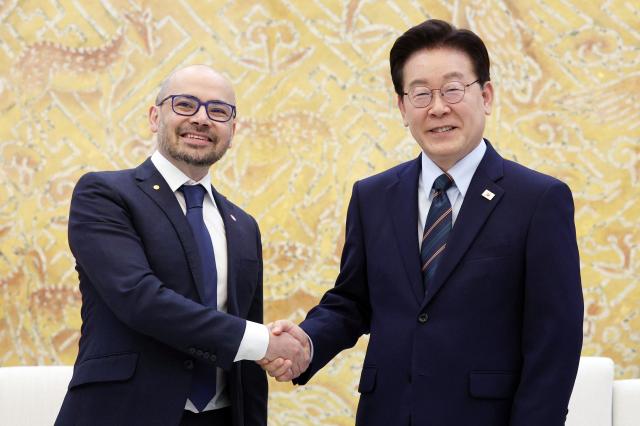
Cheong Wa Dae said President Lee Jae-myung met Demis Hassabis, Google DeepMind’s co-founder and CEO, to discuss ways to cooperate in artificial intelligence.
The meeting was arranged as part of the government’s push to broaden global AI cooperation. Since taking office, Lee has met with OpenAI CEO Sam Altman, Nvidia CEO Jensen Huang and SoftBank Group Chairman Son Jeong-ui to discuss AI partnerships, the office said.
The government also said it helped lead adoption of an “AI initiative” at last year’s APEC meeting in Gyeongju and is working with international organizations including the World Health Organization, the U.N. Development Programme and the International Telecommunication Union to establish a “global AI hub” in South Korea.
During the meeting at Cheong Wa Dae, Lee said he has strong interest in AI and that the country is investing heavily, but questioned whether AI will be used “only in a direction that helps improve human welfare” or could move toward “attacks on humans” or harming peace.
Hassabis said Lee had raised an important issue and said AI should be actively used to advance science and in medical fields. If used properly, he said, it could bring major benefits to people worldwide.
Hassabis led DeepMind’s work on the 2016 Go match between Lee Sedol and the AI program AlphaGo. He also developed AlphaFold, an AI model for predicting protein structures, and won the Nobel Prize in Chemistry two years ago.
Hassabis said AlphaGo helped validate the technology and became a starting point for tackling harder problems. He said the lessons were expanded into science and medicine, citing AlphaFold as a key example that helped researchers understand diseases in greater detail.
Lee, referring to Google’s generative AI service Gemini, said he uses it often but that it sometimes does things he did not ask for, and asked whether it was a kind of bug.
Hassabis said foundation models can veer in a different direction if guidance is not precise, and said “guardrails” must be built in when using and developing AI. He said as AI becomes more powerful, it will gain autonomy as “agent AI,” and that strong safety controls will be essential if the era of artificial general intelligence, or AGI, arrives.
After the meeting, Policy Office Chief Kim Yong-beom told a briefing that the two held an in-depth discussion on rapid advances in AI, where the technology is headed and ways to strengthen global cooperation on responsible AI.
Kim said Hassabis predicted that within five years — as early as 2030 — AGI capable of exercising all human cognitive abilities could become visible.
Lee and Hassabis also exchanged views on job changes and distribution issues driven by AI, Kim said. Lee raised the need to prepare for unemployment and job disruption, while Hassabis said the impact is hard to predict and argued for a new economic model that rethinks the definition of work and redistribution of wealth.
Kim said Lee asked whether now is the time for a basic income, noting he had discussed it for more than 20 years, and that Hassabis responded in a way that indicated agreement on the need. Kim said Hassabis also mentioned ideas such as the state providing housing, education, transportation and health services while incorporating capital-market principles, and linking gains from robot-driven productivity to support for workers.
Kim said the government will pursue practical cooperation with DeepMind. He said Lee asked DeepMind to join as a key partner in efforts to establish a global AI hub through cooperation among the government, international organizations and companies so that everyone can share the benefits of AI advances.
Kim said Google will also actively consider sending researchers to South Korea along with the AI campus. He said the government requested at least about 10 researchers and that Google agreed on the spot.
Kim described the Seoul AI campus as a space where South Korea’s top scientists can freely use Google’s latest models for joint research, and where Korean researchers and Google researchers can conduct reciprocal work, including internships and hiring.
Kim said the meeting was “completely unrelated” to issues involving Google Maps.
Ahead of the meeting, Hassabis prepared a gift commemorating the AlphaGo match with Lee Sedol, presenting Lee with a Go board signed by both Hassabis and Lee Sedol.
At the end of the meeting, Lee said he hoped that just as the AlphaGo match 10 years ago opened the AI era together with South Korea, they would work together over the next 10 to 20 years to build “AI for everyone” and a brighter future.
Google attendees included Wilson White, vice president for global government affairs and public policy, and Yoon Koo, head of Google Korea. South Korean officials present included Science and ICT Minister Bae Kyung-hoon, Chief of Staff Kang Hoon-sik, Policy Office Chief Kim Yong-beom, Senior Secretary for AI Future Planning Ha Jung-woo, Protocol Secretary Kwon Hyuk-ki, National AI Policy Secretary Kim Woo-chang and spokesperson Jeon Eun-su.
Hassabis is also scheduled to attend the “Google for Korea 2026” event in Seoul on April 29. He is set to hold a discussion with Lee Sedol and author Cho Seung-yeon on “10 years of AlphaGo, a vision of AI for everyone.”
* This article has been translated by AI.
Copyright ⓒ Aju Press All rights reserved.