

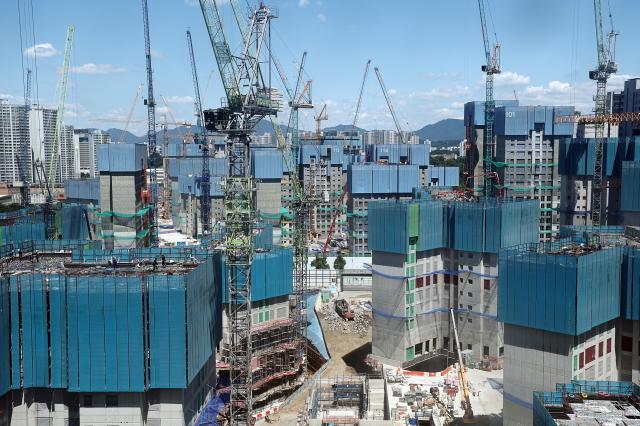
South Korea’s home subscription system, designed to support housing stability for ordinary people, has drawn criticism for enabling outsized gains that have fueled the nickname “lottery subscriptions.” Politicians are now moving to create a mechanism to recoup some of those profits.
According to the industry on the 26th, Democratic Party lawmaker Ahn Tae-jun, a member of the National Assembly’s Land, Infrastructure and Transport Committee, introduced a revision to the Housing Act that would require buyers of private homes in areas covered by the housing price cap system to purchase National Housing Bonds through a mandatory bidding scheme.
The proposal would require winners of price-capped projects to buy the bonds, allowing the public sector to reclaim part of the market premium. The bill also includes a safeguard: when the capped sale price for a private unit is 100% or less of nearby market prices, the maximum bond amount would be set below that level, limiting the additional recouped gains to the surrounding market price range.
The idea has resurfaced as controversy has grown that price-capped projects have become a tool for excessive windfalls rather than serving their original purpose. The debate accelerated after President Lee Jae-myung said at a Cabinet meeting in June last year that “lottery sales” create a large gap with actual market prices because of the cap, and that the gap can drive up nearby home prices.
The housing bond bidding system was used more than 20 years ago but was later scrapped after producing side effects. The government revived it during sales in Pangyo New Town in 2006 for mid- to large-size units over 85 square meters, citing concerns about overcrowding and demand surges. It set a ceiling so that the combined total of the sale price and losses from bond purchases would equal 90% of nearby market prices, differentiating it from the earlier version.
But after the 2008 global financial crisis sent housing prices sharply lower, the combined total of sale prices and bond losses in some cases exceeded market prices, creating a “reverse” effect. The system was abolished in 2013.
Kim Hyo-sun, a senior real estate specialist at KB Kookmin Bank, said the plan could burden even low- and middle-income households without homes by forcing additional bond purchases and could dampen subscription demand. She added that the housing price cap system was effective in the past when population growth meant most housing prices rose over time, but regional gaps have widened so much that the system is no longer effective in the long run and needs to be reworked.
Some also point to overseas models. A frequently cited example is Singapore’s leasehold approach. In Singapore public housing, the state keeps land ownership while granting individuals the right to use it for 99 years. During a visit to Singapore last month, Lee said it was a policy he had been interested in since his time as Seongnam mayor and that South Korea should learn from it.
The article notes challenges, including high housing-related taxes and the burden of deficits at public institutions. Singapore imposes an Additional Buyer’s Stamp Duty, charging a tax of up to 20% of the purchase price starting with a second home. It also places the cost of supplying public housing solely on the Housing & Development Board, and the government injects 2% of its annual budget to cover deficits.
Shared-equity housing, positioned between public rental and full ownership, has also been discussed. The United Kingdom operates programs to promote affordable ownership by recognizing split ownership for tenants, helping them transition into asset holders. In the United States, public subsidies or participation by private investors can reduce households’ purchase burdens, while resale restrictions are used to curb speculation and share gains from price increases.
Such ideas were discussed last year by the Lee administration’s state affairs planning committee under the name “equity accumulation and profit-sharing housing.”
Kim said shared-equity models have a strong public character aimed more at stabilizing residence than achieving full ownership. She added that Singapore’s housing policy succeeded because public-led supply continued, while South Korea’s housing is mostly privately owned. In areas with low home prices, she said, people may be unlikely to prefer shared equity, making it difficult to implement in practice.
* This article has been translated by AI.
Copyright ⓒ Aju Press All rights reserved.