

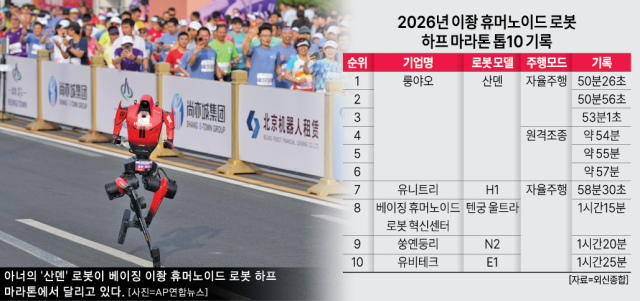
50 minutes, 26 seconds. That was the winning time at this year’s humanoid robot half marathon in Beijing’s Yizhuang area, cutting last year’s top mark of 2:40:42 to about one-third. The time also beat the human half-marathon world record of 57:20.
The winner was not last year’s champion, the Beijing Humanoid Robot Innovation Center’s “Tiangong,” nor Unitree’s “H1.” It was “Sandian,” a humanoid robot from Chinese smartphone maker Honor, competing for the first time.
Six teams entered the race using Sandian robots. Three competed in fully autonomous mode and three used remote control. All six finished and took places 1 through 6, a result seen as evidence that Sandian is more than a prototype and has demonstrated production potential, technical stability and consistent manufacturing. Chinese IT outlet eet-china called Sandian “a vanguard that symbolically shows Honor’s technological strength.”
Honor’s other humanoid robot, “Yuanqizai,” also competed and won a “best walking” award for what organizers described as the most humanlike, stable gait.
The sweep is being viewed as a milestone in Honor’s push to move beyond smartphones and position itself as an artificial intelligence device-ecosystem company.
‘HUAWEI DNA’...From smartphones to an AI ecosystem company
Finishing a 21-kilometer half marathon is difficult for humanoid robots, requiring stable walking along with battery endurance, heat management, mechanical durability, autonomous driving and algorithms.
Last year, only about 20 teams entered and just six robots finished. This year, about 100 teams competed and nearly half finished. While most entries last year were remotely controlled, about 40% chose autonomous operation this year.
The key to Honor’s first-year success, the report said, was smartphone engineering rooted in what it called “Huawei DNA.” Honor began in 2011 as a premium smartphone brand under Huawei and, during its 2020 separation from Huawei amid U.S. sanctions, absorbed many of Huawei’s core engineers and technical staff.
Honor CEO Li Jian said, “Core technologies accumulated in the mobile phone field are very helpful for robot research and development.”
One example is liquid cooling. Honor adapted its smartphone liquid-cooling technology for humanoid robots. Sandian carries a self-developed liquid-cooling unit in a backpack. Piping designed like a human capillary network runs into the motor, circulating about 4 liters of coolant per minute. The system is intended to remove heat quickly during high-speed running, prevent motor overheating and maintain stable output.
Smartphone know-how, transplanted into a humanoid robot
Power is another key factor. Sandian uses an integrated joint module capable of up to 400 newton-meters of torque, aiming to deliver strong force in compact joints while sustaining stable movement. The report said the precision miniaturization reflects know-how built from foldable smartphone hinge and internal-structure design.
Software is also central. Honor combined its motion-control algorithms with multiple sensors so the robot can recognize complex surroundings in real time and automatically adjust its center of gravity and gait. The ability to process large volumes of data quickly to control movement was described as an extension of smartphone hardware-software integration.
Sandian was designed from the outset for marathon running. It is 169 centimeters tall and weighs 45 kilograms, with legs measuring 95 centimeters, proportions the report compared to elite track athletes. Engineers removed nonessential structures to reduce weight, omitted hand joints, narrowed the arms, and used a foot design intended to minimize ground contact, reduce impact and efficiently transfer propulsion on a firm track.
Supply chain helps lower barriers, but commercialization still needs proof
China’s increasingly mature humanoid-robot supply chain has also lowered technical barriers, the report said, and open-source algorithm ecosystems have sped development. Manufacturing costs are falling quickly. According to the Gaogong Robot Industry Research Institute, the price of a humanoid robot in the first quarter was 100,000 yuan (about 21.6 million won), down 33% from a year earlier.
Honor in March last year announced its “Alpha Strategy,” declaring a shift toward an AI smart-device company with robots as a core pillar. About a year later, it has demonstrated a humanoid robot capable of finishing a half marathon.
Still, because Sandian is optimized for marathon performance, some observers said additional verification is needed before it can be used broadly across varied environments.
They said autonomous decision-making must be strengthened through repeated learning and data accumulation in real-world settings. In that respect, the report said, a gap remains with established companies such as Unitree and Galbot, which have built up long-term data across diverse scenarios.
* This article has been translated by AI.
Copyright ⓒ Aju Press All rights reserved.