

Honor’s move into humanoid robots reflects several pressures, led by a maturing smartphone market and the need for new growth.
China’s smartphone market is widely seen as saturated, limiting room for expansion in Honor’s core business.
Honor’s share in China has declined over the past five years. Counterpoint Research said Honor’s market share stood at 13.4% at the end of last year, below Huawei at 16.4%, Apple at 16.2%, Vivo at 16.2%, Xiaomi at 15.4% and Oppo at 15.2%, pushing Honor out of the top five.
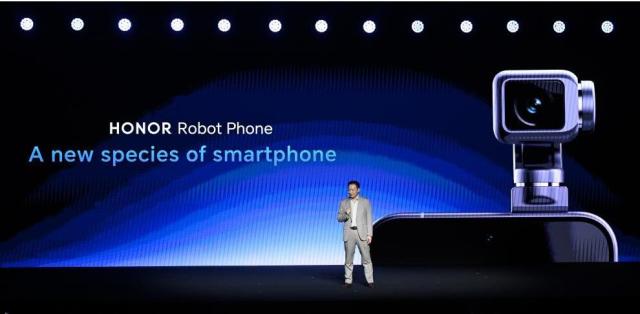
With an initial public offering in the works, Honor has been seeking a new engine to offset slowing growth. In March last year, Honor CEO Li Jian announced the company’s “Alpha strategy,” saying it would “transform into an AI smart device company centered on robots,” marking a full push into AI.
In March this year, Honor presented what it called the world’s first “robot phone” at Mobile World Congress in Barcelona, Spain, as the first product tied to the Alpha strategy. The phone features a protruding robotic arm on top fitted with a 20-megapixel camera designed to rotate and shoot in 360 degrees.
Market reaction, however, fell short of expectations. Some experts said the product lacked polish, while consumers cited drawbacks including reduced portability and an awkward grip. That has fueled doubts that investment in the robot phone will translate into purchases.
Against that backdrop, Honor’s sweep of the top spot in this year’s humanoid robot half-marathon has been viewed as a meaningful result. Chinese IT outlet Huxiu said the win would have a positive effect on Honor’s corporate value, adding that it could help boost capital-market sentiment, roadshow promotion and expectations for a “second growth curve.”
* This article has been translated by AI.
Copyright ⓒ Aju Press All rights reserved.