

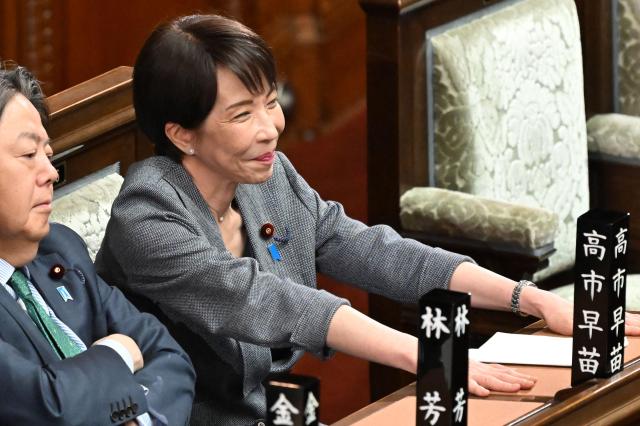
What has the new political approach dubbed the “Takaichi style” produced in practice?
There are clear cases where Takaichi’s top-down, fast-track decision-making has delivered results. A leading example was her immediate decision, soon after taking office, to abolish an additional gasoline tax that the ruling and opposition parties had agreed to end under the previous administration but repeatedly delayed. For many Japanese, it was a moment that made politics feel like it was moving again.
But the approach has also brought setbacks. One prominent case was her November response in the Diet about a “survival-threatening situation in the event of a Taiwan contingency.” The Yomiuri Shimbun quoted a government official as saying the remark was an ad-lib not included in prepared materials, adding that “this wouldn’t have happened if there had been even a face-to-face review of answers with bureaucrats.” The official pointed to the abolition of the prime minister’s answer-prep sessions — a core element of the Takaichi style — as a direct cause.
Even after voices within the Liberal Democratic Party urged her to contain the fallout, Takaichi did not retract the comment. The result, the article said, was that Chinese visitors to Japan fell to about half, and relations with China have continued to worsen. The pattern is not new: the article noted that when she served as internal affairs minister 10 years ago, controversy also grew after she said broadcasters that repeatedly violated political fairness could be ordered off the air, and she did not back down then either.
Takaichi’s preference for refusing dinner gatherings and relying on documents has also strained ties with the party and the bureaucracy. In one example, LDP officials who visited to coordinate wording for the party’s 70th anniversary address said they were sent off after about 10 minutes, having heard only Takaichi’s brief instruction: “Please fix it like this.” During deliberations on the 2026 budget, one senior LDP figure said he had spoken directly with the prime minister about the budget only once.
That communication gap has spilled into governance. Takaichi insisted the budget bill be passed within the fiscal year, but after pushing ahead without sufficient coordination with the party, it failed to clear the House of Councillors. The Nikkei said reliance on “the power of numbers” in running the Diet widened the distance between the prime minister’s office and the party and parliament.
Relations with the bureaucracy have been similarly tense. Consumption tax cuts have long been opposed by the Finance Ministry over concerns about reduced revenue, and past prime ministers have typically adjusted their rhetoric after behind-the-scenes coordination. But in a February budget committee session, Takaichi said “some ministry” was spreading obstructive information in connection with discussions of a consumption tax cut — a remark the article described as an effective public rebuke of the Finance Ministry. Finance Ministry officials reacted with shock, asking whether she viewed them as resistance to the administration. A senior government official was quoted as saying that to build a long-running administration, the Finance Ministry, which controls the budget, must be made an ally, and that turning the entire bureaucracy into one team remains a task.
Despite the side effects, the article said Takaichi has shown no sign of changing course. Instead, she has moved to tighten her grip within the party through personnel decisions. She sought to replace an LDP leader in the House of Councillors over responsibility for the failed budget passage and has repeatedly excluded lawmakers who challenged her from key posts. The Yomiuri said pressure is spreading within the party that even veterans will be treated coldly if they do not follow the prime minister’s line.
The article said there is little open criticism inside the party. Rather, after factions were dissolved and groups reorganized, they are competing to draw closer to Takaichi. Her camp is said to be envisioning an uncontested re-election as LDP president in September next year, with no clear rival in sight. If she wins again and also prevails in the 2028 House of Councillors election, the article said, the possibility of long-term rule has been raised. Whether the “Takaichi style” becomes a new standard in Japanese politics or is forced to adjust under real-world constraints remains to be seen.
* This article has been translated by AI.
Copyright ⓒ Aju Press All rights reserved.