

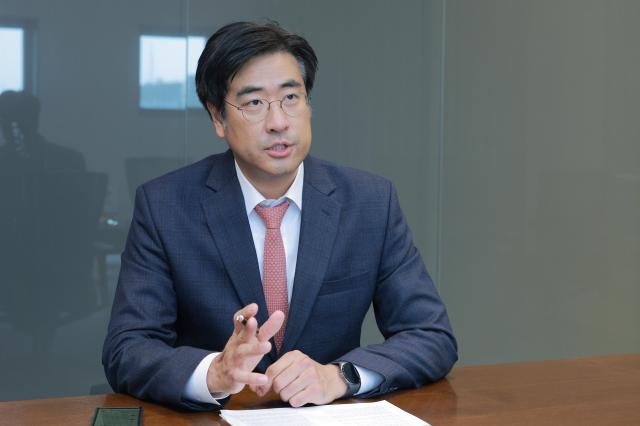
“It’s time to move supply-chain management beyond cost minimization and rebuild it around ‘sovereignty risk’ in three areas: resources, routes and contracts,” said Kim Se-jin, head of the Trade and Industry Policy Center at Sejong law firm. “Instead of focusing only on where to buy cheaply, companies must factor in which country the resource comes from, which sea lane it travels through, and whether the contract will actually be honored.”
A global economic shock tied to the Middle East has deepened after physical clashes involving the United States and Israel and Iran. President Donald Trump is pushing for a quick cease-fire ahead of November midterm elections, but experts say the fallout is likely to persist and could mark a structural turning point for global supply chains.
Kim, a New York-licensed foreign attorney and adjunct professor at Yonsei University Law School who has also served as director of the Trade Dispute Response Division at South Korea’s Industry Ministry, discussed what he sees as the core of the crisis and how Korean companies should respond.
-With the U.S.-Iran war expanding Middle East-driven economic risk, Trump says he wants fast cease-fire talks. Even if a cease-fire is reached, the impact could last. How do you view the situation?
Kim said the conflict reflects a miscalculation that it would be short. He said a localized fight, pulled into an Israel-centered frame, spread into a regional war and brought to life warnings made before the fighting: a Hormuz blockade, strikes on U.S. facilities and attacks on Israel’s energy infrastructure.
He said Trump is clearly rushing toward a cease-fire before the midterms because energy prices can be politically damaging and even the MAGA base is turning away. But, he added, a cease-fire would not mean the risk is over.
“This war is a structural turning point in which physical resources and geographic assets that had been depoliticized for 30 years are again being used as tools in sovereignty disputes,” Kim said. He said the Strait of Hormuz has shifted from a “public good” to leverage for sovereign power; Middle East resource geography has become missile targets; and byproduct processes such as LNG and helium have become instruments of sovereign control.
Kim said South Korea is among the few countries whose core industries are simultaneously exposed across many of the routes affected: Hormuz (crude oil and naphtha), Israel (97.5% of bromine used for semiconductors), Qatar (helium and LNG), and the Gulf (ammonia and aluminum). He said companies should redesign supply-chain management to embed sovereignty risk across resources, routes and contracts.
-Many companies face breach-of-contract risks due to shipping delays. How likely is it that this crisis will qualify as force majeure under international commercial law?
Kim said there is no one-size-fits-all answer because contract language will determine outcomes. He said a key legal dividing line is whether performance is physically impossible or merely economically unreasonable.
If supply is physically cut off — such as through a Hormuz blockade or damage to Qatar’s Ras Laffan facilities — force majeure is more likely to be recognized, he said. But cases where routes remain open and costs surge, such as sharply higher insurance premiums, are harder to excuse under Anglo-American law, which generally does not treat cost increases alone as force majeure.
He urged companies to review force majeure clauses and notice requirements across existing contracts and to document and preserve records of substitute procurement costs for potential recourse claims. For new contracts, he said firms should spell out scenario-based terms tied to Hormuz, the allocation of war-risk insurance costs, responsibility for any Iranian transit fees, and clear standards for when force majeure ends. “In any case, the practical benefit now is often greater in redesigning contract structures than in fighting,” he said.
-War-risk insurance premiums are surging and port-entry refusals are increasing. What urgent legal steps do you recommend for shipowners and cargo interests?
Kim said the most urgent step is a full review of contracts and insurance terms because a single clause can determine who pays and who can terminate. He said companies should first examine war-risk clauses in charter parties, which can allow owners to refuse dangerous routes, and noted that liability can flip depending on whether the charter is time or voyage-based.
He said responsibility for additional insurance premiums also varies. While charter parties often place the burden on charterers, the ultimate allocation can change depending on whether a sale is CIF or FOB. “If you don’t sort it out now, it becomes a dispute and a lawsuit later,” he said.
Kim also flagged the risk of Iranian transit fees. If Iran moves to a paid transit system, paying could violate U.S. sanctions on Iran, forcing companies to choose between breaching sanctions or breaching contracts. He said firms should check in advance whether an OFAC license from the U.S. Treasury Department’s Office of Foreign Assets Control is required.
-If a South Korean-flagged ship is seized by Iranian authorities or detained over unpaid tolls, what immediate international arbitration or legal remedies are available?
Kim said several legal avenues exist, but effectiveness varies. One commonly cited option is the International Tribunal for the Law of the Sea’s prompt-release procedure. Under Article 292 of the U.N. Convention on the Law of the Sea, a flag state can seek prompt release of a detained vessel upon posting a reasonable bond. He said the process is fast — in principle, a ruling within one month — and South Korea, as a party to UNCLOS, has standing.
But he said enforcement is limited because Iran has not ratified UNCLOS and is likely to reject ITLOS jurisdiction. He said the most realistic tool is diplomatic negotiation, citing the January 2021 seizure by Iran’s Revolutionary Guard of the South Korean chemical tanker Hankuk Chemi. The 19 crew members were released after about a month, he said, but the ship and its captain took 95 days. He said the release reflected a mix of South Korean diplomatic efforts, progress in talks on the Iran nuclear deal, known as the JCPOA, and steps by South Korea related to frozen funds. He described it as a case resolved through diplomacy before international legal procedures such as ITLOS or the International Court of Justice were activated.
-Energy security has become a top management priority. For companies trying to reduce dependence on the Middle East, what alternatives look promising?
Kim said a complete shift away from the Middle East is unrealistic because South Korea’s refining system is optimized for Middle Eastern heavy, high-sulfur crude and the country has long depended on the region for around 70% of its crude oil. He said diversification and stockpiling are more practical than outright replacement.
As potential alternatives, he said U.S., Australian and Canadian crude are widely seen as candidates. He said the crisis also exposed the risk of relying on Qatar for LNG, and pointed to U.S.-sourced LNG projects, including Alaska LNG, which he said are emerging as a major potential use of investment funds tied to a U.S.-South Korea trade agreement, linking South Korea’s energy security with bilateral trade ties.
-What specific support is Sejong providing to companies facing unpredictable geopolitical risk?
Kim said Sejong formally launched its Trade and Industry Policy Center earlier this year to respond to geopolitical shocks like the current crisis. He said the center aims to go beyond legal review by integrating overseas expansion strategy, investment structures and supply-chain restructuring.
He said the firm helps strategic industries — including defense, energy, shipbuilding, batteries, semiconductors and AI — manage regulatory risk across major economic blocs including the United States, the European Union and China. He said Sejong advises on supply-chain regulatory risk diagnostics, long-term contract renegotiation and force majeure responses, and designs linking policy finance with strategic investment, including deal architecture. For complex transactions such as U.S. shipbuilding investment or defense expansion, he said Sejong builds joint advisory structures with U.S. law firms to reflect both countries’ rules, including CFIUS, export controls, procurement regulations, tax and finance.
“Regulation is everywhere, but the companies that read the structure of regulation first ultimately gain a competitive edge,” Kim said. He added that the Iran crisis could also open major opportunities for Korean companies, including Middle East reconstruction, LNG carriers, defense and nuclear power.
* This article has been translated by AI.
Copyright ⓒ Aju Press All rights reserved.