

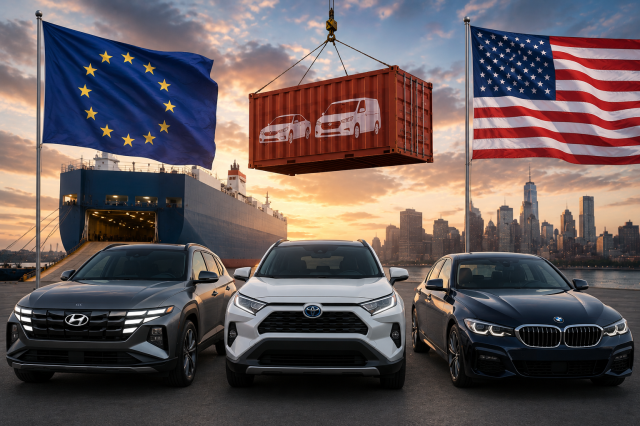
Industry officials said Tuesday that President Donald Trump is reviewing a 25% tariff on European-made passenger cars. Last year, the United States and the European Union agreed to cut tariffs on some items, including autos, from 25% to about 15%. Trump, however, warned on May 1 that tariffs could be raised, citing issues such as the EU’s implementation of the trade agreement.
The industry expects Korean and Japanese brands to benefit because they face a relatively lower tariff burden. In the U.S. market, a tariff structure of about 15% remains in place for Korean and Japanese brands, according to the report.
German automakers such as BMW operate plants in the United States, but some models, including sedans, are still exported from Europe. European brands in the U.S. market are generally seen as concentrated in luxury sedans and SUVs aimed at middle-income buyers, along with Volkswagen’s midpriced and lower-priced models. If higher tariffs are reflected in sticker prices, price resistance is expected to grow, especially for lower-priced models.
Korean and Japanese brands are expected to target that segment. According to market research firm Wards Intelligence, Hyundai Motor Co. and Kia sold a combined 1,836,172 vehicles in the United States last year, taking an 11.3% share to rank fourth. They trailed General Motors with 2,841,328 vehicles (17.5%), Toyota with 2,518,071 (15.5%) and Ford with 2,133,892 (13.1%). Among European brands, BMW sold 388,897 vehicles, placing it in the top 10.
Analysts said a tariff increase on European cars could lead to Korean and Japanese brands splitting some of the market share previously held by European automakers.
Korea and Japan both have strengths in hybrids. According to the Korea Automobile & Mobility Association’s U.S. electrified-vehicle sales data, Hyundai and Kia sold a combined 64,742 hybrids in the U.S. market in the first quarter, up 63.7% from a year earlier. That ranked third behind Toyota (281,699) and Honda (95,612).
Their electrification strategies differ, however. Hyundai Motor Group is rapidly expanding its electric-vehicle lineup alongside hybrids, while Japanese EVs have struggled to gain broad popularity in global markets, the report said.
Recent U.S. sales trends have been mixed for the two. Last month, Hyundai and Kia sold 159,216 vehicles in the United States, down 2.1% from a year earlier. Toyota sold 222,378, down 4.6%.
Hyundai is offering incentives of up to $10,000 (14.55 million won) on the Ioniq 9 in the U.S. market. Kia has also moved aggressively, including cutting prices on the EV6.
Moon Hak-hoon, a professor in the Department of Future Automobiles at Osan University, said, “The U.S. market has a strong preference for premium brands, so the impact on European brands could be limited.” He added, “But if there is some opening in the midpriced and lower-priced market, Korean and Japanese brands have plenty of room to target it.”
* This article has been translated by AI.
Copyright ⓒ Aju Press All rights reserved.