

“I’ve long hoped that someday we could do something together.”
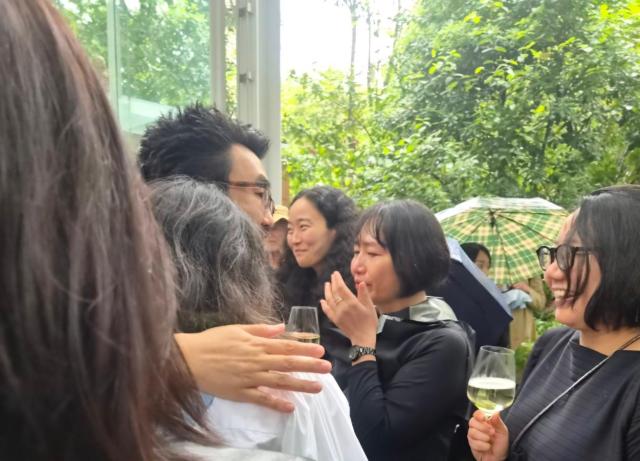
Mizuki Takahashi, a co-curator of the Japan Pavilion, said that through tears after a joint performance by the Korea and Japan pavilions on May 6 (local time) at the Venice Biennale.
Takahashi recalled that about 10 years ago, a candidate for Japan Pavilion curator suggested working together. She said she proposed a plan to build an exhibition with the Korea Pavilion, but it was not selected. “Still, I kept thinking that someday it would be good if we could do something together,” she said.
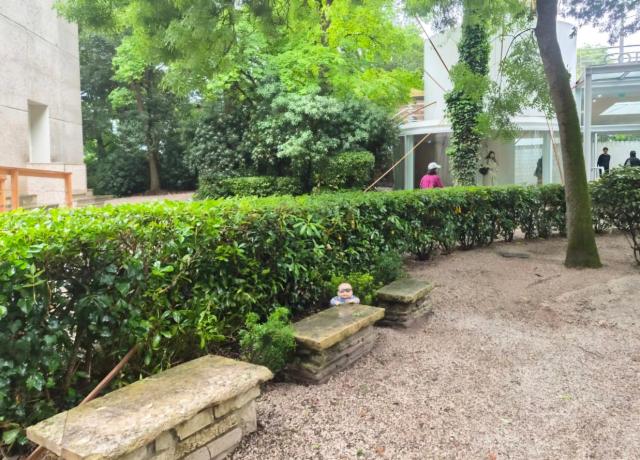
In the Giardini, where the Biennale’s permanent national pavilions stand, the Korea and Japan pavilions sit side by side. Between them is a long hedge that functions like a border. It is unclear when it was planted. The Japan Pavilion does not want it, but it cannot be removed.
Choi Bitna, the Korea Pavilion’s artistic director, said organizers tried to relocate the trees but Biennale park authorities refused.
Instead of removing the boundary, the two sides chose to cross it. During the Korea Pavilion’s official opening event, the joint performance showed how easily the hedge could be crossed.
Japan Pavilion co-curators Lisa Horikawa and Takahashi, along with participating artist Ei Arakawa Nash, stepped over the hedge into the Korea Pavilion. The Korea Pavilion director and participating artists welcomed them with open arms. Officials raised glasses and shouted “Kanpai,” then exchanged “Omedeto” and “Congratulations” and embraced.
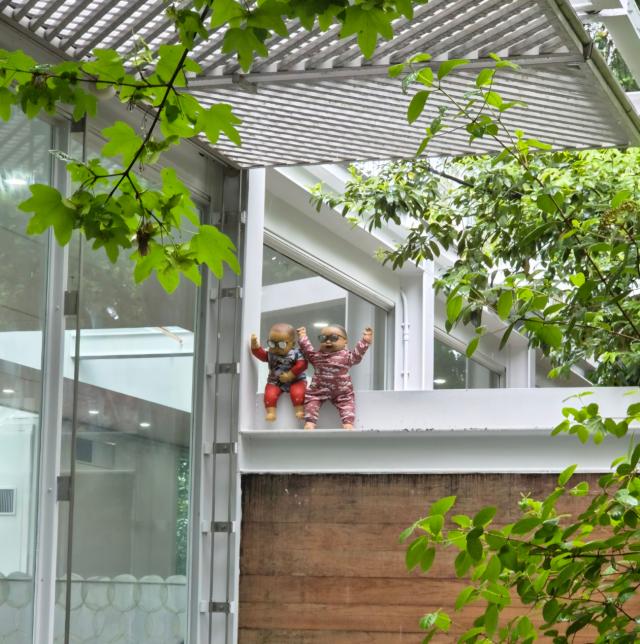
The artworks also crossed the hedge. Choi Go-eun’s Korea Pavilion work, “Merdiang,” ran through the hedge and reached the Japan Pavilion. The piece is a joint Korea-Japan project, with financial support from the Japan Pavilion.
The Japan Pavilion’s baby dolls were also invited into the Korea Pavilion. The dolls, described as born on March 1 and May 18, hold their arms high in a celebratory gesture.
Choi Bitna said the collaboration aimed to show a forward-looking relationship. “In 1995, Japan issued its first official apology (over its past),” she said. “I’m not saying it denies that, but it can seem as if it is trying to forget. Still, the Japan Pavilion team acknowledged that past and commemorated specific days in Korea, and I think that shows how solidarity can be built.”
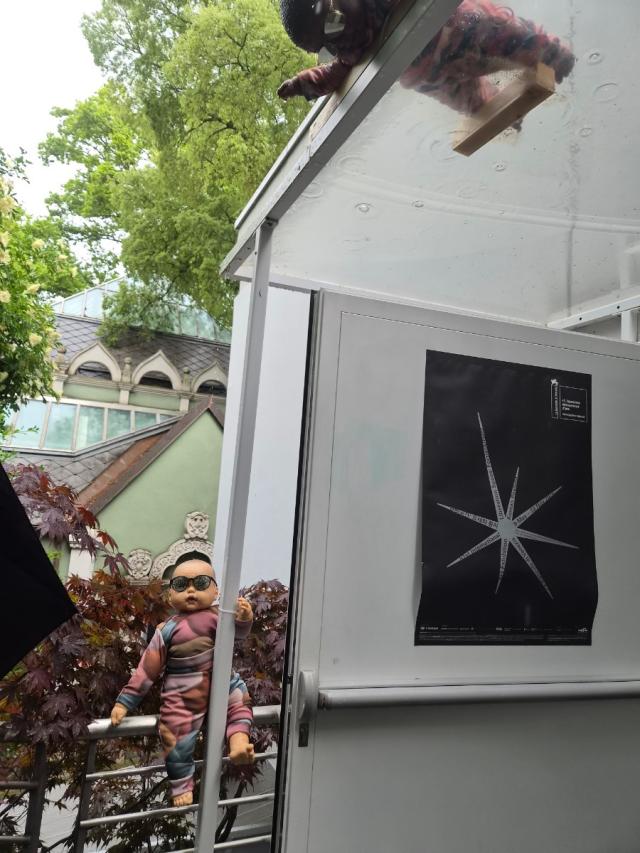
Japan Pavilion staff also promoted the Korea Pavilion. A Korea Pavilion poster was placed at the Japan Pavilion exit. The Japan Pavilion temporarily closed from 2 p.m. to 4:15 p.m., and staff told visitors, “Go see the Korea Pavilion,” and said a joint performance would begin at 4:30 p.m.
Lee Beom-heon, chair of the Arts Council Korea, said he would work to keep the cooperation going. “This performance is truly meaningful,” Lee said, adding that the council agreed to maintain “progressive collaboration” with the Japan Foundation, the Japan Pavilion’s commissioner. He said the two sides promised to expand cooperation like this performance, including Seoul and Tokyo inviting each other.
* This article has been translated by AI.
Copyright ⓒ Aju Press All rights reserved.