SEOUL, May 14 (AJP) - South Korean stocks marched closer to the 8,000-point milestone on Thursday as investors brushed aside renewed U.S. inflation concerns and instead piled into artificial intelligence and semiconductor shares through the U.S.-China summit momentum.
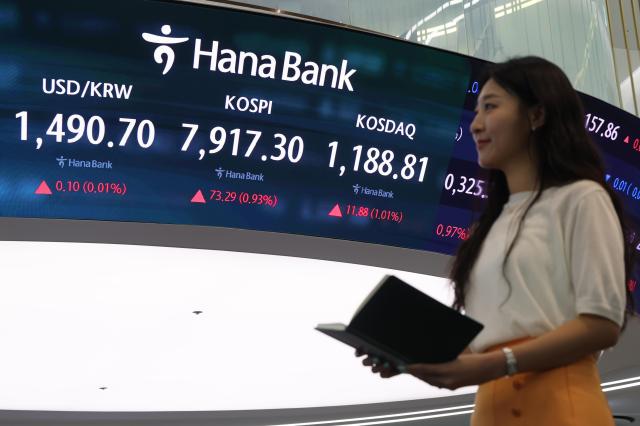
As of 10:34 a.m., the benchmark KOSPI was trading at 7,973.67, up 1.65 percent, while the tech-heavy KOSDAQ slipped 0.66 percent to 1,169.16.
The rally closely followed another record-setting session on Wall Street, where the S&P 500 rose 0.58 percent to 7,444.25 and the NASDAQ Composite jumped 1.20 percent to 26,402.34, with both benchmarks closing at fresh all-time highs despite unexpectedly strong U.S. inflation data.
The U.S. Department of Labor said producer prices in April climbed 1.4 percent from the previous month and 6.0 percent from a year earlier, marking the sharpest annual increase since December 2022 and reinforcing signs that inflationary pressures were broadening across the economy.
Rising costs in energy, intermediate goods, wholesale margins and gasoline sales suggested inflation was spreading beyond isolated sectors, following a similarly hotter-than-expected consumer inflation report earlier this week.
Yet investors largely shrugged off the inflation shock, betting that the global AI boom would continue powering earnings growth and risk appetite.
Technology shares tied to AI and optimism surrounding the U.S.-China summit that opened Thursday in Beijing drove much of the advance.
NVIDIA gained 2.3 percent overnight, while Micron Technology surged 4.8 percent and Tesla climbed 2.7 percent. Alphabet jumped 3.9 percent, while Meta Platforms and Amazon rose 2.26 percent and 1.62 percent, respectively. Only Microsoft finished lower among the so-called “Magnificent Seven,” slipping 0.63 percent.
Mixed sector rotation emerged in Seoul trading.
Among heavyweight shares, Samsung Electronics jumped 4.23 percent to 296,000 won, extending its AI-driven rally, while SK Hynix edged down 0.15 percent to 1,973,000 won.
LG Energy Solution and Samsung C&T also gained more than 1 percent.
Meanwhile, shipbuilding, defense and power equipment shares retreated as investors locked in profits after weeks of sharp gains linked to the Middle East conflict and global infrastructure demand.
HD Hyundai Heavy Industries plunged 8.05 percent, while Doosan Enerbility fell 3.08 percent to 116,300 won and HD Hyundai Electric slipped 1.87 percent to 1,256,000 won.
On the KOSDAQ, AI- and biotech-related momentum remained strong.
Alteogen surged more than 5 percent to become the market’s largest stock by capitalization, while Seojin System also rose more than 5 percent.
Retail investors continued to dominate trading flows, purchasing a net 1.36 trillion won worth of local equities. Foreign and institutional investors, meanwhile, sold a net 1.18 trillion won and 226 billion won, respectively.
The Korean won remained broadly weak, trading at 1,491.00 per dollar compared with the previous close of 1,490.60 won.
Elsewhere in Asia, Japan’s Nikkei 225 rose 0.77 percent to 63,757.71, supported by continued strength in semiconductor and technology shares, China’s Shanghai Composite Index however, edged down 0.14 percent to 4,236.45 as investors turned cautious ahead of the Trump-Xi summit, with markets awaiting signals on trade relations and U.S. semiconductor export restrictions. Hong Kong’s Hang Seng Index, gained 1.11 percent to 26,681.43.

Copyright ⓒ Aju Press All rights reserved.