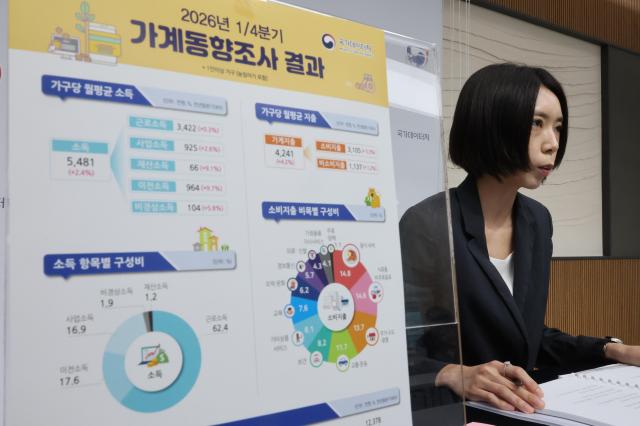
According to the ministry, average monthly household income rose 2.4 percent from a year earlier to 5.48 million won (US$4,000) in the first quarter of 2026. Among them, average income for salaried workers stood at 3.42 million won.
Average monthly household spending rose 5.3 percent from a year earlier to 3.11 million won, marking the fastest increase since the first quarter of 2023, and spending exceeded income for the first time since the second quarter of 2024. The average propensity to consume also increased 1.7 percentage points to 71.5 percent.
The income gap widened as lower-income households faced growing financial pressure, while large performance bonuses at major companies such as Samsung Electronics and SK hynix boosted earnings among higher-income households.
The average propensity to consume among the bottom 20 percent reached 155.3 percent, with households earning an average of 1.17 million won per month but spending 1.46 million won.
By contrast, households in the top 20 percent saw the strongest income growth, with average monthly income rising 4.2 percent to 12.38 million won. They were also the only group to see their income grow, up 2.6 percent to 4.08 million won. As a result, the income gap between the two groups widened to 6.59 times from 6.32 times a year earlier.
The ministry attributed the widening gap partly to wage growth at large corporations and performance bonuses from major chipmakers such as Samsung Electronics and SK hynix, which were partly reflected in February's income data.
Households in the top 20 percent of the income bracket tend to include a higher proportion of employees at large companies, where wage gains were stronger in the first quarter.

Copyright ⓒ Aju Press All rights reserved.