

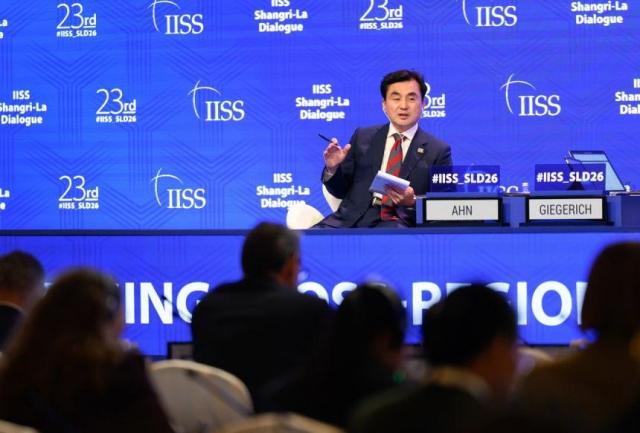
Defense Minister Ahn Kyubak announced on May 31 that discussions regarding the Korea-Japan Mutual Logistics Support Agreement (ACSA) took place during the recent defense ministerial meeting between South Korea and Japan. He emphasized the need for public understanding and persuasion, indicating a cautious stance on the matter.
During a press briefing at the Shangri-La Hotel in Singapore, where the 23rd Shangri-La Dialogue is being held, Ahn responded to questions about whether ACSA was discussed in the previous day's meeting with his Japanese counterpart.
"Since it was a meeting between the defense ministers of both countries, I am limited in what I can disclose," Ahn said. "The ACSA is a mutual logistics agreement, which requires understanding and persuasion from both peoples, and I believe we must proceed with caution."
Although the ACSA was not an official agenda item for the Korea-Japan defense talks, it was reportedly raised by the Japanese side during the discussions.
The ACSA would allow the two countries to exchange military supplies such as ammunition, food, and fuel in times of crisis. This agreement is seen as a measure to institutionalize military cooperation between South Korea and Japan, a sensitive issue for South Korea due to historical grievances.
Plans to establish the ACSA were initially considered during the Lee Myung-bak administration, following the signing of the General Security of Military Information Agreement (GSOMIA) between the two countries. However, the GSOMIA was abandoned just before its signing due to public opposition, leading to the suspension of the ACSA as well. Japan has since strongly advocated for the ACSA, while South Korea has maintained a cautious approach.
In addition, Ahn highlighted his discussions with a U.S. congressional delegation during the Shangri-La Dialogue, emphasizing South Korea's commitment to an early transfer of wartime operational control.
"I conveyed to the U.S. lawmakers that there would be no difficulties even if the transfer of operational control were to occur tomorrow," Ahn stated. "The U.S. lawmakers appeared to understand and be satisfied with our preparations for the transfer."
Ahn also noted that South Korea and the U.S. agreed in 2020 that 94% of the conditions for the transfer of operational control had already been met, providing a comprehensive explanation of South Korea's capabilities.
* This article has been translated by AI.

Copyright ⓒ Aju Press All rights reserved.