

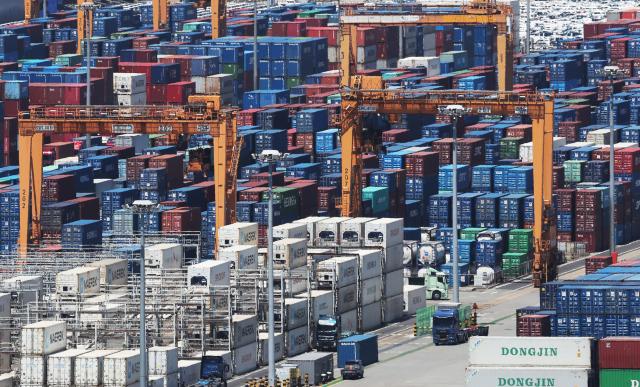
Leading the charge, semiconductor exports reached an unprecedented $700 billion last year, with the $900 billion mark now within reach. Nonetheless, the heavy reliance on semiconductors for exports has been identified as a concern.
Finalization of tariff negotiations minimizes uncertainty amid US protectionism.
According to relevant ministries, the Lee administration appointed Yeo Han-goo as head of the Trade Negotiation Headquarters in the Ministry of Trade, Industry and Energy last year, marking the first vice-ministerial appointment. Yeo had previously served in the same role during the Moon Jae-in administration.
At that time, the Trump administration had announced plans to impose a 25% reciprocal tariff on South Korea, in addition to a global 10% tariff. With Trump’s push for a revival of American manufacturing, the potential implementation of high tariffs posed a significant threat to South Korea's export-dependent economy.
In response, the government devised a strategy to navigate the tariff challenges, led by Yeo, who had overseen trade policy during Trump’s first term. Following his confirmation, Minister of Trade, Industry and Energy Kim Jeong-kwan and his team focused on tariff negotiations with the United States.
After intense negotiations, South Korea and the U.S. reached a final agreement on October 29 last year. A memorandum of understanding (MOU) on strategic investment was signed in November, which included commitments to reduce reciprocal tariffs and automotive parts tariffs from 25% to 15%, along with assurances of “most favored nation” status for semiconductors, a key export item. A $350 billion investment fund for the U.S. market is set to be managed based on commercial viability.
The conclusion of the Korea-U.S. tariff negotiations is considered a major achievement for the trade authorities, as it minimized uncertainties with the U.S., a key export market, amid rising protectionist trends. With favorable conditions secured compared to major competitors, the upcoming launch of the Korea-U.S. Strategic Investment Corporation next month is expected to serve as a foothold for advancing strategic industries in the U.S.
Exports surpass $700 billion for the first time, but diversification remains a challenge.
Exports have shown an upward trend after overcoming significant challenges. According to the Ministry of Trade, Industry and Energy, last year’s exports totaled $709.3 billion, marking a 3.8% increase from the previous year and the first time annual exports exceeded $700 billion since the establishment of the government in 1948.
Despite a slowdown in exports during the first half of the year due to U.S. tariffs, a rapid recovery in the second half significantly contributed to the overall growth. The expansion of data center investments driven by artificial intelligence (AI) has also propelled semiconductor exports.
As a result, the government set an export target of $740 billion for this year, aiming for two consecutive years of exports exceeding $700 billion. Despite global uncertainties, including the Middle East conflict, exports from January to April this year reached $306.5 billion, a 40.9% increase compared to the same period last year.
Forecasts for export targets are evolving. The Korea Institute for Industrial Economics and Trade predicts that this year’s exports could surge by 30.3% to $924.4 billion. If this projection materializes, South Korea could surpass Japan and secure a position among the top five exporting nations.
Minister Kim Jeong-kwan recently stated, "While there are other variables to consider, I expect this year’s exports to exceed $900 billion and believe we have a chance to enter the top five in exports." He noted that semiconductor demand is expected to remain strong through the first half of next year, indicating the potential for record-breaking performance.
However, the reliance on semiconductors has created a 'K-shaped' export structure, raising uncertainties for future projections. Export fluctuations are significant due to the cyclical nature of the semiconductor market. If semiconductor exports falter, overall exports could also decline. The Korea Institute for Industrial Economics and Trade forecasts that exports excluding semiconductors will only grow by 1.7% this year.
In light of these achievements and challenges, the Ministry of Trade, Industry and Energy is intensifying efforts to diversify exports. The government aims to expand exports of K-consumer goods based on the Korean Wave and increase trade financing for small and medium-sized enterprises to achieve a goal of 'inclusive exports.' Additionally, it plans to secure future competitiveness through the transition to manufacturing AI.
Minister Kim emphasized, "Industries excluding semiconductors are showing solid growth rates of 14-15%, and small and medium-sized enterprise exports have increased by 10%. We will adopt the mindset that 'the world is vast, and there are many places to export.' Please look forward to the second half of the year."
* This article has been translated by AI.

Copyright ⓒ Aju Press All rights reserved.