

The financial burden of breast cancer treatment, the most common cancer among women in South Korea, has been steadily increasing. This is particularly concerning as breast cancer primarily affects women in their 30s to 50s, a key working age, and the expansion of advanced treatments such as targeted and immunotherapy has further heightened the perceived cost of medical care.
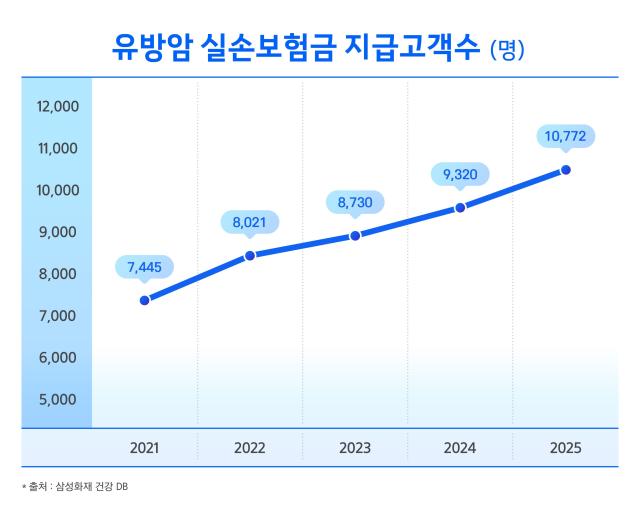
On June 1, Samsung Fire & Marine analyzed breast cancer treatment cases and costs using its health information platform, 'Health DB.' The analysis revealed that insurance payouts for breast cancer treatment increased from 3.72 million won in 2021 to 4.17 million won in 2024, marking a 12.1% rise.
This increase surpasses the growth rate of medical expenses covered by health insurance during the same period. According to the National Health Insurance Statistics, the annual medical cost per breast cancer patient rose from 5.03 million won in 2021 to 5.35 million won in 2024, a 6.4% increase. Since health insurance costs do not include out-of-pocket expenses, the actual financial burden on patients may be even greater.
Data from the National Cancer Registration Statistics indicates that breast cancer is the most prevalent cancer among women in South Korea, with an average annual increase of 5.9% from 2020 to 2023. Notably, women in their 40s are particularly affected, with cases occurring approximately a decade earlier than in Western countries.
The burden of non-reimbursable costs is also significant. The 2024 Health Insurance Patient Medical Expense Survey by the National Health Insurance Service found that the out-of-pocket expense rate for breast cancer patients was 24.1%, considerably higher than the average of 8.8% for the top 30 diseases with severe and high medical costs.
The expansion of advanced treatments has led to an increase in high-cost cases. An analysis by Samsung Fire & Marine of breast cancer patients diagnosed between 2021 and 2022 found that about 1.2% of cases incurred direct treatment costs exceeding 50 million won. All of these patients received either targeted or immunotherapy.
Among all breast cancer chemotherapy patients, the proportion receiving targeted and immunotherapy has steadily increased over the past five years, reaching 56.2% in 2025. In some instances, treatment costs have even reached 100 million won.
Samsung Fire & Marine emphasized the importance of early screening for breast cancer, not only for improving treatment outcomes but also for managing economic burdens. Their previous analysis indicated that patients whose treatment concluded within one year incurred an average medical cost of 7.51 million won, while those whose treatment extended beyond one year faced an average cost of 23.8 million won.
* This article has been translated by AI.
Copyright ⓒ Aju Press All rights reserved.