

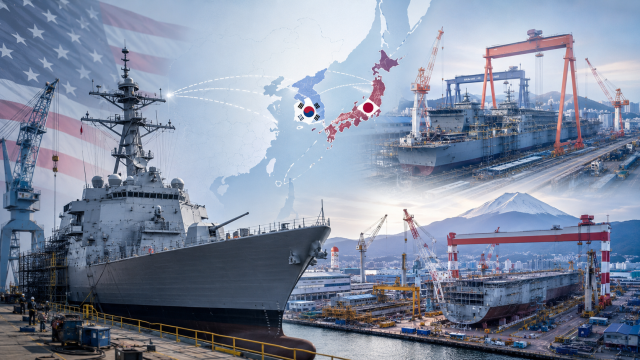
On June 1, local time, Breaking Defense reported that the U.S. Department of Defense has requested Congress to include $1.85 billion in naval research and development funding in the 2027 budget adjustment bill. This funding is ostensibly aimed at assessing whether allied shipyards in South Korea and Japan can produce combat vessels for the U.S. Navy.
However, the Office of Management and Budget (OMB) clarified that this funding is not merely for research. An OMB official told Breaking Defense, "No one uses the $1.85 billion solely for research; this money is actually for procuring ships." Depending on the manufacturer, this amount could cover the cost of an entire frigate, and considering the costs of destroyers built in South Korea or Japan, it could also serve as initial funding for procuring destroyers and cruisers.
The proposed approach involves constructing key components of the vessels in South Korea or Japan, with U.S. defense contractors integrating the combat systems. Subsequently, the shipyards would either build new facilities in the U.S. or modernize existing ones to produce follow-on orders domestically. This strategy aims to leverage foreign shipyards in the short term while expanding U.S. shipbuilding capabilities.
Companies under consideration include South Korea's Hanwha, HD Hyundai, and Samsung Heavy Industries, as well as Japan's Mitsubishi Heavy Industries, Kawasaki Heavy Industries, and Japan Marine United (JMU). The OMB noted that South Korean and Japanese shipyards are capable of constructing advanced surface combatants more quickly and at lower costs than U.S. facilities, thanks to automation, robotics, and production modernization.
The U.S. decision to explore allied shipyards is rooted in structural delays within its domestic shipbuilding industry. The U.S. Navy and Coast Guard rely on eight domestic shipbuilders for surface combatants and auxiliary vessels. However, labor shortages, supply chain vulnerabilities, outdated facilities, and production capacity constraints have delayed major ship projects. An OMB official stated, "Major ship projects in the U.S. are already delayed by one to four years, and simply allocating more budget to existing shipyards will not solve the problem."
There is significant pushback from Congress. Lawmakers are concerned that utilizing foreign shipyards could harm U.S. shipbuilders and their supply chains. The budget adjustment bill is also controversial because it allows for less detailed congressional oversight compared to the general defense budget. Some lawmakers are pushing for amendments to the National Defense Authorization Act to prevent the use of funds for producing U.S. warships or key components overseas.
Legal barriers remain as well. U.S. defense budgets typically include provisions prohibiting the construction of naval vessels at foreign shipyards. However, it has been suggested that funds allocated through the adjustment bill could be utilized if the president approves exceptions based on national security needs.
The U.S. Navy also acknowledges the necessity of expanding production capacity. Admiral Daryl Caudle, Chief of Naval Operations, stated, "We need ships, we need them now, and we need production capacity." However, introducing foreign designs would require a reevaluation of operational, maintenance, and training systems, potentially complicating the integration of new classes into the U.S. Navy's fleet.
* This article has been translated by AI.

Copyright ⓒ Aju Press All rights reserved.