

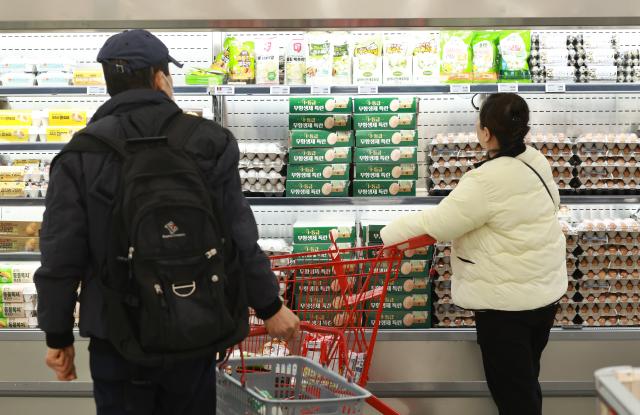
Egg display at a supermarket in Seoul. [Photo=Yonhap News]
"It's hard to find a 30-egg carton. Even when I do, the price is so high that I hesitate to buy it," said Kim Jin-joo, a 42-year-old housewife, while browsing the egg section of a supermarket on June 2. She expressed concern, stating, "I used to cook with eggs often when I ran out of side dishes, but now that's becoming difficult too."
The burden on consumers is increasing as the supply of eggs diminishes due to the impact of highly pathogenic avian influenza (AI). The culling of hens has led to a decrease in production. With the added concern of a heatwave this summer, supermarkets are actively seeking to secure supplies through discount promotions and the sale of imported eggs.
According to the Korea Agro-Fisheries & Food Trade Corporation (aT), the average consumer price for domestic special eggs (30-count) was recorded at 7,412 won as of June 1. This marks an increase of about 6% from the average price of 7,008 won in June of last year. At the end of last month, prices for special eggs in Seoul exceeded 8,500 won.
Egg prices, which were in the low 6,000 won range earlier this year, surged to the 7,000 won level by late April and have remained high. Although there has been some recent adjustment, prices are still above the average levels seen in previous years. Some supermarkets have posted notices indicating temporary shortages of eggs, and Costco has limited purchases to two cartons per person.
The primary cause of rising egg prices is the spread of highly pathogenic AI, which has led to the culling of over 11 million hens, drastically reducing the supply. Additionally, it takes time to raise new chicks to laying hens, making a quick recovery in supply unlikely.
The summer heat is also a significant factor. Chickens experience heat stress when temperatures exceed 27 degrees Celsius, which can reduce their laying rates and, in severe cases, lead to mortality. As a result, industry experts predict that prices will remain high until egg production stabilizes in July.
In response, supermarkets are considering discount promotions and the sale of imported eggs. Lotte Mart is offering a discount of 1,000 won on its Happy Egg special (30-count) from June 3 to June 10, selling it for 6,990 won through a government-supported agricultural discount program. Last month, Lotte Super sold fresh eggs from the U.S. at prices more than 35% lower than the average domestic price for the same size. A representative from Lotte Mart and Super stated, "We plan to explore various product management strategies that can help stabilize prices." E-Mart is reportedly considering importing eggs from Thailand.
The government is also implementing measures to stabilize the egg supply. The Ministry of Agriculture, Food and Rural Affairs plans to import an additional 20 million fresh eggs from the U.S. and Thailand this month and next to prepare for the expected decrease in production during the summer. Deputy Minister Kim Jong-gu stated, "The government will continue to promote discount support programs to stabilize consumer prices for eggs," adding that discussions are ongoing with relevant departments to expand tariff quotas for egg products and increase the supply of fresh eggs.
* This article has been translated by AI.
Copyright ⓒ Aju Press All rights reserved.