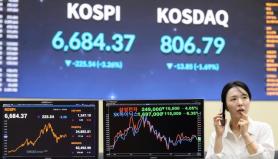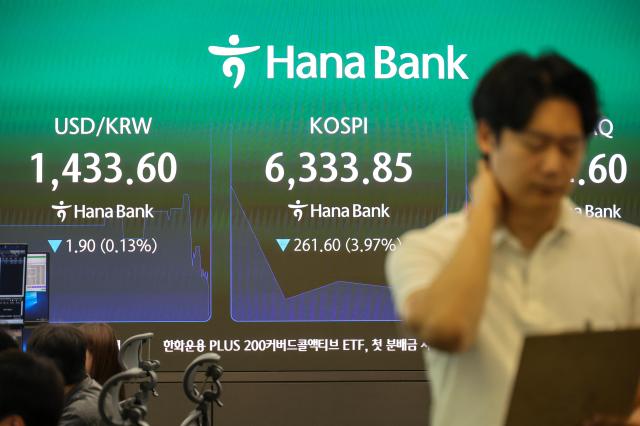
The index closed 5.12 percent lower at 6,257.45 as foreign and institutional investors extended heavy selling despite aggressive buying by retail investors. Individuals snapped up a net 4.65 trillion won (US$3.3 billion) worth of shares, but it was not enough to offset net sales of 1.95 trillion won by institutions and 2.83 trillion won by foreign investors. Foreign investors also remained net sellers in the KOSPI 200 futures market, adding pressure to the broader index.
The junior KOSDAQ, however, bucked the broader downward trend, rising 2.44 percent to 737.35 as investors shifted buying toward biotechnology and robotics shares.
The decline came even after U.S. investment bank Morgan Stanley took a favorable stance, raising its rating on South Korean equities from "equal weight" to "overweight," indicating a more positive outlook and its view that South Korean stocks could outperform. It said the recent market turmoil was mainly caused by technical factors rather than a deterioration in corporate fundamentals.
The bank said much of the recent deleveraging had already run its course, with the wave of forced selling largely over, and reiterated its year-end KOSPI target of 9,000.
The market, however, remained under pressure from short-term profit-taking following last Friday's record-setting rally, when the KOSPI surged 17.91 percent on strong foreign buying and growing optimism over global investment in artificial intelligence (AI).
Samsung Electronics plunged 8.76 percent to 239,000 won, while SK hynix tumbled 8.79 percent to 1,567,000 won.
The South Korean won also weakened, with the dollar trading at 1,430.8 won, up from 1,424.0 won in the previous session, as foreign investors continued selling domestic stocks.
Despite the sharp pullback in semiconductor leaders, the broader AI supply chain remained more resilient. Samsung Electro-Mechanics rose 3.42 percent to 1,181,000 won, while Hyosung Heavy Industries gained 3.23 percent to 2,495,000 won and LS Electric added 1.95 percent to 188,400 won.
Hyundai Motor rose 1.29 percent to 393,000 won as investors rotated into robotics plays after the United States tightened restrictions on Chinese robot imports, fueling expectations that Korean companies could gain market share. Affiliate Hyundai AutoEver surged 4.94 percent to 382,500 won while Hyundai Mobis climbed 3.68 percent to 493,500 won.
Doosan also jumped 5.81 percent after investors welcomed its planned acquisition of SK Siltron. Sentiment was further boosted after Eugene Investment & Securities raised its target price, citing stronger long-term growth prospects from the deal.
The divergence was even more pronounced on the KOSDAQ, where biotechnology and robotics stocks extended recent gains. Alteogen climbed 2.92 percent to 317,500 won, HLB added 0.98 percent to 30,900 won and Rainbow Robotics gained 5.89 percent to 458,500 won.
Among the day's biggest movers, ALT, an AI media and telecommunications device maker, rose 29.97 percent to 1,492 won. Wonik Holdings, a semiconductor and display materials company surged 29.97 percent to 19,860 won, Cosmo Robotix jumped 21.30 percent to 17,880 won and home appliance maker Winix soared 21.45 percent to 5,860 won.
The KOSDAQ's strength triggered a buy-side sidecar for the second consecutive session during morning trading, signaling continued investor demand for high-growth sectors even as large-cap semiconductor shares declined.
Across Asia, Japan's Nikkei 225 fell 0.94 percent to 63,754.90 as a stronger yen weighed on exporters and technology stocks, while China's Shanghai Composite slipped 0.59 percent to 3,809.66. Hong Kong's Hang Seng Index bucked the regional trend, rising 0.30 percent to 25,962.22 supported by bargain hunting in technology shares after recent market volatility.

Copyright ⓒ Aju Press All rights reserved.