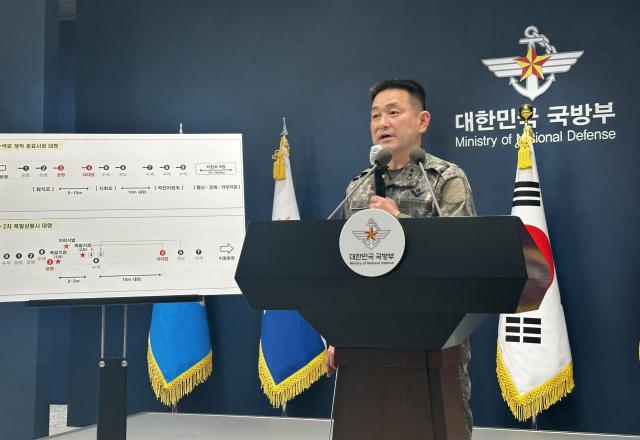
"We assess that there is a very high probability that North Korean mines were the cause of the explosions," Lt. Gen. Kwon Dae-won, vice chairman of the Joint Chiefs of Staff and head of the joint investigation task force, said in a briefing after an interim investigation.
The military said the two explosions occurred about 10 meters south of the Military Demarcation Line and roughly 10 meters from an area where terrain changes were detected that South Korea suspects were caused by recent North Korean mine-laying activities.
Three South Korean service members were injured in the Sept. 21 incident, two seriously and one lightly, while troops were clearing a new search route toward the MDL ahead of a planned on-site inspection with the United Nations Command.
The military said all 18 personnel involved in the operation were evacuated to the Armed Forces Capital Hospital. Fifteen have since been discharged, while the three injured personnel remain hospitalized.
Investigators on Monday reached the immediate vicinity of the blast site for the first time, coming within about 2 meters of the second explosion point. They visually identified two small crater-like depressions believed to have been formed by the blasts.
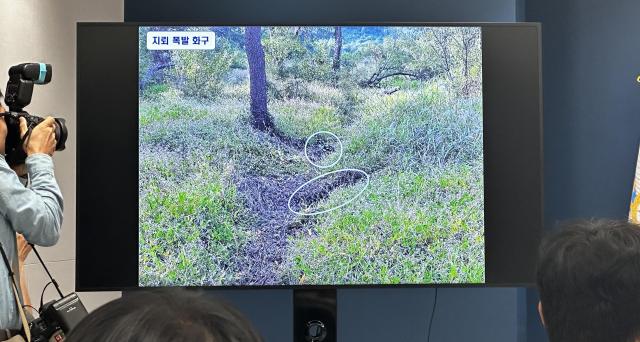
The National Forensic Service delivered its preliminary analysis to the military at around 4 p.m. Monday.
The JCS said TNT and brownish foreign material were detected on equipment belonging to the troops, including a ballistic helmet and two pieces of body armor. The military said the absence of steel fragments, combined with the brown material and the pattern of injuries, did not match the characteristics expected from South Korean mines.
The military also cited the shape of the blast craters, witness descriptions of the flames and the severity of the soldiers' injuries in reaching its interim assessment.
Another key piece of evidence is an unexploded mine-like object that troops said they saw while withdrawing from the area after the blasts.
According to the JCS, engineering personnel spotted a rectangular object buried about 5 to 10 centimeters below the surface roughly 1 meter from the first blast point. Witnesses described it as brown or reddish-brown, with a smooth plastic or resin-like exterior.
The military said the description resembles a brown, resin-bodied North Korean antipersonnel mine of the PMN type, but stressed that investigators must physically examine the object before identifying it conclusively.
North Korean wooden-box mines are known to typically contain about 220 grams of TNT.
The JCS estimates that three mines may have been present in the immediate area — the two that exploded and the additional unexploded object reported by troops.
The military's reconstruction also provided new details on how the accident unfolded.
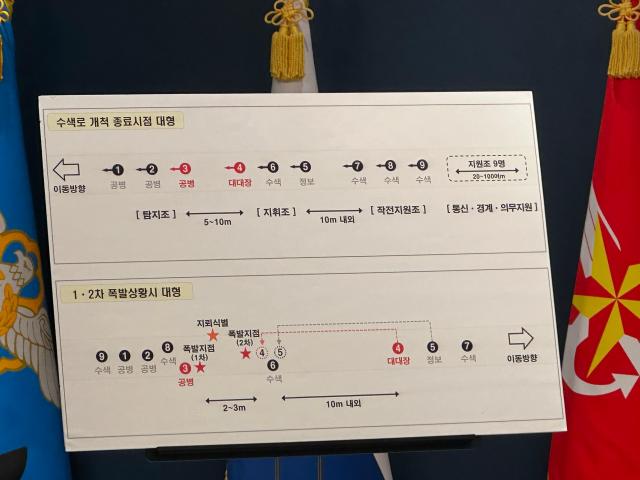
As the team prepared to leave, an engineer noncommissioned officer stepped to his left and triggered the first explosion. A reconnaissance battalion commander then rushed toward the injured soldier before a second explosion occurred.
The JCS also said there are no records of South Korean forces laying mines in the area, while terrain changes suspected of being linked to North Korean mine-laying were identified nearby in September 2025. Those factors were among the reasons the military said a South Korean mine was unlikely to have caused the blasts.
Kwon said the preliminary forensic findings further strengthened that assessment.
"Considering the brown foreign material detected in the preliminary forensic analysis and the absence of steel fragments, it is certain that the explosion was not caused by one of our mines," he said.
What remains unresolved is how a suspected North Korean mine came to be on the southern side of the MDL.
Military officials said they need to examine the unexploded object, its burial position, the surrounding terrain and its relationship to the nearby suspected North Korean mine-laying area before determining how it came to be there.
"If the final investigation determines that our troops were injured by mines planted by North Korea while lawfully conducting operations south of the MDL, all responsibility lies with North Korea," Kwon said, adding that the military would take "appropriate and corresponding measures."
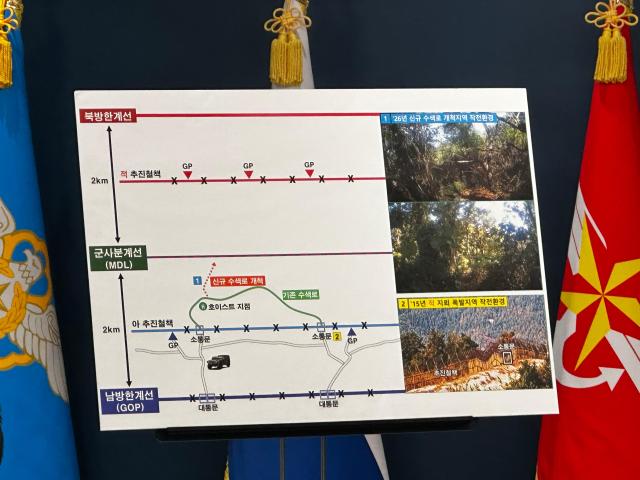
South Korean and United Nations Command personnel have conducted field investigations since Sunday. The military said additional work is planned because Monday's inspection was not completed.
Final findings will be announced after an assessment with the United Nations Command.

Copyright ⓒ Aju Press All rights reserved.