
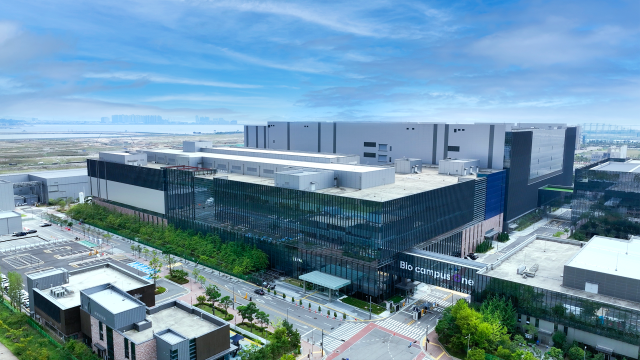
The Incheon Metropolitan Police Agency said on Friday it had sent union chief Park Jae-sung and one other official to prosecutors on charges of leaking trade secrets, breach of trust and defamation.
The two are accused of pulling tax invoices detailing advertising spending by media outlet from an in-house system and attaching them to a union bulletin.
Police, who raided the company's Songdo headquarters in May, said the charges were substantiated, though Park denied them.
"We cannot accept the police's decision," the union said in a statement, adding that Park never passed the material to the media or rivals.
"If the company thought it could silence the union with lawsuits, it has miscalculated."
The union, which seeks a 9.5 percent base pay rise against management's 6.2 percent offer, widened its second partial strike on Thursday to about 500 workers. Its first-ever walkout in May lasted five days and caused about 150 billion won in losses, the company estimated.
Kim Dong-young
Kim Dong-young is a bilingual journalist at AJU Press (AJP), covering Korean tech, energy, and bio/pharma.
He reports from the field at events like CES and APEC, runs AJP's YouTube channels,
and is pursuing a master's at Sogang's MOT program.
Copyright ⓒ Aju Press All rights reserved.
Related News
-
 S. Korea to repatriate independence activists' remains from US, Uzbekistan
A promotional image for the repatriation of Korean independence activists' remains from overseas, released by the Ministry of Patriots and Veterans Affairs. SEOUL, November 13 (AJP) - South Korea will repatriate the remains of two independence activists buried in the United States and Uzbekistan next week, marking the first return of a Korean independence fighter's remains from Uzbekistan, the Ministry of Patriots and Veterans Affairs said Friday. The remains of Ho Si-han (1885–1956) and Lee Gwal (1898–1963), who fought against Japanese colonial rule, will arrive at Incheon International Airport on Sunday, along with those of their spouses. Veterans Affairs Minister Kwon Oh-eul will personally receive the remains at the airport at 11:30 a.m., ahead of a repatriation ceremony scheduled for Monday at the March 1 Independence Declaration Monument in Seoul's Seodaemun District. The four will be laid to rest at Daejeon National Cemetery later that afternoon. The repatriation comes as South Korea marks the 80th anniversary of efforts to bring home independence activists who died and were buried overseas. The initiative dates back to 1946, when independence leader Kim Gu arranged for the remains of three prominent anti-Japanese activists — Yun Bong-gil, Lee Bong-chang and Baek Jeong-gi — to be returned from Japan and buried at Hyochang Park in Seoul. Since then, the government has repatriated the remains of 156 independence activists from 14 countries, including China, the United States, Kazakhstan and Germany. The return of Ho and Lee will bring the total to 158 activists from 15 countries. An undated photo of Korean independence activist Ho Si-han (1885–1956), whose remains will be repatriated from the United States. Courtesy of the Ministry of Patriots and Veterans Affairs Ho, born in Seoul in 1885, supported Korean independence activities in the United States and was arrested by Japanese colonial authorities in 1919 while attempting to raise funds for the independence movement. He later provided financial support to anti-Japanese resistance groups, including the Korean Liberation Army. He died in Los Angeles in 1956 and was posthumously honored in 2021. Lee, born in North Hamgyong Province in 1898, participated in Korean independence activities in the Russian Far East before being arrested in 1921 and detained for eight months. He later worked as a newspaper editor but was forcibly relocated to Uzbekistan during the Soviet Union's mass deportation of ethnic Koreans in 1937. He died there in 1963 and was posthumously honored in 2009. An undated photo of Korean independence activist Lee Gwal (1898–1963), whose remains will be repatriated from Uzbekistan for the first time in South Korea's repatriation efforts. Courtesy of the Ministry of Patriots and Veterans Affairs Lee's burial site was identified in 2024, and his family agreed to the repatriation in July this year, paving the way for the first return of an independence activist's remains from Uzbekistan. Monday's ceremony is expected to draw about 300 participants, including descendants of independence activists, government officials and members of the Liberation Association. "As we mark 80 years since Kim Gu brought home the remains of the three independence heroes, we will extend the highest honors to these two patriots and their spouses so they may finally rest in their longed-for homeland," Kwon said. He pledged to continue efforts to bring home independence activists still buried abroad. The ministry estimates that the graves of approximately 240 Korean independence activists remain in 10 countries, including China, the United States and Kazakhstan. It said repatriation efforts would continue in consultation with surviving family members.
-
 56th Anniversary of Jeon Tae-il's Death: Memorial Ceremony and Declaration of 'Jeon Tae-il Day'
On November 13, the 56th anniversary of Jeon Tae-il's death, a memorial ceremony will be held at Moran Park in Namyangju, Gyeonggi Province. Related events will also take place at the Jeon Tae-il Memorial Hall and the Democracy Movement Memorial Hall in Seoul. At 11 a.m. on November 13, the Jeon Tae-il Foundation will hold the 56th anniversary memorial service and the 34th Jeon Tae-il Labor Award ceremony at Jeon Tae-il's gravesite in Moran Park. Prior to the memorial service, a declaration ceremony for 'November 13 is Jeon Tae-il Day' will take place. The foundation and labor and civic groups have been advocating for November 13 to be designated as a national holiday in honor of Jeon Tae-il. The 34th Jeon Tae-il Labor Award will be presented to the Hanbit Media Labor Rights Center. The Achievement Award will go to Lee Ho-dong, former chairman of the Power Workers' Union, while the Special Award will be given to the Kabuki Workers' Cooperative and the National Association for Customized Public Jobs for Severely Disabled Persons. The Jeon Tae-il Memorial Hall in Jongno, Seoul, will host an opening ceremony for a special exhibition and a celebratory performance at 2 p.m. At 3 p.m., Minister of Employment and Labor Kim Young-hoon will give a special lecture on 'The Spirit of Jeon Tae-il and Current Labor Challenges' in the multipurpose hall on the second floor. The Democracy Movement Memorial Foundation will hold an opening ceremony for the special exhibition 'Seeking Coexistence: Labor and Democracy' at 2 p.m. in the multipurpose hall on the first floor of the Democracy Movement Memorial Hall. Minister Kim Young-hoon and Lee Jae-jin, the emergency response committee chair of the Korean Confederation of Trade Unions, are expected to attend. The exhibition will run until March 28 of next year and will be closed on Mondays.* This article has been translated by AI.
-
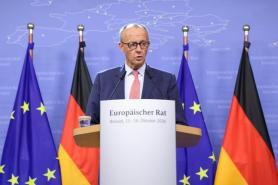 Shut out of Ukraine talks, Europe's leverage rests on its money
German Chancellor Friedrich Merz speaks to reporters at a European Council summit in Brussels on October 16, 2026. Merz has threatened to block the EU’s next long-term budget unless all member states commit to funding Ukraine. (Photo: © European Union) ZURICH, November 12 (AJP) -Europe may not be leading the talks to end the war in Ukraine, but it is paying for much of the war effort — making its money its main source of influence over any peace deal and the focus of a budget fight this week. Since the United States sharply cut its aid, European countries have become Ukraine’s largest military donors, according to the Kiel Institute for the World Economy, a German research group tracking support for Ukraine. European governments committed nearly 11 billion euros ($12.2 billion) in May and June alone, most of it through a 90 billion euro EU loan covering Ukraine’s budget and defense needs in 2026 and 2027. That funding matters at the negotiating table. Ukraine faces a funding gap of about 70 billion euros next year, and the EU has promised to cover about 45 billion euros, or 64 percent of the shortage. The latest round of talks between Russia, Ukraine and the United States ended in Abu Dhabi on Wednesday with an agreement in principle on a large prisoner exchange but no breakthrough on territory. European officials were present, but Russia’s chief negotiator Vladimir Medinsky said his delegation did not engage with them. Europe’s financial leverage is being tested at home. On Monday, German Chancellor Friedrich Merz threatened to block the EU’s next seven-year budget unless all 27 member states commit to funding Ukraine. Both decisions require unanimous approval. Four countries pushed back. Slovak Prime Minister Robert Fico called the move “a textbook case of blackmail” and threatened to use his veto. Czechia and Hungary, which also stayed out of the 90 billion euro loan, rejected the link as well. Bulgaria cited its high deficit. Hungarian Prime Minister Péter Magyar struck a more conciliatory tone, however. “I do not consider this to be blackmail,” he said, adding that he expected a solution would be found. Economy Commissioner Valdis Dombrovskis said Ukraine’s funding should be backed “by the EU27, not by the EU24 or any number of countries.” Europe’s money also has limits on the battlefield. It still depends on American weapons, especially Patriot air defense systems, for which there are few European alternatives, the Kiel Institute said. European governments bought at least 3 billion euros of weapons from U.S. companies for Ukraine in the first half of this year. Security guarantees offer another potential source of influence. A group of European countries known as the “coalition of the willing” has been preparing a possible force to help secure Ukraine after a ceasefire. U.S. envoy Jared Kushner said the talks had made “significant progress” on guarantees, but no details were released. A ceasefire would bring another substantial bill: rebuilding Ukraine. Europe expects to carry much of that cost, with countries outside the EU also pledging support. Switzerland has committed 5 billion Swiss francs to Ukraine’s recovery through 2036. It also hosted the first international conference on rebuilding Ukraine in Lugano in 2022. Asian allies are contributing too. Japan plans to provide about 6 billion dollars in humanitarian and economic support to Ukraine this year, Ukrainian President Volodymyr Zelenskyy said. South Korea’s role is smaller but growing. President Lee Jae Myung pledged 100 million dollars in aid at a NATO summit in July, and the government has set aside another 100 million dollars for Ukraine in its 2027 draft budget. EU leaders are due to return to the budget fight at a special summit on Nov. 26 and 27. Whether Europe can agree on paying for Ukraine may say more about its influence over a peace deal than any seat at the negotiating table. Tags: Ukraine, Russia, European Union, Abu Dhabi talks, Friedrich Merz, Robert Fico, Péter Magyar, Valdis Dombrovskis, Jared Kushner, Vladimir Medinsky, Kiel Institute, coalition of the willing, EU budget, Switzerland, Japan, South Korea, Lee Jae Myung, North Korea, Volodymyr Zelenskyy