

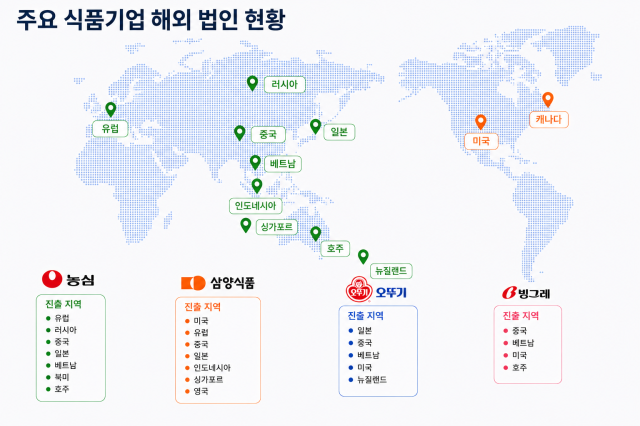
Domestic food companies are rapidly establishing overseas subsidiaries. With the K-food craze driving growth in international markets, there is an increasing competition to secure local distribution, marketing, and product development capabilities beyond simple exports.
According to industry sources on June 3, major food companies such as Ottogi, Nongshim, Samyang Foods, and Binggrae are either launching new overseas subsidiaries or expanding infrastructure investments to target global markets.
Ottogi established a local subsidiary in Tokyo, Japan, last month, which is set to begin operations in September. This new base, following locations in New Zealand, the United States, Vietnam, and China, will allow Ottogi to introduce ramen, sauces, and sesame oil, while also developing products tailored to local tastes.
Ottogi's entry into Japan aligns with its rapid overseas growth. In the first quarter of this year, the company reported sales of 955.2 billion won, a 3.7% increase from the same period last year, with overseas sales rising by 9.6%, significantly outpacing overall sales growth. The share of overseas sales in total revenue increased from 10.9% to 11.5%. This strategy aims to maintain growth momentum by securing local bases as overseas performance drives overall expansion.
Nongshim, which established its European subsidiary, Nongshim Europe, in Amsterdam last March, plans to launch its sales subsidiary, Nongshim Russia, in Moscow this month. This move is part of a strategy to capture the Russian and Central Asian markets, which are expected to grow at an annual rate of around 10%. Currently, Nongshim operates subsidiaries in North America, China, Japan, Vietnam, Australia, and Europe.
The Russian subsidiary will target the local premium ramen market while also expanding its sales network to countries in the Commonwealth of Independent States (CIS) such as Kazakhstan and Uzbekistan. Nongshim has set a goal of achieving $300 million in European sales and $30 million in revenue from its Russian subsidiary by 2030.
Samyang Foods is accelerating the establishment of local infrastructure to penetrate the European market. After setting up a European sales subsidiary in the Netherlands in 2024, it recently launched a logistics-focused subsidiary and established Samyang Foods UK earlier this year. Additionally, it has set up a research and development center near Wageningen, Netherlands, to enhance its research on plant-based and functional foods.
In the first quarter of this year, Samyang Foods reported European sales of 77 billion won, a 215% increase from the same period last year. The company currently operates subsidiaries in Shanghai, the United States, Japan, Indonesia, Singapore, and the United Kingdom.
Binggrae established its Australian subsidiary, BC F&B Australia Pty Ltd., in December last year. This move aims to reduce distribution steps and strengthen localized sales and marketing efforts, moving away from a direct export-focused structure. Binggrae is also considering developing Australia as a manufacturing and export hub for the Oceania and European markets. The company currently operates four overseas subsidiaries in China, the United States, Vietnam, and Australia, with the U.S. subsidiary generating 97 billion won in revenue last year, becoming a key base for its overseas operations.
Industry experts note that overseas subsidiaries are evolving from simple sales organizations to strategic bases responsible for local distribution network building, brand management, and product development. A source in the food industry stated, "As demand for K-food grows, the ability to directly manage local consumers and distribution networks has become crucial. Overseas subsidiaries play a key role in quickly responding to market changes and developing products tailored to local needs."
* This article has been translated by AI.

Copyright ⓒ Aju Press All rights reserved.