

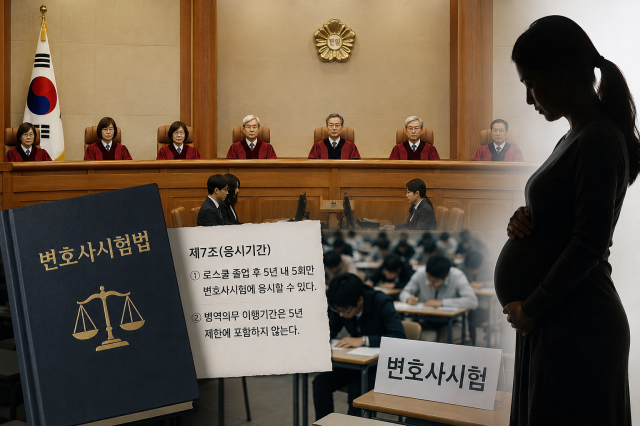
The Constitutional Court has narrowly upheld a provision in the Lawyer Examination Act that does not recognize pregnancy and childbirth as exceptions to the five-exam limit imposed on law school graduates within five years of graduation. However, the majority of justices expressed concerns about the law's alignment with constitutional protections for maternal rights, indicating that legislative discussions for reform are likely to follow.
On June 4, legal sources reported that the court ruled 4 to 5 in favor of upholding Article 7, Section 2 of the Lawyer Examination Act. Although five justices voiced opinions of unconstitutionality, the ruling did not reach the required six votes for a declaration of unconstitutionality, resulting in a final decision of constitutionality.
Article 7, Section 1 of the Lawyer Examination Act stipulates that graduates of law schools can take the bar exam only five times within five years from the end of the month in which they obtain their master's degree. Section 2 allows for the exclusion of the period of military service from this five-exam limit, a provision often referred to as the 'typo' system.
Claimant Kim Nuri, who graduated from law school in 2016, attempted the bar exam but failed. After giving birth to and raising two children, she was unable to take the exam again after failing in 2020. Kim and others argued that the current law, which recognizes only military service as an exception, infringes on their rights to equality and freedom of occupational choice.
Justices Kim Hyung-doo, Jeong Jeong-mi, Jeong Hyung-sik, and Jo Han-chang supported the constitutionality of the law. They argued that the provision aligns with constitutional requirements to prevent disadvantages for those fulfilling military obligations and maintained existing precedents. They also expressed concerns that recognizing additional exceptions could complicate the fairness of exam opportunities and pass rates, potentially undermining trust in the examination system.
Conversely, Justices Kim Sang-hwan, Kim Bok-hyung, Jeong Gye-seon, Ma Eun-hyeok, and Oh Young-jun expressed opinions of unconstitutionality. They stated, "Considering the state's obligation to protect maternal rights, this provision violates the principle of proportionality by infringing on the occupational freedom of candidates who cannot adequately take the bar exam due to pregnancy and childbirth."
They emphasized that the unconstitutionality lies not in the exemption for military service but in the failure to recognize any other exceptions. This creates a situation where candidates preparing for or experiencing pregnancy and childbirth must choose between forgoing exam opportunities and delaying their family planning.
The dissenting opinion also highlighted the state's obligation under Article 36, Section 2 of the Constitution to protect maternal rights. They noted that adequate birth rates and population are fundamental to national existence and development, linking maternal issues to community interests. Furthermore, they argued that many female candidates for the bar exam are of childbearing age, making it excessive to disregard pregnancy and childbirth as potential exceptions.
The Constitutional Court has previously upheld Article 7 of the Lawyer Examination Act multiple times. In a 2020 ruling, the court first acknowledged the need to consider unavoidable circumstances like pregnancy and childbirth, leading to ongoing related petitions. The increase in dissenting opinions to five in this case has amplified calls for reform of the system.
The Anti-Corruption and Civil Rights Commission also recommended in December of last year that the Ministry of Justice amend the Lawyer Examination Act to exclude one year from the exam limit for those giving birth.
Attorney Park Eun-sun, representing Kim, stated, "With five justices now expressing the opinion that this is unconstitutional, we will continue our legislative efforts. We will also seek a ruling from the Constitutional Court if similar cases arise, including those involving serious illness preventing attendance at the exam."
* This article has been translated by AI.

Copyright ⓒ Aju Press All rights reserved.