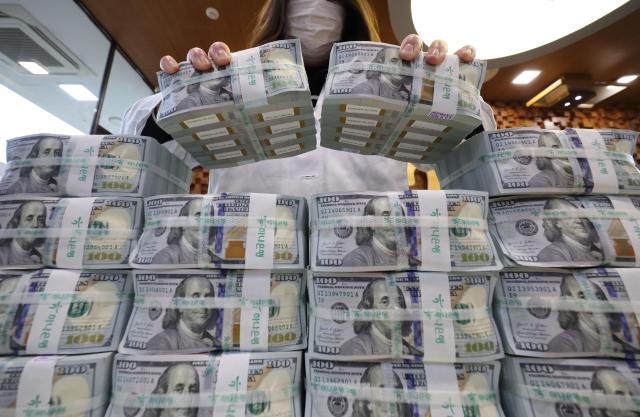
According to the Bank of Korea on Thursday, South Korea's foreign exchange reserves stood at $426.99 billion at the end of May, down $880 million from the previous month.
The drop came after authorities implemented market stabilization measures including a foreign exchange swap with the National Pension Service (NPS), which reduced the country's dollar holdings amid a weaker won and rising long-term interest rates.
In April, foreign exchange reserves rebounded by $4.22 billion as gains in the dollar value of non-dollar assets and stronger investment returns more than offset the impact of market stabilization measures. But in May, those measures became the main factor behind the decline, reversing the previous month's recovery.
The latest decline came after reserves increased by $1.72 billion in February, dropped by $3.97 billion in March and then rebounded in April.
Market volatility intensified in May. After briefly stabilizing in the 1,400 won range against the dollar in early May, the won weakened beyond 1,500 per dollar later in the month, prompting continued policy intervention.
The average won-dollar exchange rate rose to 1,491.39 won in May from 1,486.72 won in April, while the average yield on South Korea's benchmark 10-year government bond climbed 34.7 basis points to 4.080 percent from 3.733 percent over the same period.
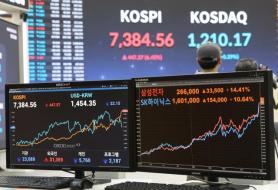
While the stock market extended its gains, foreign capital outflows persisted. Foreign investors net sold 44.71 trillion won worth of KOSPI-listed shares between May 1 and 29, weighing on the won even as the broader equity market rallied.
Despite the stock market rally, foreign equity outflows, a weaker won and rising long-term bond yields added to pressure in the foreign exchange market.
Foreign securities fell by $3.39 billion to $380.68 billion, accounting for 89.2 percent of total reserves, while deposits rose by $2.59 billion to $21.35 billion or 5 percent of the total.
Special Drawing Rights (SDRs) allocated by the International Monetary Fund (IMF) edged down by $30 million to $15.78 billion, while South Korea's reserve holdings at the IMF fell by $60 million to $4.4 billion. Gold holdings remained unchanged at $4.79 billion, accounting for 1.1 percent of total reserves.
Monthly fluctuations in FX reserves are typically driven by changes in the dollar value of non-dollar assets, investment returns and market stabilization measures. The swings seen in recent months reflect a combination of exchange rate movements and policy intervention.
Meanwhile, South Korea maintained its position as the world's 12th-largest holder of foreign exchange reserves as of the end of April with 427.9 billion. China topped the list with $3.41 trillion, followed by Japan with $1.38 trillion.

Copyright ⓒ Aju Press All rights reserved.