

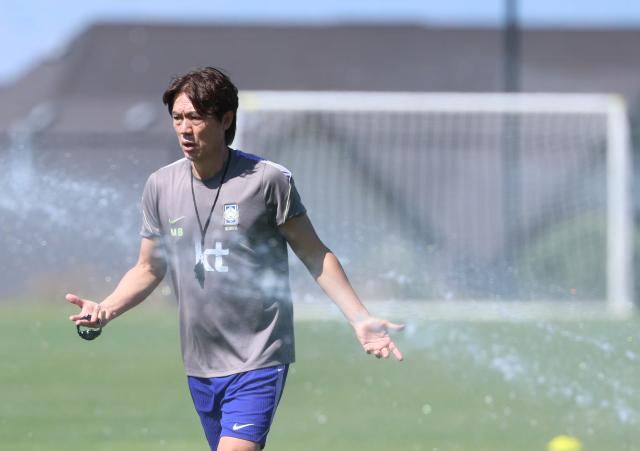
The South Korean national soccer team is set to conduct its final preparations for the World Cup today. This friendly match will feature key players, including Lee Kang-in and Oh Hyun-kyu, who are currently excelling in major European leagues, drawing significant attention both domestically and internationally. Given the imminent start of the tournament, today's game is crucial for solidifying the team's organization and tactical effectiveness.
The experience and skills of the young players accumulated on international stages are undoubtedly assets that enhance the team's structural capabilities. However, soccer is a sport that relies heavily on a cohesive system. Even with talented individuals, if they fail to fully integrate into the coach's tactical framework and establish organic relationships with their teammates, their potential will be as fragile as a sandcastle.
Coach Hong Myung-bo has faced challenges in defining the team's identity due to short training periods and the adjustment of overseas players to time differences. The evaluation criteria for today's match should not focus solely on the individual skills of star players. Instead, it should assess whether the team functions as a cohesive unit, including the speed of transition between defense and offense, the timing of pressing, and the ability to manage defensive risks during counterattacks. The essential task of this friendly match is to see how the technical sharpness of overseas players combines with the organizational solidity of domestic players to create tactical synergy.
Moreover, the behavior of the South Korean soccer community in recent years has been disappointing, bordering on tragic. The problematic appointment process for coaches, administrative incompetence within the Korea Football Association, and a lack of communication have led to severe criticism and internal strife. Trust among soccer fans has plummeted, and the prevailing sentiment towards the national team has been one of cynicism and concern, closely tied to these administrative failures.
In this rigid environment, the only way for Coach Hong's team to regain public trust is to prove its worth through performance on the field. The value of sports is manifested in its fundamental performance. While the numerical outcomes of wins and losses are important, maintaining structural focus and crisis management throughout the game is crucial for winning back the hearts of fans. Today's friendly match should serve as a turning point to dilute the accumulated administrative noise and rebuild the national team's public credibility.
Furthermore, rather than being consumed by immediate World Cup results, this should be an opportunity to pursue long-term systemic innovation and a paradigm shift in South Korean soccer. With the emergence of next-generation stars like Lee Kang-in and Oh Hyun-kyu as central figures, now is the optimal time to fundamentally improve the structure of South Korean soccer.
Relying on outdated methods that depend solely on individual players' determination and mental strength will not keep pace with the highly organized trends of global soccer. Instead of hastily repeating temporary fixes in pursuit of short-term results, this should be a chance to establish a clear technical philosophy and a robust administrative system. A consistent tactical approach must be shared from youth development through to the senior national team, supported by advanced, data-driven infrastructure, to enable a leap towards becoming a structurally strong soccer nation.
Today's match serves as a test for this long-term vision and sustainability. What is required of Coach Hong's team now is to present practical tactical alternatives that can succeed on the world stage. Soccer fans are watching not just the numbers on the scoreboard but also the coherent tactical execution and the forward-looking potential of South Korean soccer. Tonight, we hope that Coach Hong's team can harness the capabilities of its elite members to open a stable and convincing chapter toward the World Cup finals.
* This article has been translated by AI.

Copyright ⓒ Aju Press All rights reserved.