

The Ministry of Science and ICT is preparing a national science and technology blueprint aimed at the 100th anniversary of Korea's liberation in 2045. The initiative focuses on securing technological sovereignty for South Korea and aims to elevate the country to a leading position in science and technology (G3) by establishing the '2045 Science and Technology Frontier Strategy,' centered on future strategic technologies such as artificial intelligence (AI), quantum, and biotechnology.
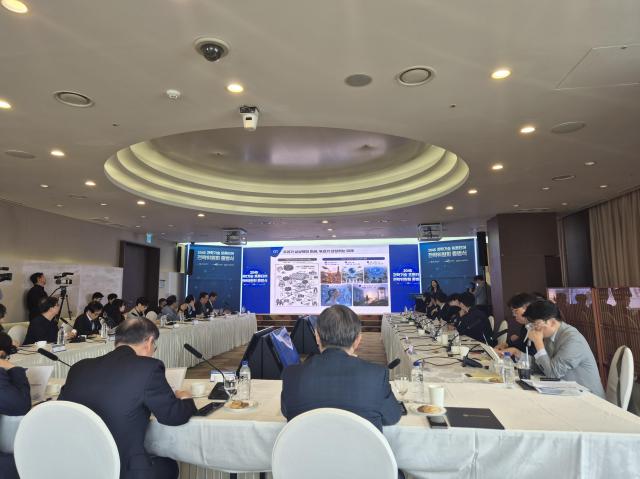
On June 4, the Ministry held the inauguration ceremony for the '2045 Science and Technology Frontier Strategy Committee' and its first general meeting at the President Hotel in Jung-gu, Seoul.
The 2045 Science and Technology Frontier Strategy is a long-term national strategy aimed at advancing South Korea to a G3 status in science and technology. It will develop detailed strategies specialized in the science and technology sector, linked to the 'Korea 2045 National Development Strategy.'
Deputy Prime Minister and Minister of Science and ICT Baek Beom-kyu stated, "This is a critical time to reflect on how we view science and technology and how we should live in the future. Through this committee, we will discuss not only AI but also how science and technology will change the world in 20 years."
To establish the strategy, the Ministry has launched a strategy committee consisting of a general committee and eight subcommittees. The general committee is co-chaired by Deputy Prime Minister Baek and Lee Kwang-hyung, President of the Korea Advanced Institute of Science and Technology (KAIST).
The subcommittees focus on eight areas: future design, superintelligence and hyperconnectivity, life and medical sciences, climate, environment and energy, future mobility, space and deep-sea exploration, future materials and manufacturing, and innovation policy. Experts from academia, industry, and research, along with young researchers and science fiction writers, will participate in identifying future technological agendas and supporting strategy development.
During the inauguration ceremony, the timeline and direction for developing the 2045 Frontier Strategy were revealed. Jeong Il-young, a researcher at the Science and Technology Policy Institute (STEPI), noted, "We have moved beyond an era where a catch-up growth strategy was effective; now is the time for us to transition into a leading country that designs its own future."
Consequently, this strategy will deviate from the traditional approach of relying on a single future vision. Instead, it will derive multiple future scenarios and combine future forecasting with reverse engineering to validate feasibility.
The strategy development will proceed in a four-stage cyclical structure: designing future visions, identifying science and technology challenges, setting directions for frontier organizations and research and development (R&D), and proposing improvements to the national science and technology system.
The subsequent open discussion covered various topics, including space data centers, investment in young researchers, and scientific talent. Park Soo-bin, the youngest member of the committee and a graduate student at Yonsei University, emphasized the need for investment in basic sciences. She remarked, "As we prepare for 2045, we should reflect on what thoughts guided us in 2006 to prepare for 2026. Just as fields like quantum and AI have become central, continuous investment in basic sciences is essential."
Following this inauguration, the Ministry plans to fully operate each subcommittee. Based on this groundwork, it aims to identify science and technology challenges in the third quarter and prepare a list of frontier technologies and a draft strategy in the fourth quarter. A public hearing is scheduled for the first quarter of 2027, with the final strategy to be announced in the second quarter.
Deputy Prime Minister Baek emphasized, "By 2045, the 100th anniversary of our liberation, South Korea should no longer be a follower of advanced nations but should firmly establish its technological sovereignty and position itself as a science and technology powerhouse contributing to human progress."
He added, "We will do our utmost to prepare for the next 20 years of South Korea's science and technology by gathering the wisdom of top experts in each field."
* This article has been translated by AI.
Copyright ⓒ Aju Press All rights reserved.