

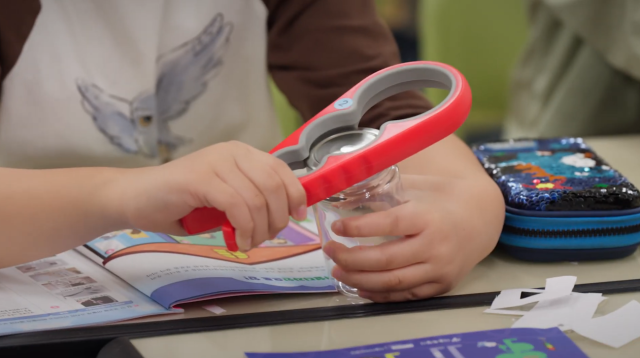
"How can we make it comfortable for everyone?"
Elementary students wear aging glasses while reading and attempt to hold pencils with finger splints. As they struggle with tasks that are usually easy, they begin to ponder, "How can we make this easier?"
On June 9, the Seoul Design Foundation announced the expansion of its hands-on 'Universal Design (UD) Education Package' program nationwide.
Since its launch in 2023, the UD Education Package has engaged approximately 29,100 students across 291 schools by this year.
The education package includes tools such as aging glasses, finger splints, and weight bands. Students use these tools to directly experience the challenges faced by the elderly and people with disabilities, comparing products designed with universal design principles to standard products to explore solutions. Universal design refers to the concept of designing products, spaces, and services that are accessible and usable by everyone, regardless of age, ability, or physical condition.
This program is notable not only for its experiential learning but also for its emphasis on design thinking. By comparing standard products with those designed for universal accessibility, students discuss the differences in design and which options are more convenient for a broader audience. They move beyond the idea of simply helping those in need to ask, "Can we create something that everyone can use from the start?"
Feedback from educators has been overwhelmingly positive. As of 2025, teacher satisfaction ratings reached 95.9 out of 100. Teachers noted high student engagement and the ease of integrating the program into their lessons without additional preparation.
The foundation has recently partnered with the Namwon Education Support Office in North Jeolla Province to further expand the program across the country. This initiative aims to extend the previously metropolitan-focused educational program into regional areas, promoting inclusive design education.
The elementary school years are crucial for developing empathy and awareness of others' perspectives, making universal design education an excellent opportunity for future generations to learn and practice the value of inclusivity.
Cha Kang-hee, CEO of the Seoul Design Foundation, stated, "Universal design education fosters civic sensitivity in designing cities and environments where everyone can coexist. We aim to spread this educational model, pioneered in Seoul, nationwide, so future generations can learn and practice the value of inclusivity in their daily lives."
* This article has been translated by AI.

Copyright ⓒ Aju Press All rights reserved.