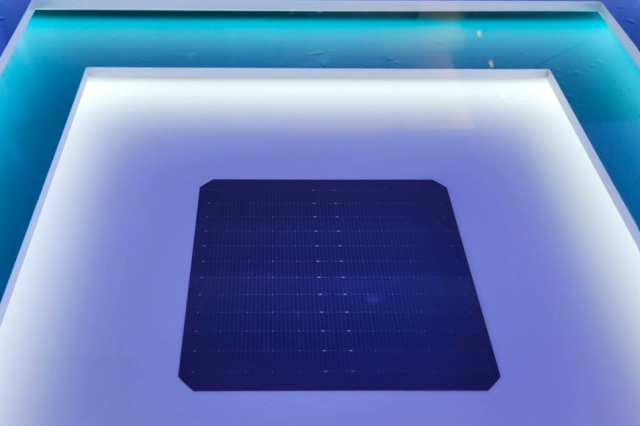
Hanwha Q CELLS GmbH, the company’s German unit, will provide samples of its perovskite-based tandem cells for the Space Science & Technology Evaluation Facility – First Flight Lunar In-Situ Solar Cell Experiment, or SSTEF-1, a project funded by NASA and led by U.S.-based Aegis Aerospace Inc.
The Georgia Tech Research Institute, a nonprofit applied research unit under the Georgia Institute of Technology, selected Hanwha Qcells’ tandem cells for the demonstration mission to evaluate solar cell performance in space.
The samples will be installed on the surface of a lunar lander and exposed to the space environment to collect data under conditions different from those on Earth, including vacuum, extreme temperature fluctuations, ultraviolet radiation and cosmic radiation.
The research will be led by W. Jud Ready, principal research engineer at GTRI and director of Georgia Tech’s Space Research Institute.
Hanwha Qcells said it plans to use data from the project to shape its research and development roadmap for highly reliable space solar power technologies.
Tandem technology, seen as a potential game changer for the future terrestrial solar market, uses a perovskite top cell and a silicon bottom cell to capture different wavelengths of light. The company said the technology could also offer advantages for space applications by achieving high efficiency while reducing weight compared with conventional solar cells with the same installed capacity.
Hanwha Qcells is aiming to commercialize tandem products for terrestrial use by 2029, while also expanding the technology into the space solar power sector.
Hanwha Qcells said it is also testing its tandem modules outdoors at its Thalheim R&D center and a third-party site, where they have maintained stable power generation for about one year and six months, respectively.
“Space solar power is not only a future energy source that can effectively respond to rapidly growing electricity demand beyond the limits of terrestrial solar power, but also a platform industry with major ripple effects across key industries closely linked to security, including AI data centers, defense and communications,” said Park Seung-deok, CEO of Hanwha Qcells.
“Based on the technological capabilities and market competitiveness we have built in solar manufacturing, Hanwha Qcells will leap forward as a global renewable energy solutions company opening the era of space solar power,” he said. “This project will be an important turning point in expanding the potential of sustainable energy into space.”

Copyright ⓒ Aju Press All rights reserved.