
Humanity is currently undergoing one of the most significant civilizational transformations in history. Artificial intelligence (AI) is learning human language, robots are replacing human labor, and algorithms are beginning to predict human judgments and choices. While people enjoy unprecedented material wealth, paradoxically, anxiety, loneliness, conflict, and emptiness are deepening. Despite remarkable technological advancements, fundamental questions about human existence remain. Why do humans live? What is the purpose of human existence? How can one achieve true freedom and peace?
In light of these questions, humanity is once again looking to Asia. At the center of this exploration is Buddhism, which has been investigating human suffering and the meaning of life for over 2,600 years. Buddhism is not merely a religion; it represents a profound reflection on human existence and a significant intellectual revolution that analyzes the causes of human suffering and offers solutions. Today, millions around the world find direction in the teachings of Buddhism, and it is no exaggeration to say that much of East and Southeast Asian civilization is built on this vast spiritual foundation.
Buddhism began not with a deity, but with a human being. Siddhartha Gautama, the founder of Buddhism, was born around the 6th century BCE in what is now Lumbini, Nepal. He lived a life of privilege as a prince but one day encountered an old man, a sick person, and a corpse outside the palace. This moment led him to realize that no one can escape aging, illness, and death. At that time, Indian society was dominated by a ritual culture centered on the Vedas and a caste system. People believed their destinies were determined by their birth status, and religion focused heavily on rituals and ceremonies. However, the young Siddhartha believed that religions and philosophies that could not address human suffering could not provide true answers. Ultimately, at the age of 29, he renounced his life as a prince to pursue the path of a seeker.
His six years of ascetic practice were a challenge to human limits. He sought out the best practitioners of the time and experienced extreme self-denial. However, he realized that torturing the body was not the path to resolving human suffering. Finally, he sat under the Bodhi tree, entered deep meditation, and attained enlightenment at the age of 35. From that point on, he became known as the Buddha, meaning 'the awakened one.' The essence of his enlightenment is encapsulated in the core doctrine of Buddhism, the Four Noble Truths.
The Four Noble Truths provide the most concise yet profound insights into human life. The first is the Truth of Suffering (Dukkha). Suffering exists in human life; birth is suffering, aging is suffering, illness is suffering, and death is suffering. Parting from loved ones is suffering, and encountering those we do not wish to meet is suffering. Not obtaining what we desire is also suffering. Buddhism does not turn away from the realities of human life; rather, it confronts them with honesty.
The second is the Truth of the Cause of Suffering (Samudaya). There are causes for suffering, which are not found in the external world but in human greed, attachment, and ignorance. The desire to possess more, the ambition to rise higher, and the attachment to permanence ultimately lead to human suffering. Even in modern life, this remains true. Constant competition, comparison, excessive consumption, and obsession with success create greater anxiety.
The third is the Truth of the Cessation of Suffering (Nirodha). Suffering can be overcome. By letting go of greed, attachment, and ignorance, humans can escape suffering. Buddhism does not lead people to despair; rather, it sees the potential for self-transformation within each individual.
The fourth is the Truth of the Path to the Cessation of Suffering (Magga). There is a path to overcome suffering, known as the Noble Eightfold Path. This path includes right understanding, right thought, right speech, right action, right livelihood, right effort, right mindfulness, and right concentration. Buddhism does not simply instruct what to believe; it teaches how to live. The Eightfold Path is a practice that aligns human thoughts, words, actions, and consciousness.
To understand Buddhism, one must ultimately grasp the Four Noble Truths and the Eightfold Path. This is not a mere doctrine; it is a form of mental medicine that diagnoses and treats the problems of human life, a philosophy of living. Many scholars refer to Buddhism as the world's first psychology for this reason. The Buddha observed the human mind, analyzed the causes of suffering, and proposed a path to healing.
Another significant insight of Buddhism is the concept of Interdependence (Pratītyasamutpāda). Everything in the world is interconnected, and nothing exists in isolation. A single flower cannot exist without sunlight, rain, soil, and wind, and humans live within families, societies, nature, and the universe. All beings are interdependent and connected. In today's era of climate crisis and ecological emergency, the concept of interdependence holds even greater significance. The realization that humans are not the rulers of nature but a part of it is wisdom that modern civilization must relearn.
Buddhism also regards compassion (Karuna) as the highest virtue. Compassion is not mere sympathy; it is the feeling of another's suffering as one's own and the desire to alleviate it together. After attaining enlightenment, the Buddha did not retreat to the mountains. He traveled across India for 45 years, sharing the truth with people. Buddhism did not seek to change the world through force or violence; it aimed to transform the world by changing human hearts. This is the greatest strength of Buddhism.
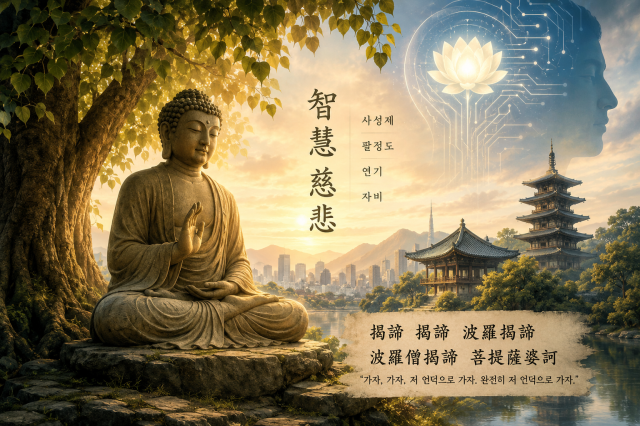
One of the most beautiful encapsulations of the spirit of Buddhism is found in the final mantra of the Heart Sutra:
“Gate, gate, pāragate, pārasaṃgate, bodhi svāhā.”
In Chinese characters, it is written as “揭諦 揭諦 波羅揭諦 波羅僧揭諦 菩提薩婆訶.”
The meaning is, “Let’s go, let’s go. Let’s go beyond. Let’s go completely beyond. Let’s go to the world of enlightenment.”
Buddhism does not keep humans trapped in worldly desires and attachments. It teaches to cross over from the hill of greed, anger, and ignorance to the hill of wisdom, compassion, and freedom. This is not merely a reference to the afterlife; it signifies that even in this moment, humans can transition from ignorance to wisdom, from hatred to love, and from desire to freedom. This single phrase from the Heart Sutra encapsulates the essence of the spirit that Buddhism seeks.
Buddhism subsequently spread beyond India throughout Asia. It traveled along the Silk Road to Central Asia and continued to China, Korea, Japan, and Vietnam, becoming a spiritual pillar of East Asian civilization. In China, it developed into Zen Buddhism through interactions with Confucianism and Taoism, while in Tibet, it formed a tradition of Tantric Buddhism. In Japan, Zen merged with the samurai spirit. Korea, too, has been deeply influenced by Buddhism since the Three Kingdoms period through the Goryeo and Joseon dynasties. Sites like Bulguksa Temple, Seokguram Grotto, and Haeinsa Temple's Tripitaka Koreana are not merely cultural heritage but represent the great spiritual legacy of Buddhist civilization.
Particularly, Korean Buddhism has produced outstanding thinkers such as Wonhyo, Uisang, and Jinul. Wonhyo proposed the philosophy of harmony through his teachings on the reconciliation of differing thoughts. This holds significant relevance for contemporary Korean society, where conflict and division are intensifying. It emphasizes that it is not about defeating the other but about harmoniously integrating different truths, which is a higher wisdom.
Today, Western societies are also turning their attention back to Buddhism. Meditation and mindfulness have become part of global culture, and research on Buddhism in relation to neuroscience and psychology is actively conducted at institutions like Harvard, Stanford, Oxford, and Cambridge. Companies in Silicon Valley are also incorporating meditation into their organizational culture, realizing that technological innovation alone cannot lead to human happiness.
The age of AI poses new questions for humanity. Machines can calculate faster and store more information than humans. However, machines cannot feel compassion, cannot harbor empathy, and do not seek enlightenment. Ultimately, what makes us human is not our computational ability but our capacity for reflection, not competition but compassion, and not possession but freedom, as Buddhism reminds us.
The enlightenment of a seeker that began under the Bodhi tree 2,600 years ago remains relevant today. Humanity's greatness lies not in possessing more but in understanding more deeply, loving more broadly, and living more freely. This is the greatest legacy that Buddhism has left for humanity beyond Asia, and it is a voice of wisdom that we all must heed as we navigate the age of AI.
※ This article was generated using generative AI and has been reviewed by an editor.
* This article has been translated by AI.
Copyright ⓒ Aju Press All rights reserved.