

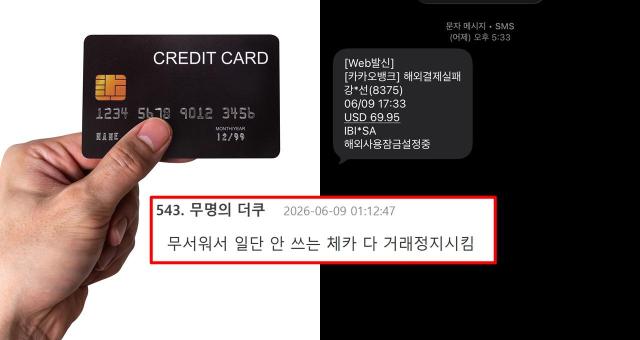
Concerns are rising among card users following reports of unidentified foreign charges. On June 9, various online communities, social media platforms, and Naver cafes shared multiple instances of attempted charges amounting to 299,000 won (approximately $210).
A reporter received a notification on June 9 regarding an attempted charge from an unknown foreign merchant on a card that had foreign transaction blocking enabled. According to the card issuer, there was an approval attempt for $69.95 (about 95,000 won), but the transaction was blocked before it could be completed.
"Sudden Charge of 299,000 Won"... Multiple Users Report Victimization
Users have shared their experiences online, with one stating, "A charge of 299,000 won was made on my usual card in the early morning hours," prompting them to freeze their card and report fraudulent use.
Others commented, "I only use the free plan, yet a charge of 299,000 won related to ChatGPT appeared," and "It seems my NongHyup card has been compromised." Many users reported similar sudden charges of 299,000 won occurring recently.
Some victims claimed that the transaction details included references to OpenAI subscriptions or AI services. However, the actual source and method of these charges require individual verification.
"Concerns Following Domestic Data Breaches"... No Confirmed Links
Speculation has arisen online connecting these payment attempts to recent data breaches at domestic companies. However, as of now, no official confirmation has been made regarding a direct link between the data breaches and the recent fraudulent charge attempts.
Experts advise that, due to the difficulty in pinpointing how card numbers may have been leaked, users should follow guidance from their card issuers and financial institutions rather than relying on unverified speculation.
"Could This Be a BIN Attack?" Speculation Emerges
Some users have suggested that these incidents may be a result of a so-called BIN attack. This method involves using automated programs to guess card numbers based on a specific card issuer's number system (Bank Identification Number) and then attempting to process transactions.
Online discussions have included comments like, "A card that I haven't registered anywhere was charged," and "It seems random charges are occurring from overseas AI sites." However, it remains unverified whether these cases are indeed the result of a BIN attack.
"Blocking Foreign Transactions Doesn't Ensure Safety"
Some community members argue that even with foreign transaction blocking, approvals can still occur through domestic payment networks, suggesting that simply blocking foreign transactions may not be sufficient. Victims have claimed that the payment processing company, Nice Information Communication, was identified during the transaction process, sharing their inquiries related to this issue.
However, these claims are based on individual cases, and it has not been confirmed whether they apply universally to all reported incidents.
Users Advise Checking Card Transactions via Account Info
Online, users are actively sharing information to prevent further victimization. They recommend checking transaction histories and upcoming charges through 'Account Info,' a public financial service operated jointly by the Financial Payment Agency and financial institutions.
Community members have advised, "If you're confused about which cards you hold, it's best to check via Account Info," and "Reports of issues are coming from both check cards and credit cards, so regularly verify your upcoming charges and card statements."
Financial industry representatives explain that blocking foreign transaction capabilities on unused cards and activating transaction alert services are effective ways to minimize potential losses. Users should report any suspicious transactions to their card issuer immediately and initiate reissuance procedures.
* This article has been translated by AI.

Copyright ⓒ Aju Press All rights reserved.