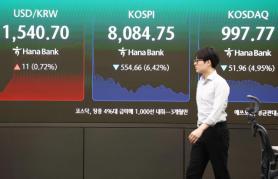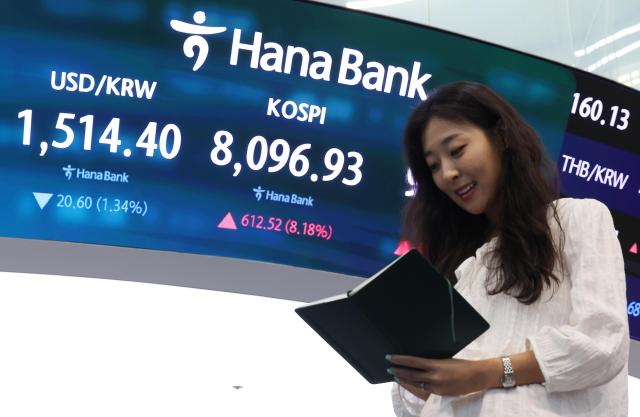
In the Seoul foreign exchange market, the won closed at 1,512.1 per dollar, up 22.9 won from the previous session. The currency continued to strengthen after turning sharply higher Monday afternoon.
The main driver was policy intervention. Foreign exchange authorities said the NPS began currency hedging procedures Monday, a move seen as helping support the won.
Expectations of a faster hawkish response from the Bank of Korea (BOK) also aided the rally. Kim Jin-wook, an economist at Citigroup, said Monday that "the BOK could respond faster than expected if market instability expands," raising the possibility of an extraordinary Monetary Policy Committee meeting in June.
A strong rebound in stocks further eased risk aversion. The benchmark KOSPI jumped 8.18 percent to close at 8,096.93, recovering most of Monday’s losses.
The bond market also snapped a three-session losing streak. The benchmark three-year government bond yield fell 8.4 basis points to 3.856 percent, while the 10-year yield dropped 7.5 basis points to 4.273 percent.
Sentiment improved after Japanese media reported that the BOJ may pause its plan to reduce Japanese government bond purchases. The reports raised hopes that the recent slide in global bond prices could ease.
Japanese government bond yields are closely watched in Korea because they serve as a key reference point for Asian long-term rates, prompting global investors to adjust Korean Treasury positions in tandem.
Market participants also pointed to a shift in foreign investor positioning. "Foreign investors, who had remained net sellers in the morning, turned net buyers of both three-year and 10-year bond futures in the afternoon," a fixed-income market source said on condition of anonymity. The source said the shift likely gave additional support to both bonds and the won.

Copyright ⓒ Aju Press All rights reserved.