South Korean President Lee Apologizes for Falling Approval Ratings
by Kim BongcheolPosted : June 10, 2026, 14:06Updated : June 10, 2026, 14:06
Share
facebook
twitter
URL
Text size
South Korean President Lee Jae-myung expressed his apologies on June 10 regarding the decline in his approval ratings, stating, “I am sorry to the people.”
In a post on X (formerly Twitter), President Lee shared a recent poll indicating a drop in his approval ratings. He acknowledged, “I humbly accept the cold evaluation from the public” and promised to approach his duties with greater humility and inclusiveness, saying he would work harder.
The president made these remarks while in Brussels, Belgium, ahead of a summit with the Belgian Prime Minister during his first European tour since taking office.
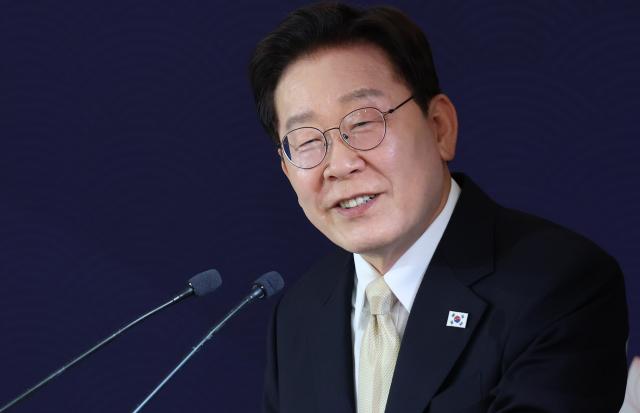
President Lee Jae-myung delivers remarks at a dinner meeting with expatriates in Brussels on June 9, local time. [Photo: Yonhap News]
As the aftermath of the June 3 local elections continues, the leadership of the Democratic Party of Korea did not attend a farewell event for President Lee's European tour, effectively issuing their own ‘self-reflection’ statement.
According to a survey conducted by the Korea Social Opinion Institute (KSOI) from June 8 to 9, President Lee's approval rating stands at 50.4%, a significant drop of 9.4 percentage points from the previous poll.
His approval ratings have been on a downward trend since peaking at 63.4% in the second week of April, falling to 62.4% in the fourth week of April, 60.7% in the second week of May, and 59.8% in the fourth week of May, before this latest sharp decline.
Negative evaluations of his performance rose to 45.7%, an increase of 10.5 percentage points from the last survey. This marks the first time the gap between positive and negative evaluations has narrowed to within the margin of error.
KSOI analyzed that the decline in President Lee's approval ratings is likely due to the ruling party's victory in the local elections, which did not meet expectations in key races such as the Seoul mayoral election and parliamentary by-elections.
The institute noted that the drop in positive evaluations was particularly pronounced among the younger generation (ages 20-30), as well as among conservative and centrist voters, especially in the Busan, Ulsan, and Gyeongnam regions. They suggested that the rallying of support for the main opposition party, People Power Party, in the lead-up to the elections may have influenced the evaluations of the president's governance.
In party support ratings, the Democratic Party recorded a 4.7 percentage point drop to 38.6%, while the People Power Party saw an increase of 6.5 percentage points to 38.1%. The gap between the two parties is now just 0.5 percentage points.
Other parties included the Reform Party at 3.9%, the Justice Party at 1.6%, and the Progressive Party at 1.0%, while 13.1% of respondents indicated they had no party affiliation.
The survey utilized automated response technology with virtual numbers provided by three telecommunications companies. It has a margin of error of ±3.1 percentage points at a 95% confidence level, with a response rate of 5.8%. For more details, please refer to the website of the National Election Survey Deliberation Commission.